
Listen to this article
Estimated 3 minutes
The audio version of this article is generated by AI-based technology. Mispronunciations can occur. We are working with our partners to continually review and improve the results.
Numerous teachers’ unions are at an impasse with the Ontario government over contract talks, which could prolong negotiations and push potential strike action well into the school year.
Education workers’ contracts are set to expire Monday night, according to Martha Hradowy, president of the Ontario Secondary School Teachers’ Federation (OSSTF).
This year’s talks have stalled because teachers’ unions including the OSSTF and the Elementary Teachers’ Federation of Ontario (ETFO) couldn’t agree with the province on what items to negotiate centrally versus locally.
David Mastin, president of the ETFO, said the province is undermining local bargaining by trying to centralize all of the issues teachers unions want to negotiate on.
“For the last four rounds [of talks], we’ve had a pretty stable pattern of what is local and what is central. This particular round the government decided to really object to what has traditionally been local,” said Mastin.
The province uses a two-tiered bargaining system that governs how school boards and education unions negotiate contracts. Teachers unions, school boards and the province typically discuss which issues will fall under central or local bargaining during contract talks.
Central bargaining usually involves key issues like benefits and salary, while local bargaining involves issues specific to the local school board, according to the Toronto District School Board’s website.
The standstill means the province’s labour relations board will now be involved. It will have to set a hearing date to determine what will be bargained at the central versus local tier, which could take “weeks, if not months,” said Hradowy.
In an emailed statement Monday, Emma Testani, spokesperson for the education minister’s office, said the ministry is “at all times” ready to continue discussions on local versus central issues “before proceeding to the next stage of negotiations.”
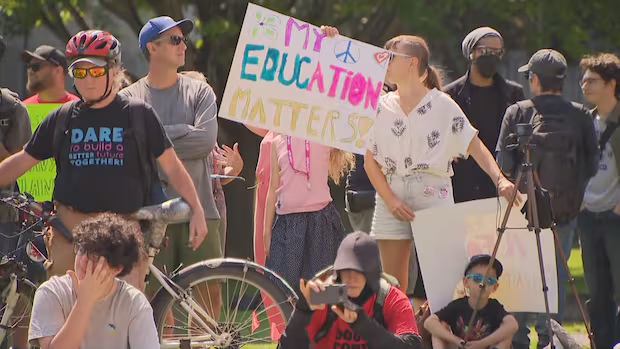
WATCH | Rallies held Saturday in support of Ontario education workers:
Rallies in support of education workers take place around Ontario
Rallies in support of Ontario’s education workers were held across the province Saturday. The protests come as students are set to head back to school and workers’ collective agreements are set to expire. CBC’s Mercedes Gaztambide spoke with participants about where they think support is most needed.
What does this mean for back to school?
Because talks are currently stalled, back-to-school season will be “business as usual,” according to Chantal Mancini, an adjunct assistant professor in labour studies at McMaster University.
“There can’t be job action until there’s actual bargaining,” she said.
Mancini said that the bargaining landscape changed in the late 90s when then-premier Mike Harris government centralized education funding to the province. Prior to that, school boards were funded by local taxes.
The change meant that “school boards and unions could have conversations, but in order to get money to fund anything they were taking about, they had to talk to the government,” she said.
In 2014, Ontario’s Liberal government embedded that move into a piece of legislation that spelled out how school boards, education unions and the provincial government negotiated employee contracts, according to Mancini.
The legislation detailed how the two-tiered bargaining system worked, but it also “slowed down the process,” she said.
“The concern is that clearly if it’s taking this long, maybe they need to re-examine this legislation,” said Mancini.
“In one way, the legislation works for the government because they can control their costs. But clearly it’s not getting the job done, which is labour negotiations in a timely fashion.”