
Listen to this article
Estimated 6 minutes
The audio version of this article is generated by AI-based technology. Mispronunciations can occur. We are working with our partners to continually review and improve the results.
WARNING: This story contains details of violence against Indigenous women, as well as references to racist beliefs and behaviours. Resources can be found at the bottom of this story.
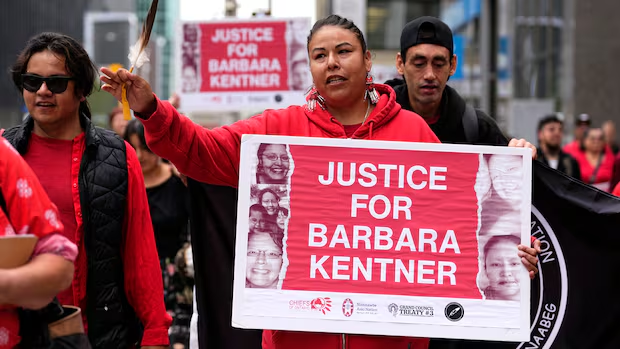
Family and friends of Barbara Kentner, and First Nation leaders marched on Parliament Hill in Ottawa on Monday to raise concerns about the full parole of the man found guilty in the manslaughter of the 34-year-old from Wabigoon Lake Ojibway Nation.
In 2017, Kentner died from medical complications months after she was struck by a trailer hitch that Brayden Bushby threw from a moving vehicle.
Bushby, now 27, was released on full parole with conditions on Aug. 13, according to documents from the PBC that were obtained by CBC News.
“There is a family on the other side of that decision, which is us. There is a community on the other side of that decision,” Connie Kentner, Barbara’s sister, told media ahead of the march in Ottawa by about 30 people.
“There are Indigenous women and girls watching. There are families who are asking themselves whether the justice system will protect them and whether their voices will matter if something happens to them.”
The PBC’s decision documents say releasing Bushby on full parole won’t pose “undue risk” and “will contribute to the protection of society” by facilitating his reintegration “back into society as a law-abiding citizen.”
 Connie Kentner, sister of Barbara Kentner, and others marched on Parliament Hill in Ottawa on Monday to protest the full parole of Brayden Bushby, who was convicted of Barbara’s manslaughter. (Justin Tang/The Canadian Press)
Connie said the family “is left feeling that we have once again been failed by a system that is supposed to recognize and respect victims of crime.”
She also said the family wasn’t made aware beforehand by the PBC that Bushby would be getting full parole.
CBC News previously reported that the family wasn’t informed when Bushby was granted day parole in August 2023.
That day parole was revoked in July 2024 after the PBC said he violated various conditions. He was granted day parole again in December 2025 for six months and denied full parole. In June 2026, his day parole was extended.
Parole board says members do thorough assessments
During Monday’s march, CBC News observed a representative of the PBC accepting a letter from Barbara’s family.
No decision can undo what happened, but we will continue to speak for my sister, Barbara.– Connie Kentner, sister of Barbara Kentner
A spokesperson for the PBC later sent an emailed statement to CBC News that said the board “would like to express its sincere sympathy for the harm and loss that the Kentner family have experienced.”
 The march on Parliament Hill to protest Bushby’s full parole drew about 30 people. (Justin Tang/The Canadian Press)
It also said the PBC can’t comment directly on Bushby’s release in accordance with the Privacy Act.
However, it added, registered victims “may receive information about the offender who harmed them, attend a PBC hearing, submit and present a victim statement at the hearing, and request PBC written decisions and to listen to the audio recording of PBC parole hearings.”
As for the family’s lack of knowledge about his release, the PBC said “we understand that in this instance, some members of the victim’s family may not have been aware of the need to register with the PBC or Correctional Service of Canada (CSC) in order to receive and submit information.
“We have reached out to a representative of the family members to offer to assist them with registering and to answer any questions they may have.”
Parole board board members receive extensive training to conduct thorough risk-based assessments, which include anti-racism and trauma-informed approaches, the statement added.
Chiefs call for ‘culturally safe support service’
A news release issued Monday by Chiefs of Ontario said First Nation leaders are calling for “a dedicated, proactive, culturally safe support service for First Nations [victims] and families navigating the federal corrections and parole system.”
“Families should be informed directly of hearings and decisions, supported in exercising their rights, and provided with a clear point of contact throughout the process. No grieving family should be left to navigate a complex federal system on their own,” the release said.
First Nation leaders at the march included those from Nishnawbe Aski Nation (NAN), Kitigan Zibi Anishinabeg, the Assembly of First Nations’ 2SLGBTQQIA+ Council and Grand Council Treaty #3.
Ogichidaa (Grand Chief) Francis Kavanaugh of Grand Council Treaty #3 spoke of the disproportionate number of Indigenous women, girls and two-spirit people who experience violence.
WATCH | Decision on Bushby conditional parole ‘unacceptable’: Grand Chief Kavanaugh:
Decision on Bushby conditional parole ‘unacceptable’: Grand Chief Kavanaugh
Grand Chief Francis Kavanaugh of Anishinaabe Nation in Treaty #3 says he ‘can’t believe’ the Parole Board of Canada’s decision to grant Brayden Bushby, who was convicted of manslaughter in the 2017 death of Barbara Kentner, full parole with conditions. ‘This decision is a miscarriage of justice,’ said Chief Kavanaugh.
“Today I am more ashamed of this country than I have been in a long time, and I stand with you all today in solidarity to call out this national shame,” Kavanaugh said.
“As I have said over and over again, this decision [to release Bushby] is a miscarriage of justice. It sends a horrible message to our people that our lives are only worth a small jail sentence and a few lines in the media.”
 Connie Kentner holds an eagle feather beside a sign with photos of her sister Barbara during the march in Ottawa. (Justin Tang/The Canadian Press)
Kavanaugh told a story about his daughter, who attended college in Thunder Bay. He said a group of non-Indigenous boys threw full cans of Coke at her and her friend.
“This is not an isolated incident. It’s systemic racism and hatred,” he said.
Connie has vowed to continue to tell her sister’s story.
“My sister was a real person. She was not just a victim. She had a laugh, she had dreams. She deserved to see her children grow and she deserved to be a grandmother,” she said.
“We will not let Barbara be forgotten. We will continue to seek justice and accountability.”
Support is available for anyone affected by the issue of missing and murdered Indigenous people. Immediate emotional assistance and crisis support is available 24/7 through a national hotline at 1-844-413-6649.
Mental health counselling and crisis support is also available 24 hours a day, seven days a week through the Hope for Wellness hotline at 1-855-242-3310 or by online chat at www.hopeforwellness.ca.