
Open this photo in gallery:
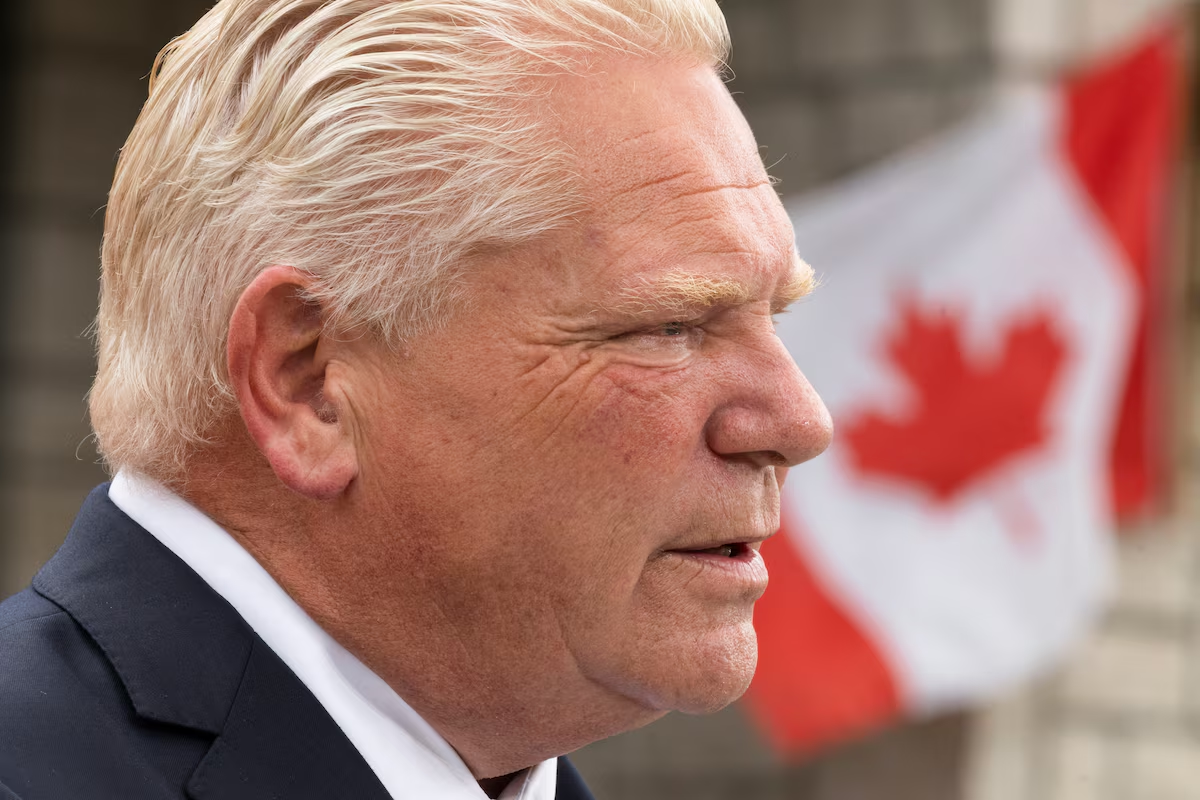
Ontario Premier Doug Ford speaks to media in Hamilton, on Monday.Nick Iwanyshyn/The Canadian Press
Ontario Premier Doug Ford said Ottawa needs to do more to help his province’s tariff-hit steel and auto sectors weather the trade war with the U.S., and should exempt them from federally required carbon taxes while also ending tailpipe emissions standards.
Speaking to reporters on Wednesday in Vaughan, Ont., north of Toronto, Mr. Ford also denied that his opposition to a tentative deal last week – and his refusal agree to a U.S. precondition to end his ban on U.S. liquor and wine sales – amounted to a veto that scuppered negotiations.
And despite publicly trading personal insults with the U.S. President this week, Mr. Ford urged Ottawa to get back to the bargaining table, saying Prime Minister Mark Carney and Donald Trump need to speak by phone to restart talks.
The Premier said he largely supported the federal government’s plans, unveiled on Tuesday, for retaliatory tariffs and supports for sectors affected by the new U.S. levies, which the U.S imposed when Canadian negotiators walked away from the table last Friday.
Four takeaways from Canada’s tariff counterpunch
Mr. Ford called for any revenues generated by Canada’s retaliatory tariffs to go back to the affected sectors. And he said Ottawa should enact measures to restrict steel imports, in order to stop cut-rate Chinese steel from entering Canada’s supply chain via third countries.
He also repeated his call, first made in a letter to Mr. Carney last week, for an end to federal tailpipe emissions standards for Canadian-made cars in order to save costs as tariff damage mounts, and for exemptions for sectors hit by tariffs from the industrial carbon tax. He said the levy was set to cost steel companies hundreds of millions of dollars a year and threatens their survival.
Mr. Ford said he had discussed his demands with Mr. Carney, and was “very confident” the Prime Minister would “correct the issue,” noting U.S. competitors do not face similar carbon taxes.
“We can’t put an additional burden on these companies, or they just won’t exist,” he said.
Open this photo in gallery:
Prime Minister Mark Carney speaks with Ontario Premier Doug Ford in Charlottetown, in July.Darren Calabrese/The Canadian Press
Asked if his refusal to support the tentative deal floated last week, which would have lowered but not eliminated auto, steel and aluminum tariffs, amounted to a veto that he exercised, Mr. Ford said it was the Prime Minister who made the decision to walk away, not him.
“At the end of the day, the Prime Minister is the person in charge,” Mr. Ford said. “ … He’s a fighter. He’s standing up to President Trump, and again, at the end of the day, it’s his choice and he made the right choice.”
Carney to address EU Parliament in push to grow non-U.S. ties
The Premier said both he and Mr. Carney had heard from industry leaders that the deal did not go far enough. And he suggested that the involvement of U.S. Commerce Secretary Howard Lutnick complicated the talks: “Try to make a deal with Howard Lutnick and President Trump. You know they kept moving the goalposts on the Prime Minister. And he did the right thing.”
Ontario’s Premier also insisted that “everything is on the table” as far as cutting off or surcharging electricity or critical minerals exports to the United States. But he said all provinces, such as Quebec, that send electricity south would have to agree, and that he would follow a “Team Canada” approach. (He had suggested in an appearance on Bloomberg Television on Tuesday that he was considering a surcharge, not cutting off the crossborder flow of electricity.) Last year, he briefly imposed a surcharge on electricity bound for the U.S. but withdrew it after the move attracted the ire of Mr. Trump.
Mr. Ford, who discussed the tariff crisis with Alberta Premier Danielle Smith in a call on Monday, has also in the past listed Alberta oil and Saskatchewan potash and uranium as potential bargaining chips – despite opposition to the idea from Ms. Smith and Saskatchewan Premier Scott Moe. On Wednesday, asked about his recent conversation with the Alberta Premier, he said the pair discussed his concept for a new pipeline from Alberta to Ontario meant to ensure that natural gas bound for his province is not routed through the U.S., as it is now.
Appearing alongside federal and local officials at an announcement about housing, Mr. Ford was also asked about his back-and-forth with the President this week, which saw the Premier call Mr. Trump a “loser” and tell him to “kiss my ass.” Mr. Trump, in a social media post, said Mr. Ford was less intelligent that his late brother Rob, the former mayor of Toronto, and was a “Flunky” of “Governor Carney.” In U.S. TV media interviews on Tuesday, Mr. Ford took a much more conciliatory tone – but the Premier said the change was not because of any conversation with the Prime Minister.
“I had a call, but he never said that at all,” Mr. Ford said. “ … I thought it’d be best just to simmer down. It was a heated day for both him [Mr. Trump] and I going back and forth, but it looks like he simmered down too. So let’s get back to the table.”
Andrew Coyne: The whole world is watching as Canada stands up to Trump
He also ruled out running any pro-free-trade U.S. TV ads, like the ones the Prime Minister blamed for crashing U.S. trade talks last year. But he said he hoped that Mr. Trump’s opponents in the U.S. Democratic Party “get their act together” in time for midterm congressional elections this fall. He said he was concerned by a split in the part between “socialist communists,” whom he called “pretty scary” and “hardworking, smart, pragmatic Democrats.”
“Let’s go back to the, you know, the Bill Clinton days that they worked together with the Republicans and really had the country booming.” Mr. Ford said.
Also Wednesday, the Premier erroneously said that Ontario had “eliminated the gas tax” – the province in fact made a temporary reduction to its gas tax permanent last year but still charges 9 cents a litre – and urged Mr. Carney to “eliminate the gas tax permanently.” (The federal government temporarily dropped its 10-cent-a-litre excise tax on gas to zero in April, but it is set to resume Sept. 7.)
In the same breath, Mr. Ford also accused oil companies of raising prices for drivers at the gas pumps at different times of day in unison: “They’re screwing us. That’s what they’re doing. Prices don’t change that quickly. So, to the oil companies, get your act together. Stop playing games withe the people of Ontario. You know, you think we just fell off the turnip truck? Not happening anymore.”