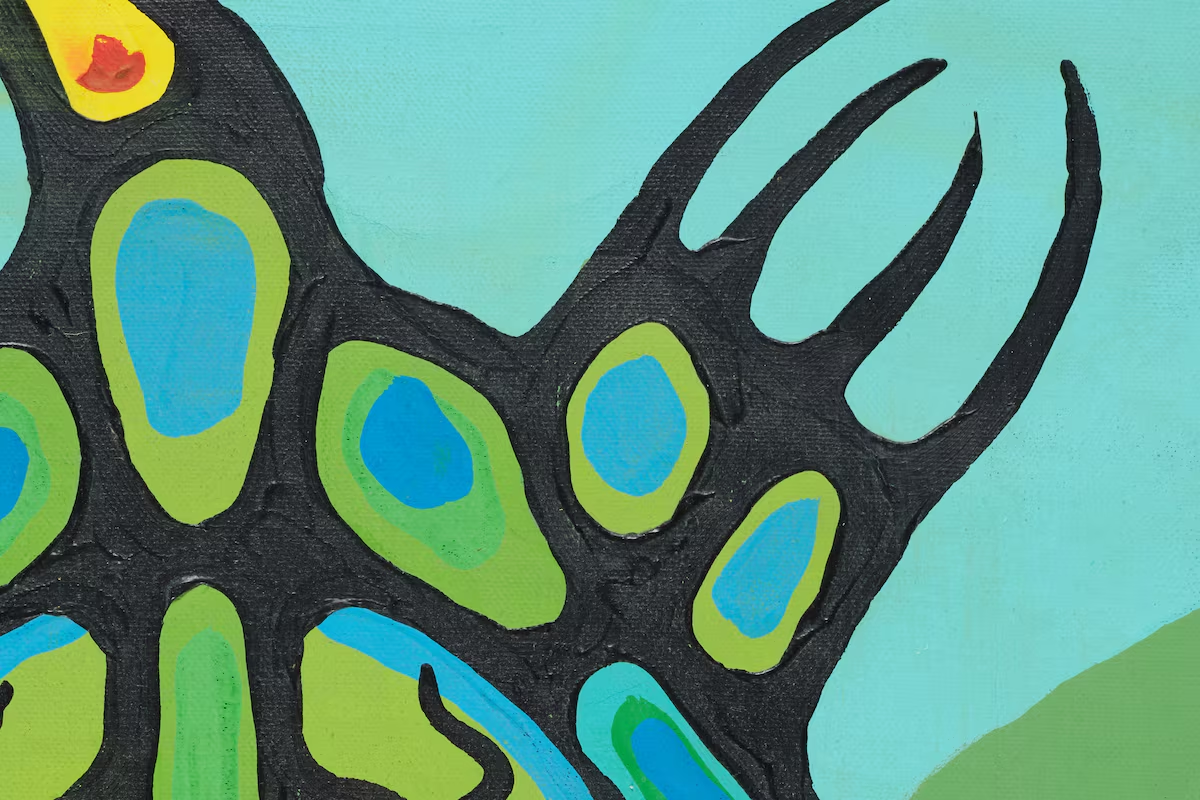
In the fall of 2020, the manager of the Canadian Conservation Institute received a phone call from police that pulled his team into an investigation that exposed what is now called “the biggest art fraud in world history.”
Eric Henderson, in charge of the Ottawa-based agency at the time, learned during this call that the Ontario Provincial Police and Thunder Bay Police Service were jointly examining art fraud allegations: They believed paintings were being falsely attributed to the late Anishinaabe artist Norval Morrisseau.
Morrisseau, a residential school survivor often called Copper Thunderbird, died at the age of 75 in 2007. He is lauded for founding the Woodland school of art. His pieces, featuring representations of Ojibwa stories and legends, have been displayed in galleries across Canada.
Open this photo in gallery:
Norval Morrisseau was feted internationally as ‘the Picasso of the North.’Chuck Stoody/The Canadian Press
But police believed sinister efforts were afoot – art fraud involving thousands of fakes, estimated in the realm of $100-million – that were eroding Morrisseau’s artistic legacy.
They wanted to know if the CCI, a special operating agency within the Heritage Department, could look at suspected forgeries.
CCI has not widely shared its work that helped expose the fraud because of ongoing legal proceedings.
But now that the Crown has five convictions in hand, the institute is telling the public about how it unearthed key information in the investigation, including previously undetected paint-by-number-style codes pencilled on the canvas of forged pieces. This coding system corroborated witness statements about fraudsters using an assembly-line-style operation to make fakes for financial gain.
“This was their opportunity to take advantage of an Indigenous artist to make a profit for themselves,” said Mylène Choquette, a senior scientific documentation technologist at CCI.
Before Choquette and other team members agreed to become involved in examining the paintings, Henderson advised they first needed to watch the documentary There Are No Fakes.
The 2019 film featured allegations that a group of individuals were profiteering off Morrisseau’s name by producing paintings falsely attributed to the late painter.
Open this photo in gallery:
Jennifer Poulin, senior conservation scientist, knew that this investigation was something the Canadian Conservation Institute should be involved in.Jess Deeks/The Globe and Mail
The documentary spurred a Thunder Bay Police Service investigation and later the joint involvement of the Ontario Provincial Police. Their police operation was dubbed “Project Totton.”
After watching There Are No Fakes, Jennifer Poulin, a senior conservation scientist with CCI, remembers having concerns about how her involvement in this work could affect her safety. Individuals in the film shared they were targeted for raising concerns about forgeries.
Barenaked Ladies musician Kevin Hearn detailed in the film how he endured fierce backlash after he raised concerns about the authenticity of Spirit Energy of Mother Earth, a piece he purchased in 2005.
“We were nervous and we still said yes,” Poulin said. “We absolutely thought it was something that we should be participating in.”
CCI’s efforts in support of the art fraud investigation had to be kept under wraps.
In spring 2021, CCI discreetly began conducting imaging and analysis on four suspected fakes.
Open this photo in gallery:
Senior scientific documentation technologist Mylène Choquette works with photographic equipment that captures infrared light showing what’s under a painting.Jess Deeks/The Globe and Mail
“We certainly didn’t want anyone knowing that we were investigating this or helping to investigate this,” Poulin said, adding they did not want to do anything that could impact the OPP’s case.
After they looked at the first four paintings, a co-ordinated scientific investigation of suspected fakes unfolded over two years. This involved also looking at characteristics of authenticated Morrisseau paintings.
More than two dozen additional suspected fakes had to be delivered to CCI’s Ottawa site for examination.
At one point, Poulin remembers the police checking in on CCI’s progress. Things back in Ottawa were progressing very slowly; they were unrolling each painting from its packaging with an extreme level of care, which is how they handle all pieces to ensure they are not damaged.
Once the pieces were unpacked, the team did scientific imaging of the paintings.
A high-resolution camera, capable of capturing infrared light, was used to show what was hidden beneath the paint.

What is infrared detection?
Infrared reflectography (IRR) helps conservators assess artwork condition, uncover historical techniques and detect potential forgeries without invasive sampling. By using infrared wavelengths, it can penetrate certain paint layers and reveal hidden elements such as underdrawings, alterations and previously obscured details.
Seeing infrared
A camera works similarly to the human eye. Light reflected from an object passes through a lens and is focused onto an image sensor, which converts the light into electrical signals that are processed into an image. Standard digital cameras use silicon sensors that mainly detect visible light, whereas IRR requires specialized sensors.
Lens
Designed to collect light reflecting off the subject and transmit it to the image sensor
Common sensor
Uses a grid of tiny pixels. In each pixel, light passes through a microlens and colour filter to a photodiode, where it is converted into an electrical signal and then into a digital pixel value
IRR sensor
Works much like the sensor in a regular digital camera, but it is made from a special material that can detect infrared wavelengths capable of penetrating paint layers and revealing hidden features beneath the surface.
Different layers
of paint
Infrared light bouncing
off the subject
Note: For illustration purposes only.
MURAT YUKSELIR / THE GLOBE AND MAIL, SOURCE: NASA; LUCID VISION LABS; AMERICAN INSTITUTE FOR CONSERVATION

What is infrared detection?
Infrared reflectography (IRR) helps conservators assess artwork condition, uncover historical techniques and detect potential forgeries without invasive sampling. By using infrared wavelengths, it can penetrate certain paint layers and reveal hidden elements such as underdrawings, alterations, and previously obscured details.
Seeing infrared
A camera works similarly to the human eye. Light reflected from an object passes through a lens and is focused onto an image sensor, which converts the light into electrical signals that are processed into an image. Standard digital cameras use silicon sensors that mainly detect visible light, whereas IRR requires specialized sensors.
Lens
Designed to collect light reflecting off the subject and transmit it to the image sensor
Common sensor
Uses a grid of tiny pixels. In each pixel, light passes through a microlens and colour filter to a photodiode, where it is converted into an electrical signal and then into a digital pixel value
IRR sensor
Works much like the sensor in a regular digital camera, but it is made from a special material that can detect infrared wavelengths capable of penetrating paint layers and revealing hidden features beneath the surface.
Different layers
of paint
Infrared light bouncing
off the subject
Note: For illustration purposes only.
MURAT YUKSELIR / THE GLOBE AND MAIL, SOURCE: NASA; LUCID VISION LABS; AMERICAN INSTITUTE FOR CONSERVATION

What is infrared detection?
Infrared reflectography (IRR) helps conservators assess artwork condition, uncover historical techniques and detect potential forgeries without invasive sampling. By using infrared wavelengths, it can penetrate certain paint layers and reveal hidden elements such as underdrawings, alterations, and previously obscured details.
Seeing infrared
A camera works similarly to the human eye. Light reflected from an object passes through a lens and is focused onto an image sensor, which converts the light into electrical signals that are processed into an image. Standard digital cameras use silicon sensors that mainly detect visible light, whereas IRR requires specialized sensors.
Lens
Designed to collect light reflecting off the subject and transmit it to the image sensor
Common sensor
Uses a grid of tiny pixels. In each pixel, light passes through a microlens and colour filter to a photodiode, where it is converted into an electrical signal and then into a digital pixel value
IRR sensor
Works much like the sensor in a regular digital camera, but it is made from a special material that can detect infrared wavelengths capable of penetrating paint layers and revealing hidden features beneath the surface.
Different layers
of paint
Infrared light bouncing
off the subject
Note: For illustration purposes only.
MURAT YUKSELIR / THE GLOBE AND MAIL, SOURCE: NASA; LUCID VISION LABS;
AMERICAN INSTITUTE FOR CONSERVATION
When she first saw letter codes appear, Choquette was “stunned.”
At the same time, she knew this was a significant find. “We’ve got this,” she remembers thinking.
The markings corroborated what the OPP heard in witness statements about how paintings were produced in an assembly-line fashion; one person would draw in pencil and then add letter codes to indicate the paint colour to be applied, for example, “B” for blue or “Y” for yellow.
CCI also examined authenticated Morrisseau paintings under visible and infrared light to draw comparisons with the suspected forgeries. Those pieces, Choquette said, did not feature letter codes.
Additionally, Poulin removed microscopic samples of the base layers of paint for analysis.
By doing so, she uncovered significant chemical differences in the suspected fakes compared to the authenticated Morrisseau works.
The suspected forgeries used various combinations of acrylic, styrene and polyvinyl acetate, she said. The real Morrisseaus, on the other hand, featured acrylic polymers.
A paint collection from the 1960s was tested through a technique that Poulin developed to find the chemical composition of products used from different time periods.
Jess Deeks/THE GLOBE AND MAIL
By Feb. 27, 2023, CCI reported their findings to police.
Just two days later, police moved in on their suspects, arresting eight people on March 1 for their alleged involvement in the fraud.
Four of these individuals pleaded guilty, meaning they bypassed a trial before sentencing. Three others had charges dropped by the Crown.
Another represented himself while fighting charges but was found guilty last year by a 12-member jury.
Looking back on the experience, Poulin is proud of what she and her fellow CCI team members did to help expose decades of abuse and greed.
“It was a really good use of our expertise,” she said. “It felt good doing something for Norval Morrisseau.”