
Open this photo in gallery:
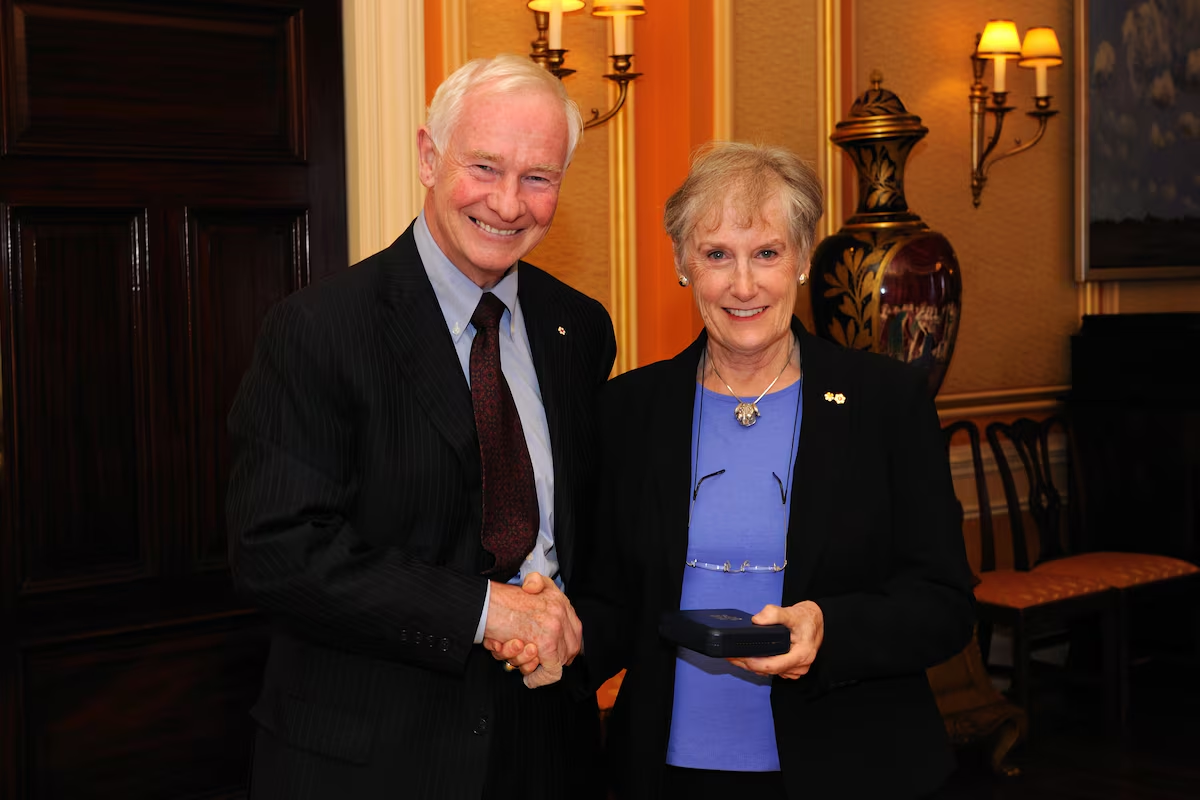
His Excellency the Right Honourable David Johnston, Governor General of Canada, presents an award to Patricia Baird member of the Advisory Coucil of The Order of Canada in the Long Dining room at Rideau Hall, Nov. 16, 2010.MCpl Dany Veillette/Rideau Hall
In 1968, Patricia Baird did not waver when she walked into an oral exam room for a Royal College of Physicians and Surgeons fellowship, carrying a tiny baby.
Dr. Baird, who was breastfeeding at the time, thought nothing of bringing her wee daughter Jennifer into this rigorous test. She wasn’t the kind of person to ask for permission, nor offer apologies. Dr. Baird entered this room like she did many others in her 88 years of life, holding her own.
Her unrelenting spirit, say loved ones and friends, was the engine behind her scientific undertakings that saw her become a giant in the world of genetics. She is also remembered as a visionary leader. Dr. Baird died at her Vancouver home on Aug. 7, along with her husband.
When named an Officer of the Order of Canada in 2000, she was commended for having devoted her life to the study of human genetics.
“I think that what always underpinned her research agenda was a real understanding of how this information was going to affect individual people and individual families,” Jennifer Baird said of her late mother, who was a pediatrician before becoming a distinguished scientist. “She kept seeing kids who individually she could help, but there were these themes to their health problems.”
Dr. Baird was also lauded for her role as chair of the Royal Commission on New Reproductive Technologies. She was appointed to the position by prime minister Brian Mulroney in 1989.
The royal commission collected feedback from thousands of Canadians and reviewed data from more than 300 researchers. Its mandate was to review current and potential medical developments related to new reproductive technologies.
In November, 1993, it published a 1,275-page report, Proceed with Care, that shaped federal regulation of reproductive technologies.
Its recommendations included prohibiting the commercialization of reproduction, including the sale of eggs and sperm.
“We conclude that government, as the guardian of the public interest, must act to put boundaries around the use of new reproductive technologies, and must put in place a system to manage them within those boundaries, not just for now, but, equally important, in an ongoing way,” the royal commission report said in its executive summary.
The commissioners also wrote that the government, on behalf of citizens, had “a responsibility to ensure that inappropriate and unethical use of technology is prohibited and that the procedures and supports necessary for informed decision-making are in place.”
Dr. Baird held many other prominent roles, such as serving on the ethics committee for the International Federation of Gynecology and Obstetrics and advising the World Health Organization.
She also chaired B.C.’s Council on Aging and Seniors’ Issues, producing a report in 2005.
Open this photo in gallery:
Dr. Baird moved to Canada at the age of 17 to attend McGill University.Courtesy of family
Patricia Ann Holt was born on Oct. 11, 1937, in Lancashire, England, to Winifred and Harold Holt. She had a good relationship with her mother, but she had challenges with her father, who was very much the dominant person in the family, Jennifer said.
“He was not at all supportive of education,” she said. “As an 11-year-old, she took charge of what she was going to do educationally.”
Taking charge of her education involved excelling on a test taken by 11-year-old students that determined what further education they could pursue.
Jennifer said her mother understood early on in life that to escape her family dynamics, she would need a good education. And then there was Patricia’s “sheer grit.”
She earned a scholarship from a local girls’ school where she had a couple of supportive teachers who helped her, Jennifer added.
“When her dad, a couple of years into it, tried to say ‘Well, we’re moving, you’re just going to find a new school’, her teachers went to bat for her,” she said.
“She just took a long bus ride every day. She went to university with no assistance from her parents.”
Patricia moved to Canada at the age of 17 to attend McGill University, where she first obtained her Bachelor of Science and then completed medical school in 1963.
During her undergraduate education, she received assistance from one of her professors, Muriel Roscoe. “Without her, my mom would have had a very difficult time supporting herself,” Jennifer said.
After her Montreal-based studies, she headed to the west coast for postgraduate training in medical genetics and pediatrics.
In 1964, she married Robert Baird, a surgeon, with whom she shared 62 years of marriage. They complemented one another. He was known to be quieter in social settings while she was a more commanding force. Together, they had three children: Jennifer, Brian and Bruce, all two years apart.
In 1968, she joined the faculty at the University of British Columbia medical school.
Dr. Baird’s research work unfolded in two phases, according to UBC. The first focused on genetic epidemiology, including the prognosis for several birth defects and genetic diseases. The second phase looked at the societal, ethical, and policy implications for genetic and reproductive technology.
In 1978, she was appointed head of the Department of Medical Genetics, becoming the first woman to lead a clinical department at UBC.
The university credits Dr. Baird for bolstering the department’s size and prestige during her tenure, including by recruiting scientists Connie Eaves, Judy Hall and Michael Hayden.
Dr. Hayden was completing his postdoctoral studies at Harvard University when Dr. Baird made a successful case for him to move to UBC in the early 1980s.
“I said yes without even consulting my wife,” he said.
Dr. Baird was able to foster trust by being transparent, clear in her expectations and supportive, Dr. Hayden said. She was also a warm, strong person with many opinions and open to sharing guidance.
“She was a great cheerleader,” Dr. Hayden said.
Open this photo in gallery:
In 1978, Dr. Barid was appointed head of the Department of Medical Genetics, becoming the first woman to lead a clinical department at UBC.Courtesy of family
UBC now offers The Patricia Baird Prize in her honour, awarding $1,000 to promising trainees who take on medical genetics research.
Along with being a generous mentor in her field, she was known for her hospitality.
The Bairds held end-of-year parties where guests received sheets with song lyrics and were asked to sing along while someone played piano.
Dr. Baird’s party prowess, perhaps, hinged on her excellent organizational skills. She was, her daughter recalls, a “queen of lists.”
Jennifer, now also a physician who enjoys a good list, said despite her mother’s “fantastically accomplished” career, she maintained a successful marriage and close bonds with all of her kids.
They always felt their mom was a part of their lives.
“Neither side ever got compromised,” Jennifer said, adding that her parents pulled equal amounts of weight at home.
“He had a huge respect for her and her work and valued her career just as much as his,” she said. “Having that equal partnership really made it work.”
The Bairds were also passionate about travel, including trips to Palm Desert, Calif.
John Dirks, an acclaimed clinician-scientist and member of the Canadian Medical Hall of Fame, remembers Dr. Baird not only as a gifted geneticist and generous colleague. They worked together at UBC when he became the head of its Department of Medicine in 1976.
At 93, he fondly recalls how his family and the Bairds spent personal time together at their Vancouver homes and in Whistler, B.C. There, he recalls sharing laughter around a fire. Dr. Baird had a strong sense of humour.
The Bairds also drew joy from many B.C. hikes.
It is perhaps unsurprising the outdoor enthusiasts decided their final moments would be on a patio at their Vancouver home, looking at English Bay on the Pacific Ocean.
Jennifer said medical assistance in dying had been on their radar for some time. The prospect of being able to access it afforded both of them peace of mind in the face of medical challenges.
Patricia had Parkinson’s disease for a decade. She also suffered a fall this year, spurring further health decline. At 94, Robert was very frail.
Both were adamant they didn’t want to go to a care residence. Instead, they wanted to remain at home, but that was increasingly untenable.
On Aug. 7, after a drive with their children that included visiting a nearby beach and driving around Patricia’s old UBC stomping grounds, the family sat outside, enjoying ice cream. The temperature was about 25 C.
Around 4 p.m., Patricia and Bob settled into their patio chairs, surrounded by the kids. Two medical providers came to the Bairds’ home, which they had owned since 1989, and prepared to inject medication to end their lives.
Patricia and Bob then held hands and looked out at the ocean for the last time, while tucked under a large, shared blanket.
“They were cozy in the sunshine.”
You can find more obituaries from The Globe and Mail here.
To submit a memory about someone we have recently profiled on the Obituaries page, e-mail us at obit@globeandmail.com.