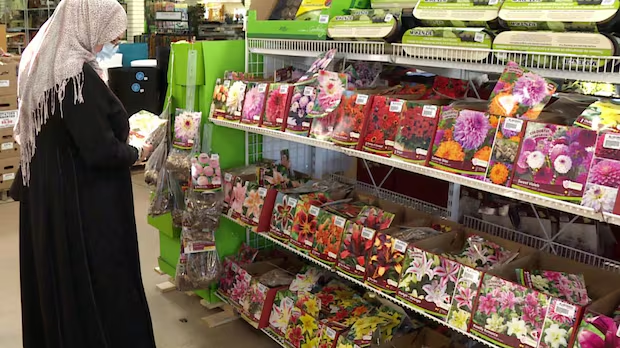
Canadian cities are trying to stop invasive plants from being sold in local garden centres, as advocates push Ottawa to create a national approach to regulating the horticultural trade.
With invasive plants threatening biodiversity across the country, municipalities are increasingly trying to fill gaps in a regulatory system that varies by jurisdiction. Canada, meanwhile, has set a target of reducing the rate of introduction and establishment of known invasive species by at least 50 per cent by 2030.
The Canadian Coalition for Invasive Plant Regulation (CCIPR) wants the federal government to establish a regulatory body for the horticultural industry and create a national database identifying invasive plants and their risks in different regions.
“Even if we don’t prohibit them, we need to let the public know when there is potential harm,” said CCIPR co-founder Cathy Kavassalis. “We do this on other products, and we should do it on plants too. It’s just common sense.”
The Canadian Food Inspection Agency regulates some invasive plants, while provinces and territories have their own invasive species or weed-control legislation.
CBC News reached out to the Canadian Food Inspection Agency for comment but did not receive a response by publication time.
 Goutweed, an invasive plant, in a garden in Clyde River, P.E.I. (Sara Fraser/CBC)
In July, Nanaimo council passed a motion to pursue a bylaw amendment restricting the sale of plants on a list maintained by the Invasive Species Council of B.C. A week later, Surrey moved to ban sales by businesses including nurseries, large retail chains and florists.
In May, London, Ont.’s, environmental committee recommended requiring retailers that sell invasive plants and animals to provide information to customers at the point of sale.
Kavassalis said a problem that could be addressed at higher levels of government is being pushed down to municipalities.
“These are all patchwork solutions that, in some ways, just waste a lot of resources,” she said.
Kirsty MacDonald, Nanaimo’s parks manager, said invasive plants are already affecting the local landscape, with some posing potential risks to human health.
Most local plant suppliers were aware of the problem, she said, though invasive species can still appear in plant mixes or popular varieties such as English ivy.
“Banning the sale of new introductions [of invasive plants] in backyards, especially, is one method,” she said. “It’s a many-pronged approach that we need to be looking at to make some headway.”
“All levels of government really need to be part of the solution,” she said.
 A white trillium is surrounded by periwinkle, an invasive plant sold in some stores, in Inglis Falls Conservation Area in Ontario. (Photo by Andy Fyon, supplied by CCIPR)
What advocates want Ottawa to do
Kavassalis said meeting the federal government’s 2030 target will require addressing the horticultural trade.
A 2021 study by University of Massachusetts Amherst researchers identified the sale of ornamental non-native plants as a “primary pathway” for introducing invasive plants in the United States. A 2023 study found plant nurseries could contribute about 80 per cent of invasive plant introductions there.
Kavassalis said the same problem exists in Canada.
“Our gardens are actually the source of a lot of harm being done to our environment and economy,” she said.
The CCIPR says a national database could give provinces, territories, retailers and gardeners a shared source of information about which plants pose risks in different regions. Kavassalis also wants invasive plants removed from shelves or clearly labelled.
What would new rules mean for nurseries?
Jim Hole, a horticulture and agriculture expert who previously owned Hole Greenhouses and Gardens in St. Albert, Alta., said most garden centres would support efforts to prevent the spread of invasive plants.
When purple loosestrife was identified as invasive to wetlands, he said his greenhouse stopped selling it.
LISTEN | Invasive plants for sale in London, Ont.:
London Morning7:14Should invasive plants come with warning labels?
A group of Londoners are calling on city council to require garden centres to warn customers about buying invasive plants and pets. Brendon Samuels, a member of the city’s environmental stewardship and action community advisory committee, joined London Morning with more details about the pitch.
With thousands of plants available, Hole said removing a species is unlikely to threaten a business.
“It’s not like you think, ‘Oh well, there goes my business. That was a plant that I made all the money off of,'” he said.
He said stronger research, regulation and public education could also help greenhouse owners and farmers who spend time and money controlling unwanted plants.
“The payback is huge if you can keep even one more invasive species out,” he said.
Why gardeners still matter
Native plant advocate and author Lorraine Johnson said consumers often don’t know which plants are invasive, while nurseries have significant influence over what people put in their gardens.
She said the horticultural industry is “deeply implicated” in biodiversity loss.
“Their main bread and butter is selling non-native plants, introduced plants that have not co-evolved with those insects that we want to support, [or] with the pollinators,” she said.
 Native plant gardens are beneficial for pollinators, like bees, that play a key role in ecosystems, said Lorraine Johnson, a native plant advocate and author. (Daniel Thomas/CBC/Radio-Canada)
Kavassalis said regulating garden centres can also help gardeners get past “plant blindness,” where every green thing can seem equal.
“We need to help the public … treat the plants in their gardens not simply as garden decor, sort of outdoor living space, but as something that’s connected to the greater living world.”