
Listen to this article
Estimated 4 minutes
The audio version of this article is generated by AI-based technology. Mispronunciations can occur. We are working with our partners to continually review and improve the results.
Newfoundland and Labrador Premier Tony Wakeham says political circumstances are behind his decision to forgo putting a new Churchill Falls deal to the public as previously promised.
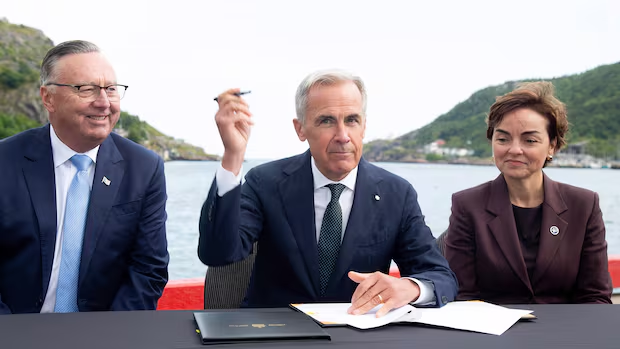
While campaigning in last year’s provincial election, he promised a referendum on any Churchill Falls deal. Alongside Prime Minister Mark Carney and Quebec Premier Christine Fréchette, Wakeham announced a new deal on Monday but it wouldn’t be put to a referendum. Wakeham said he understood people would be “disappointed” a vote would not take place.
“What has changed is the enormity of the opportunity now that the federal government is involved. This was never even contemplated in the old [memorandum of understanding] or ever before that,” Wakeham told CBC Radio’s The St. John’s Morning Show by phone on Wednesday.
Alongside a federal government urging quick action, he said the “facts on the ground” have changed in the last year, pointing to the U.S. trade war.
U.S. President Donald Trump has paused 50 per cent tariffs on Canadian goods for three days, previously scheduled to come into effect Aug. 19, while negotiations on a trade deal continue.
“We stare down the barrel of even more U.S. tariffs and that threat isn’t going anywhere,” said Wakeham.
The House of Assembly will open on Sept. 14 for a special debate and Wakeham said MHAs will be given the resources so they can look at the details. He said the negotiating team will be present.
The new deal replaces a 2024 MOU reached by the previous Liberal provincial government, which a review later commissioned by Wakeham’s government determined was not in the best interests of the province.
The PC caucus walked out during the vote on the previous MOU.
When asked if the opposition could similarly walk out, Wakeham said they had voted to support the previous MOU and the one that is before them now is better.
“A new and better deal and with more power, more value and more transmission,” he said.
Wakeham added another benefit in the new agreement is the option for N.L. to sell power to Quebec or keep excess power to support N.L.’s industry. He also highlighted the ways Ottawa’s involvement boosts the current MOU, like the proposed 2,000 megawatt onshore wind energy project in Labrador could have Ottawa taking a 40 per cent equity stake that N.L. could buy back in the future.
Other benefits include loan guarantees for the Gull Island hydroelectric project that will help lower the cost of borrowing, investment tax credits and that Ottawa is also helping build the Labrador Transmission Line, he said.
“All of these things put together over $3.5 billion in investment by a federal government who are coming to this as a partner with us.”
A looming Quebec election could see a new government in power. Wakeham said he can’t control what happens on that front, but he believes this is a good deal for both provinces.
He added he hopes to have the definitive agreement in place by the end of the year.
‘Tenuous geopolitical world’
Energy N.L. CEO Charlene Johnson was present at Monday’s announcement and she said it left her feeling pride that N.L. has “natural resources that are the envy of the world.”
Her members are looking forward to years of work that the energy projects could bring, from engineering, fabrication, on-site construction and then its operation and maintenance.
“We’re looking forward to all those opportunities in the full life cycle of this project,” said Johnson.
 Energy N.L. CEO Charlene Johnson says her members are eager to work on all aspects of the projects. (Danny Arsenault/CBC)
She also said Carney calling it the largest clean energy investment in North American history as “pretty significant.”
“The world needs energy right now, and Newfoundland Labrador has the resources and the expertise to deliver,” said Johnson. “We’re all acutely aware right now, the tenuous geopolitical world that we live in.”
Download our free CBC News app to sign up for push alerts for CBC Newfoundland and Labrador. Sign up for our daily headlines newsletter here . Click here to visit our landing page.