
Open this photo in gallery:
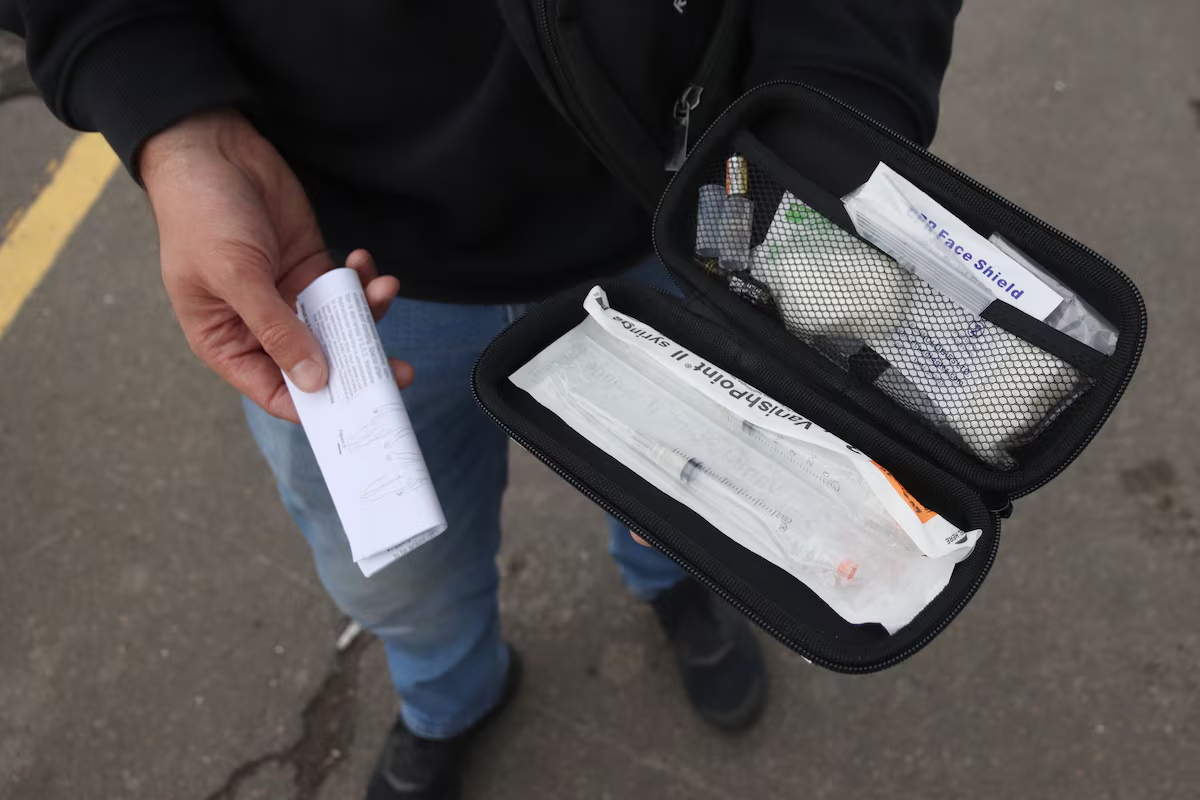
Harvest House, an addiction recovery and emergency housing non-profit in Moncton, has assisted 688 people experiencing overdoses just this month, with 41 per day since last week. A Naloxone kit in Moncton, N.B., on June 15.The Globe and Mail
Moncton has seen a sustained surge in suspected overdoses in the past few weeks, with officials warning that the drug supply is tainted with a notorious veterinary tranquilizer.
The fire department has deployed a new rapid-response vehicle with extra firefighters solely to attend up to five times more overdose calls than usual in the downtown, while outreach non-profits have hired additional staff and are also working around the clock to respond to a drug crisis that has plagued the small city of 100,000 since the end of May.
Veterinary tranquilizers, such as medetomidine and xylazine, are increasingly being cut into Canada’s illicit drug supply, further complicating the country’s overdose response.
While medetomidine has emerged in other provinces and cropped up previously in Amherst, N.S., and Charlottetown, the crisis unfolding on the streets of Moncton is the first time the tranquilizer has had a serious and sustained impact in the Maritimes, said Scott Phipps, executive director of ENSEMBLE, a harm-reduction non-profit in Moncton.
“We had suspected an infamous tranquilizer known as medetomidine and that was indeed verified by both our professional in-house testing and by Health Canada,” he said.
“It is a pretty powerful drug, and it can be quite devastating and very frightening to the clients.”
Drug-overdose deaths are falling across Canada. Why is Edmonton an exception?
Because medetomidine is not an opioid, overdose reversal agents, such as naloxone, are unable to counter its effects. The sedative increases the risk and complexity of a drug poisoning because it lowers the heart rate and prolongs sedation.
Health officials across the country have issued warnings about medetomidine and, earlier this month, New Brunswick’s French health authority cautioned the powerful veterinary sedative may be found in drugs in the Moncton area.
“There has been a high number of overdoses and poisoning cases linked to this situation,” said the Vitalité Health Network.
New Brunswick’s Health Department doesn’t have community-level data on non-fatal overdoses or up-to-date data for acute toxicity deaths, but three different first-responder groups told The Globe and Mail they have each responded up to on average of 20 to 27 suspected overdoses daily since the end of May.
Ambulance New Brunswick’s 911 dispatch team received 352 calls for suspected overdoses in the Greater Moncton Area since the beginning of June.
ENSEMBLE is steadily receiving more requests for drug testing and has witnessed 170 overdoses since the end of May.
Opioid overdose survivors face higher death risk after hospital release than previously thought, study says
Harvest House, an addiction recovery and emergency housing non-profit, has assisted 688 people experiencing overdoses just this month, with 41 per day since last week.
“We’re in a crisis mode. We’re trying to manage it,” said executive director Leon Baker.
He said they’ve hired additional staff and security guards, and have added community volunteers to patrol the streets to respond to people experiencing an overdose. As the beginning of next month approaches, when people receive provincial social development cheques, Mr. Baker said there is added concern.
Mr. Baker’s son, Christian Baker, a 26-year-old volunteer firefighter, jumped in to help out on his day off, assisting four of the 27 overdose cases Harvest House handled on one recent Friday.
“You never know the ripple effect that it can cause for one person to be down there,” Christian Baker said about his decision to help out.
Every second day, a task force made up of staff from the province’s health and social development departments, ambulance, police, firefighters and shelters meets to monitor the crisis, said Moncton Fire Chief Conrad Landry.
Open this photo in gallery:
Christian Baker walks the streets of Moncton with a Naloxone kit.The Globe and Mail
As the city’s Fire Chief for the last eight years, Mr. Landry said he has never seen overdoses to this degree – on average 15 to 20 a day compared to the usual four or five. After weeks of this, he said it’s starting to affect the mental health of his firefighters.
“We’re watching that quite closely,” he said. “What we don’t want is what’s called compassion fatigue. We want to make sure that they still have compassion on the 20th call, the same as they had on the first call.”
Nova Scotia Health has warned the public twice this month about increasing toxicity in the illicit drug supply, after multiple suspected overdoses in the past few weeks in the northwestern part of the province, near the boundary with New Brunswick. It cited medetomidine as one of the contaminants.
New Brunswick RCMP, who have been responding to some of the overdose calls, have also warned the public about “highly dangerous and in some cases potentially lethal” illegal drugs currently circulating in the province and the Moncton region.
RCMP spokesperson Corporal Hans Ouellette did not respond to a question about whether police know the source of the toxic drug but said reducing the presence and impact of illicit drugs is a priority.
2025: Spike in B.C. overdoses linked to veterinary additive in street drugs
“In response, we are taking a co-ordinated approach with policing partners to disrupt and dismantle organized drug trafficking networks, focusing on those responsible for the greatest harm,” Cpl. Ouellette wrote in an e-mail.
The Ontario Poison Centre, in March, said drug checking data from Toronto first detected medetomidine in fentanyl samples in early 2024 and it “has since been found with increasing frequency.”
In January, the British Columbia Centre for Disease Control issued a rare provincewide toxic drug alert about the sedative. The provincial agency said there had been increased detections of medetomidine in law enforcement seizures and drug checking samples. Last November, for example, it was found in 38 per cent of opioid samples.
Roughly 5,800 people died from opioid poisonings across Canada last year, which amounts to about 15 people a day, according to the latest national data released this month. This is a 23-per-cent reduction compared to 2024, marking the second year in a row in which the death toll has fallen.
New Brunswick follows that national trend, with 72 opioid deaths across the province last year, but the data obscure what’s happening at the local level because the drug crisis constantly fluctuates.