
Listen to this article
Estimated 4 minutes
The audio version of this article is generated by AI-based technology. Mispronunciations can occur. We are working with our partners to continually review and improve the results.
Canada-U.S. Trade Minister Dominic LeBlanc and his American counterpart are aiming to present U.S. President Donald Trump a path to a potential trade deal as early as Monday, CBC News has learned.
Sources who were recently briefed on the matter say the hope is the joint proposal can be presented to Trump at least a day before the president’s latest tariff deadline.
That timeline would give Trump the space to make a final decision before new 50 per cent levies on hundreds of Canadian imports are scheduled to take effect on Aug. 19.
CBC News is not naming the sources as they weren’t authorized to speak publicly.
Trying to extend the Canada-U.S.-Mexico Agreement
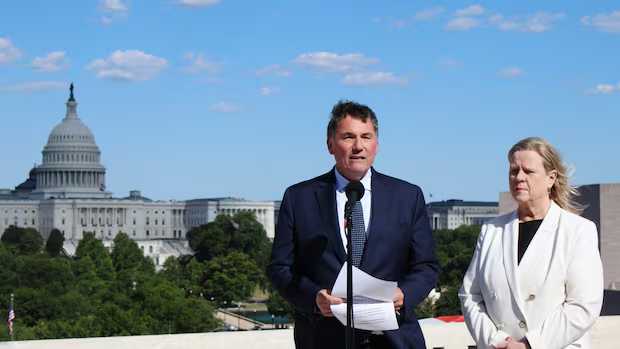
LeBlanc met with U.S. Trade Representative Jamieson Greer in Washington on Tuesday, marking the third time in three weeks the pair has met face to face.
Neither LeBlanc nor Canada’s chief trade negotiator, Janice Charette, answered reporters’ questions after they were seen leaving Greer’s office on Tuesday afternoon.
The meeting lasted for about an hour.
Leblanc later posted to X saying that discussions are “ongoing” and he and Charette will “continue to engage at the negotiation table.”
LeBlanc had initially planned to travel to Washington on Monday, but his flight to the U.S. capital was diverted back to Montreal Monday afternoon due to severe weather.
Charette, meanwhile, spent all day Monday in Washington meeting with officials from the Office of the United States Trade Representative.
In addition to trying to dissuade Americans from levying new tariffs, LeBlanc and Charette are looking for relief on sectoral tariffs the U.S. has slapped on Canadian steel, aluminum, lumber and autos.
Canada is also hoping the ongoing trade talks between the two countries will result in an extension of the Canada-U.S.-Mexico Agreement (CUSMA) after the Trump administration declined to renew the deal back in July.
WATCH | Canada, U.S. officials plan to pitch trade deal to Trump:
Canada-U.S. trade reps working on new pitch for Trump
CBC News has learned Canada-U.S. Trade Minister Dominic LeBlanc and U.S. Trade Representative Jamieson Greer are working on a proposal to pitch to U.S. President Donald Trump before a tariff deadline that could see hundreds of Canadian goods hit with a 50 per cent levy.
When announcing the Aug. 19 tariffs, the U.S. raised a number of trade irritants, including Canada’s retaliation against U.S. trade policy with the removal of U.S. alcohol from provincial store shelves and alleged Canadian discrimination against U.S. motor vehicles and dairy.
According to U.S. Census Bureau figures, the alcohol bans in every province, save Alberta and Saskatchewan, have resulted in a $360-million US drop in wine exports to Canada in 2025 from the previous year, along with a $150-million US drop in spirit exports.
The new tariffs cover about five per cent of Canadian exports to the country. The targeted goods range from alcohol to hockey sticks to cement.
Conservatives push Carney for results
When negotiating with the White House, Canada should ensure it’s in the strongest position possible, Conservative MP Michelle Rempel Garner said Tuesday.
The Calgary MP also argued Prime Minister Mark Carney has been in office for more than a year, and has yet to secure a trade agreement with the Trump administration.
“The person who needs to be held to account in the domestic capacity in Canada is Mark Carney,” Rempel Garner said in Ottawa. “He has to deliver on his promise to Canadians — that’s why Canadians lent him their vote.”
Her comments come two days after Conservative Leader Pierre Poilievre wrote to Carney, calling on him to show some “backbone” as trade negotiations ramp up.
Poilievre said Canadians deserve a “good deal” that includes zero tariffs on softwood lumber, an end to sectoral tariffs on steel and aluminum, a tariff-free auto pact and full exemption to Buy America rules on infrastructure projects at all levels of government.
“No more pursuing policies of a managed decline at home. No more caving,” Poilievre wrote.