
Open this photo in gallery:
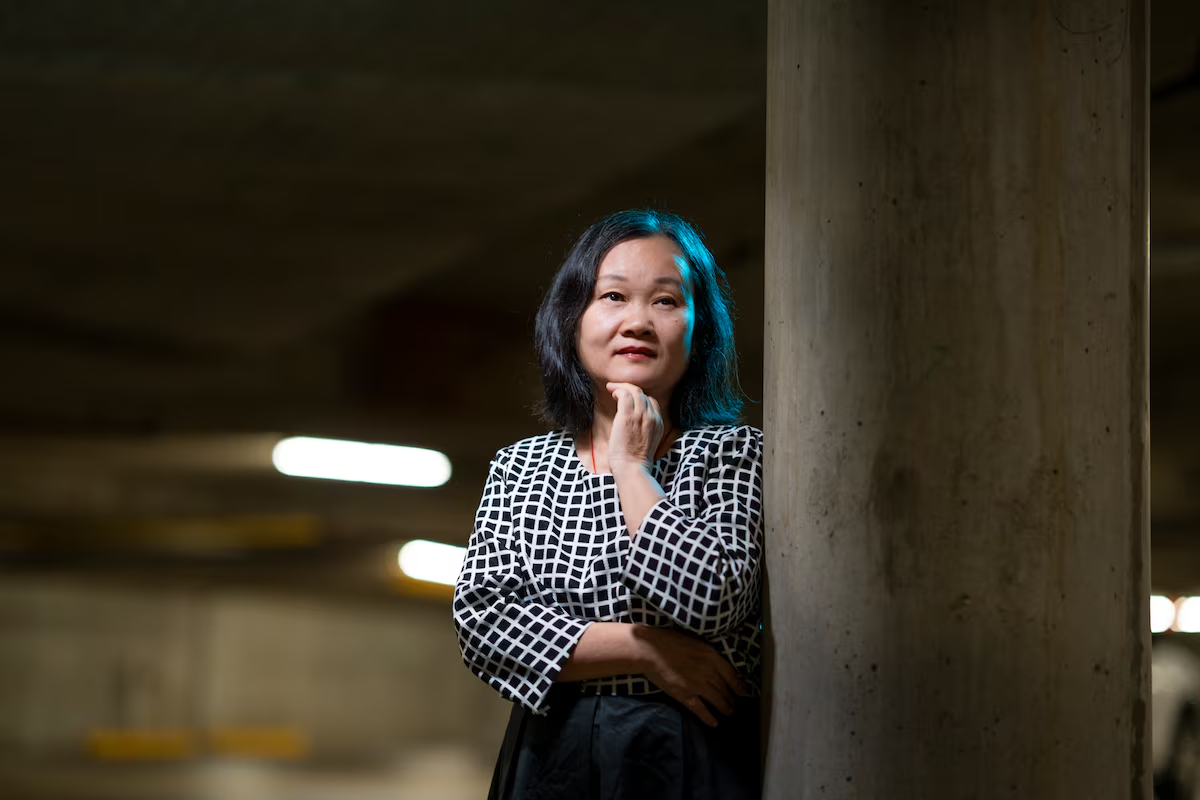
Activist Zhang Xinyan, shown on Wednesday, was elected last year to the Toronto-based dissident ‘Hong Kong Parliament,’ which claims to represent Hong Kongers in exile. Authorities in the Chinese territory placed a bounty on her head for subversion.Jimmy Jeong/The Globe and Mail
A Chinese activist who was living in Thailand and detained there for three months, after facing persecution for years by China’s Communist Party, says she plans to keep speaking out in Canada to draw international attention to what she says are the regime’s efforts to silence dissidents abroad.
Zhang Xinyan, 55, arrived in Vancouver on Monday after a co-ordinated effort from Ottawa, the United Nations refugee agency, Thai lawmakers and international human-rights groups. She recounted her experience in a lengthy Cantonese-language interview with The Globe and Mail on Wednesday.
“My story is an example of CCP persecution – of transnational repression,” she said. “If we don’t draw international attention to it, it’s saying that the CCP can do whatever it wants.”
Chinese activist detained in Thailand arrives in Canada
Ms. Zhang, a long-time practitioner of the controversial spiritual movement Falun Gong, said she fled to Thailand in 2014 to evade persecution from China, where it is banned and heavily suppressed. Two years later, she was recognized as a refugee by the UN Refugee Agency.
Ms. Zhang was also among 15 people elected last year to the Toronto-based dissident “Hong Kong Parliament,” a group comprising exiled, pro-democracy Hong Kongers, prompting authorities in the Chinese territory to place a $36,000 bounty on her head for subversion.
China’s embassy in Ottawa did not respond to a request for comment Thursday.
Sheng Xue, a Toronto-based activist, said Ms. Zhang’s last-minute detention raised concerns about Beijing’s “long-arm jurisdiction” and had echoes of the case of Dong Guangping, a Chinese human-rights activist who in 2015 was also prevented from travelling from Thailand to Canada.
Mr. Dong was forcibly returned to China before travelling by rubber boat to South Korea and eventually flying to Toronto where he reunited with his family last month.
Ms. Zhang arrives in Canada as Ottawa recalibrates its approach to Beijing. Amid deteriorating relations with the U.S., Prime Minister Mark Carney’s government is pursuing closer economic ties with China as part of a broader global effort to diversify trade.
Canada diverged from U.S. trade policy in January by reaching an agreement with China to replace its 100-per-cent surtax on Chinese-made electric vehicles with a quota of 49,000 vehicles a year at a 6.1-per-cent tariff rate. The quota will increase by 6.5 per cent annually. In exchange, China agreed to reduce tariffs and other trade barriers affecting Canadian agriculture, including canola products.
Carney ‘not interested’ in narrow U.S. trade deal
In the interview, Ms. Zhang said she has been a practitioner of Falun Gong for nearly 30 years. While teaching at a middle school in Shenzhen, she said she wrote on a bank note that “Falun Dafa is good” – a tactic used by practitioners who put the notes back into circulation to bypass state censorship and spread information about their movement. Falun Dafa is another name for Falun Gong.
A student brought the note to the headmaster, who lambasted her at a school assembly and said he would be reporting her to the police, she said. She fled to Thailand shortly after.
“For sure, I would be arrested,” Ms. Zhang said. “I would be put in jail and subject to torture. And then sentenced.”
In Thailand, she says she worked for a Falun Gong news outlet covering the Hong Kong government.
On May 7, Ms. Zhang said she was leaving her apartment when she was approached by officers who asked if she had her passport. She did not; it had been seized by authorities at the Chinese embassy when she sought to renew it, she said.
Ms. Zhang insisted that she held protected refugee status with the United Nations, to no avail. Officers took her to an immigration detention centre in Bangkok, where she faced possible deportation to Hong Kong or mainland China.
As Ms. Zhang sat in detention, pro-democracy activists worked to draw attention to her case and international human-rights organizations underscored the risk of harm she faced should she be transferred to Chinese custody. Ms. Sheng, the activist, co-ordinated efforts to secure her resettlement. Ms. Zhang obtained legal counsel.
Canadian embassy officials in Bangkok interviewed Ms. Zhang, and completed medical examinations and biometric data collection at the detention centre, eventually finalizing her flight itinerary from Bangkok to Vancouver for July 8, Ms. Sheng told The Globe.
Freeland, in Taiwan, warns new Chinese law has ‘dark kinship’ with Putin invasion rationale
Ms. Zhang said her understanding was that an officer would meet her at 3 a.m. to take her to the airport for her early-morning flight. But when the time came, no one showed up.
“I was in tears, begging police to take me to the airport,” Ms. Zhang recalled. “I showed them my plane ticket. But their hearts were not moved. They told me the ticket had already been cancelled.”
She said she was given no explanation why and was not allowed to make a phone call or watch the news to determine what had happened. Her lawyers petitioned the South Bangkok Criminal Court for a hearing under the Prevention and Suppression of Torture and Enforced Disappearance Act after they were unable to contact her.
Questioned by a judge at a July 16 hearing, a representative from Thailand’s Immigration Bureau said the plane ticket had been cancelled at the behest of Chinese embassy officials in Thailand because she was wanted by Hong Kong police, Ms. Zhang said.
“It was the Chinese embassy’s instruction for the ticket to be cancelled, after which I was supposed to be taken back to China,” she said. “They even showed evidence of the instructions given by the Chinese embassy – documents.”
Ms. Zhang said someone assured her in English that she could not be returned to China. She was sent back to the detention centre, where she says representatives from the UN regularly checked in on her, until her Aug. 3 flight to Canada.
She said she was taken to the airport where she was met by UN representatives who didn’t leave her side until she boarded the plane.
In Vancouver, Ms. Zhang has since met with two members from the “Hong Kong Parliament” who say they will continue to advocate for her in the pursuit of freedom and democracy. She said she plans to take some time to rest, then hopes to connect with other Falun Gong practitioners and resume her activist work.
Ms. Zhang said she believes she was only able to evade persecution because of the international attention on her case, and the efforts of many. She said she is grateful to be in Canada.
“I eventually was able to breathe the air of freedom,” she said.