
Open this photo in gallery:
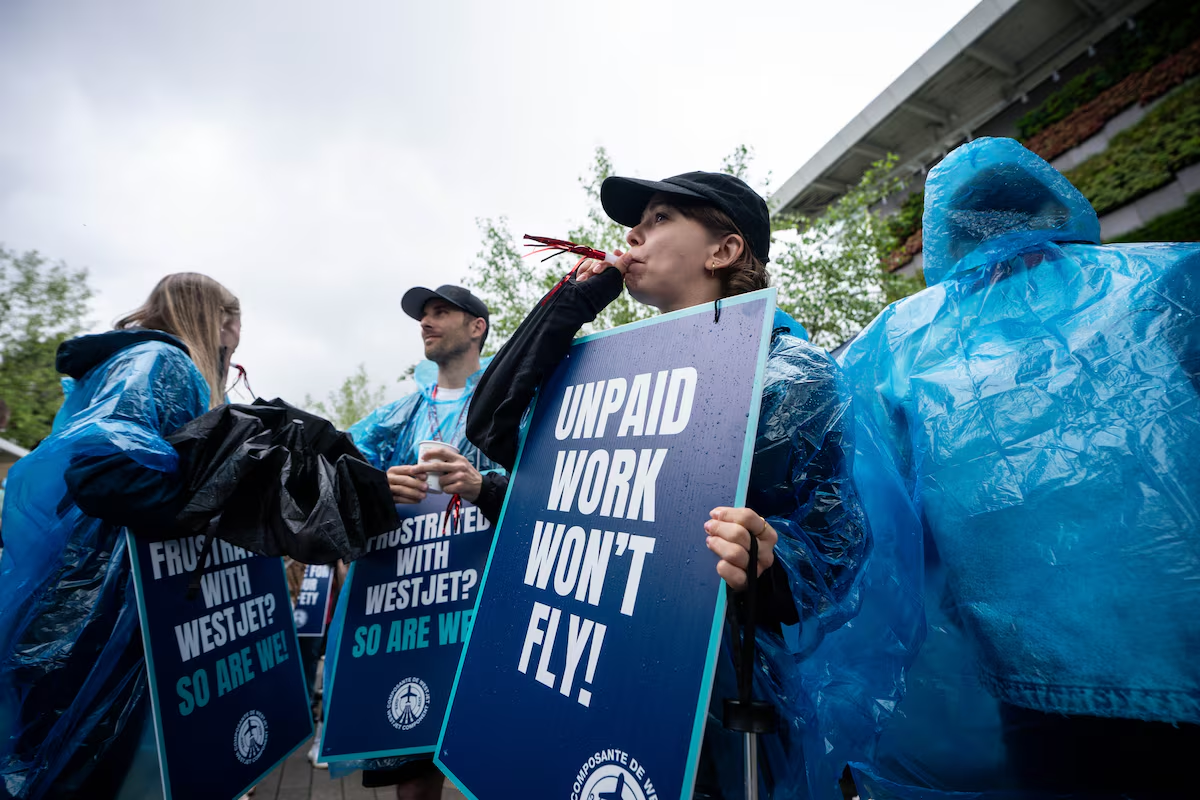
WestJet flight attendants strike at Vancouver International Airport in Richmond, B.C., on Sunday. Their union shared details of the tentative agreement reached with the airline on Thursday.ETHAN CAIRNS/The Canadian Press
WestJet flight attendants will see sizable increases to their overall compensation, including eventually getting paid for all the unpaid preboarding work they currently do, setting a new standard for the airline industry in Canada.
More than 4,000 WestJet flight attendants represented by the Canadian Union of Public Employees went on a one-day strike last weekend in an attempt to hash out a deal with the Calgary-based carrier.
A tentative deal was struck on Aug. 3, and on Thursday, the union released details of that agreement. They include a wage increase of 18.25 per cent for all flight attendants over the course of the next three years, including a retroactive increase from Jan. 1, 2026. Critically, the deal also includes a new “duty pay premium,” or compensation for work that flight attendants do before a plane takes off and after it lands.
By the end of their contract in December, 2028, flight attendants will be paid for 100 per cent of “uncredited time,” which the union defines as the hours that cabin crew currently work but are not compensated for.
“The union found a smart way to move towards full compensation for unpaid work, in phases, moving in the same direction as the compensation for ground pay that Air Canada flight attendants achieved last year,” said Steven Tufts, an associate professor of labour studies at York University who has closely followed the negotiations.
Opinion: WestJet labour dispute is really a proxy battle between Carney and unions
Last summer, Air Canada flight attendants also represented by CUPE won partial compensation for ground pay, which started at 50 per cent of their hourly wage per hour of work done before a plane departs, with yearly increments that peak at 70 per cent of their hourly wage. The deal was considered a win by labour experts, because it kick-started the overhaul of flight attendants’ compensation structure by recognizing and rewarding preboarding work.
Mr. Tufts cautioned against comparing the WestJet deal with Air Canada’s, however, because the airlines have different pay structures.
WestJet flight attendants get paid through a system known as “credit hours.” A credit hour rate is a negotiated hourly rate that is typically an inflated hourly wage that the airline says accounts for the work that flight attendants do before a plane departs. CUPE has long argued that despite the credit hour system, flight attendants are still inadequately compensated for work done before boarding and after landing. The “duty pay premium” included in the contract attempts to address this gap.
“My initial comparison with the Air Canada deal is that this seems to be a step beyond because, ultimately, WestJet flight attendants will get some compensation for all hours of unpaid work,” said Adam King, an assistant professor of labour studies at the University of Manitoba.
The tentative agreement, which is a three-year deal, will be voted on by members in early September, according to the union.
On its website, CUPE 8125, the local representing roughly 4,400 WestJet flight attendants, explains in great detail how a flight attendant’s overall salary will improve if the deal is ratified. For example, if a junior flight attendant (the lowest salary rung) works a four-day block that includes 12 flight legs, they are currently compensated $750.80. If the deal is ratified, that amount would increase to $1039.29 and, eventually, by the end of 2028, to $1,226.37.
This takes into account the duty pay premium formula and agreed-upon yearly wage increases.
When the tentative deal was reached on Aug. 3, CUPE 8125 president Alia Hussain described it as “meaningful progress that evolves the flight credit system by recognizing more of the work cabin crew do.” The union is hopeful that members will vote in favour of the deal.
Air Canada flight attendants rejected the tentative agreement fought for by their union last year, arguing that the negotiated wage increases (20.25 per cent over four years) did not come close to making up for a decade of inflation. Air Canada’s previous agreement was a 10-year deal that began in 2015 and expired in March, 2025.
In February, 2026, an arbitrator determined the terms of the contract and maintained the proposed wage increases, much to the disappointment of flight attendants and CUPE.