A work stoppage looms for 4,400 flight attendants at Canada’s second-largest air carrier, raising concerns for travellers as WestJet has already cancelled dozens of flights ahead of a possible strike.
The flight attendants’ union issued a 72-hour strike notice early Thursday morning. WestJet responded to the union’s move by issuing a 72-hour lockout notice.
For summer travellers worried about what this means for their plans, here’s what you need to know.
Have the strike and lockout started?
Not yet. The flight attendants represented by the Canadian Union of Public Employees (CUPE) early on Thursday signalled the intent to go on strike, with negotiations continuing during a 72-hour notice period.
The notice period runs out on Sunday at 12:01 a.m. MT, or 2:01 a.m. ET, which is the earliest a strike could begin if a deal is not reached. It’s possible the two sides may come to an agreement earlier or continue negotiating past the deadline if they are close to a deal.
WestJet said in a news release on Thursday that it is still actively negotiating to reach a deal. In a separate release, CUPE said the same.
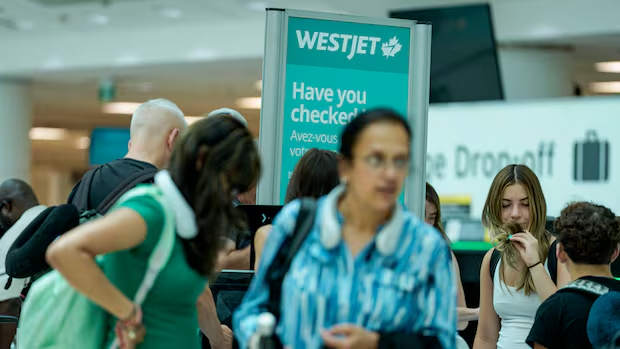
 WestJet has said it will communicate with passengers ahead of any flight changes or cancellations. (Evan Mitsui/CBC)
Will all WestJet flights be cancelled?
As of 11 a.m. MT (1 p.m. ET) on Saturday, WestJet said 198 flights had been cancelled.
However, if the two sides are not able to come to a tentative agreement before Sunday morning, more disruptions could occur.
The airline said the cancellations announced so far aimed to prevent crew and passengers from getting stranded, and travellers should check their flight status before leaving for the airport.
WestJet said earlier this week that it will communicate with ticket-holders in advance of changes or cancellations to their flights.
Travellers booked on the airline’s regional WestJet Encore service or code-share flights run by an airline partner such as Delta Air Lines will not be affected by a strike, the carrier said.
What should I know about my upcoming flight?
Ahead of the potential strike, WestJet has been allowing passengers travelling between July 30 and Aug. 4 to make a one-time change or cancellation with no fees.
But only passengers with certain kinds of bookings can get a refund back to their original form of payment if they take advantage of the one-time cancellation offer. Those who booked PremiumFlex and BusinessFlex flights, or premium and business passengers travelling between Canada and Asia, can get their cash back, and others will get a refund in the form of a travel credit.
If a customer decides to keep their WestJet booking, and delays or cancellations still occur, the airline said affected passengers will be refunded or re-accommodated as applicable. Under Canada’s Air Passenger Protection Regulations, affected customers should be rescheduled on a flight with WestJet or one of its partners within 48 hours, or they can receive a refund instead of a travel credit. If the airline cannot reschedule you within 48 hours, it is obligated to try to reschedule you on a competitor’s flight if necessary, but that can be at another airport.
The airline said travellers who booked with WestJet directly will be notified of any changes through the contact information provided in their booking, and those who booked through a third party such as a travel agent will have to make changes through the third party.
T.J. Dunn, a Vancouver-based travel expert and writer, said if WestJet cancels flights, it has a responsibility to rebook passengers via other airlines — but that could be easier said than done on a busy summer long weekend.
WestJet on Friday began grounding planes and then cancelling flights ahead of the possible strike or lockout, since winding down operations takes advanced planning.
WATCH | The view from Vancouver International Airport:
YVR prepares for busy long weekend amid possible WestJet strike
Vancouver International Airport is gearing up for a busy long weekend as some travellers could see disruptions due to a looming strike at WestJet. The CBC’s Amelia John has more from the international terminal.
How did we get here?
On July 15, WestJet flight attendants approved a strike mandate if the two sides are not able to reach a deal.
Union members voted 99 per cent in favour of the strike mandate, with turnout topping 97 per cent. Following a cooling-off period, the cabin crew could go on strike as soon as Sunday, which falls on a long weekend in most of the country.
On July 14, CUPE held rallies across the country in a “day of action” as part of a public relations campaign. At the Calgary rally, some 250 WestJet flight attendants stood side by side in front of the airline’s headquarters. Meanwhile, ads have appeared on various platforms arguing the cabin crews’ case.
CUPE represented about 10,000 Air Canada flight attendants who went on strike last summer and ultimately secured compensation increases. Ottawa intervened less than 12 hours after their strike began, requesting the Canada Industrial Relations Board end the strike and send the parties to binding arbitration.
But the board’s order was defied by union officials, leading it to declare the strike unlawful. Air Canada workers remained on the picket lines until the two sides came to a tentative deal three days into the strike.
Air Canada is not impacted by the WestJet strike, despite workers at both companies being represented by CUPE.
 The flight attendants’ union issued a 72-hour strike notice early Thursday morning, and WestJet responded with a 72-hour lockout notice. (Evan Mitsui/CBC)
What is this dispute all about?
Compensation for work done on the ground remains a key stumbling block in the talks, less than a year after the same issue sparked a work stoppage by Air Canada flight attendants.
The union has characterized certain ground duties as unpaid, but WestJet describes it differently.
WestJet’s current “credit hour” system combines flight time, ground duties, delays and other labour into a “single, higher rate of pay” that is then credited across the work day, the company says on its website.
The pay rate ranges between $28.88 and $53.61 per credit hour, the company says. At 80 credit hours a month — considered full-time work — that adds up to between $2,300 and $4,300.
Many airlines operate under a similar structure, but Delta Air Lines spearheaded reforms in 2022 when it became the first carrier in North America to pay flight attendants specifically for work done on the ground. American Airlines and Alaska Airlines followed suit with boarding pay of 50 per cent of regular rates.