
Listen to this article
Estimated 3 minutes
The audio version of this article is generated by AI-based technology. Mispronunciations can occur. We are working with our partners to continually review and improve the results.
Fierce winds whipping through southern Manitoba Wednesday night reached speeds as high as 133 km/h, leaving a trail of downed trees and knocking out power for thousands.
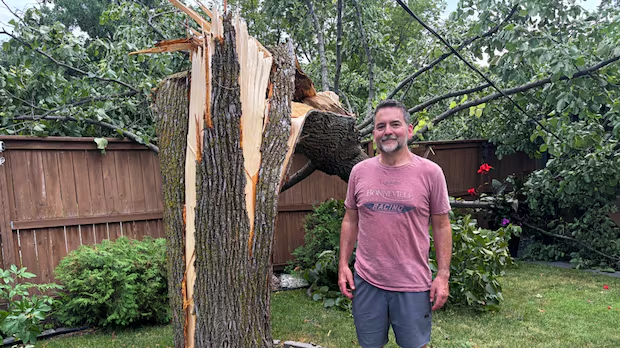
Gale-force winds tore down seven trees on Jim and Mona Hardy’s property, including a 20-metre tall cottonwood.
“It’s the strongest wind I’ve ever felt,” said Jim, who lives in Prairie Grove, between the Trans-Canada Highway and Lorette, south of Winnipeg. “I was awoken when our house shook like an earthquake, power went out.”
Brandon had the highest recorded wind speeds provincewide at 133 km/h, said Environment and Climate Change Canada meteorologist Terri Lang. Winds reached 113 km/h in Souris, 106 km/h in Portage la Prairie and 91 km/h in Winnipeg, she said.
Lang said there were 2,916 lightning strikes within 50 kilometres of Winnipeg overnight.
The strikes and wind knocked out power for thousands across southern Manitoba. As of midday Thursday, there were 500 separate outages affecting about 28,000 Manitoba Hydro customers, according to spokesperson Peter Chura.
Most were in Winnipeg, “where we’re seeing most of the worst damage from trees falling on lines and polls down,” he said.
 Part of a street in Winnipeg’s St. Norbert area was taped off Thursday morning after gale-force winds knocked it over. (Santiago Arias Orozco/CBC)
Outages were “radiating outward” from the city, with hydro maps showing outages in Portage la Prairie, Treherne and St. Adolphe.
Many of the outages are in the southern parts of Winnipeg, including the Charleswood, Waverley Heights and St. Vital areas.
Hydro has yet to determine when power will be restored, said Chura.
In addition to downed lines, “we have poles down, equipment damaged by fire — so right now crews are working on assessing all of the damage as best we can,” he said.
‘Abnormally busy’: arborist
Arborist Pierre Duguay was fielding calls early Thursday morning about downed trees and branches, most of them coming from Winnipeg’s south end, including Fort Richmond, St. Norbert and just south of the city in La Salle.
By midday, he’d had 25 calls to clean up properties, including one for a tree that had fallen on a home.
“This summer has been abnormally busy with storms,” he said.
 A tree lies atop a fence in Winnipeg’s Waverley Heights neighbourhood. (Chidi Ekuma/CBC)
Environment Canada’s Lang said high heat and humidity have contributed to storm strength this summer. Those conditions are also leading to something known as “corn sweat.”
“The crops are full-growth right now, giving off a tremendous amount of moisture. We call it evapotransperation — farmers would call it corn sweat,” she said.
“That is adding to the atmosphere, and then you just need those things that happen in the upper atmosphere to come together and you’ve got all the ingredients for severe weather.”