
Listen to this article
Estimated 4 minutes
The audio version of this article is generated by AI-based technology. Mispronunciations can occur. We are working with our partners to continually review and improve the results.
A debilitating injury that an elite B.C. snowboarder sustained while representing her country has highlighted the financial challenges of pursuing an Olympic dream.
Prince George’s Meryeta O’Dine took home a pair of bronze medals in snowboard cross at the 2022 games in Beijing, and travelled to Italy to compete in the 2026 Milano-Cortina Olympics.
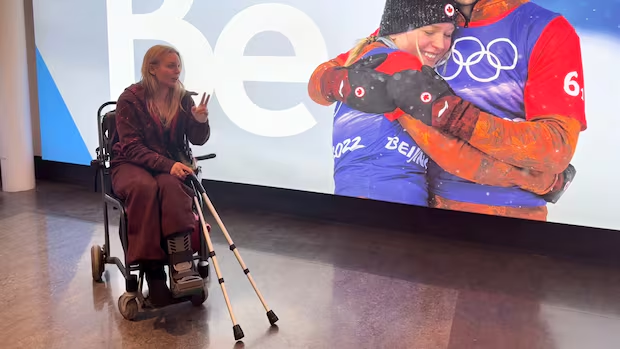
But she suffered a fractured ankle in a devastating crash during a snowboard cross training run in February and was unable to compete.

First aid workers treat Meryeta O’Dine after a fall during training at the 2026 Winter Olympics. (Submitted by Meryeta O’Dine)
“I was home by the time my event was happening,” O’Dine said. “It was horribly upsetting.”
Adding to the heartbreak of missing the competition was financial strain.
O’Dine said she was unable to fulfil contracts and attract future sponsors, and was injured badly enough she couldn’t work for five months.
Meanwhile, travel, training and rehab bills have piled up.
“I’m essentially kind of in crisis mode right now,” she said. “It’s more than what I currently have in my bank account, and the bills I have coming up.”
O’Dine said people often don’t realize that most competitive athletes, outside of the high-paying professional leagues, are already scrambling to make ends meet.

Canadian Olympic snowboarder Meryeta O’Dine is seen dressed for competition. (Submitted by Meryeta O’Dine)
Big money sponsorships are hard to come by unless you top the podium, while international travel and a weak Canadian dollar make training and competition expensive, she said.
“Genuinely, I’ve never had a year where I haven’t ended my season in debt, because things always cost a little bit more than we are expecting them to,” O’Dine said.
Nationwide issue
Advocates have long raised concerns about funding for Canadian athletics.
Can Fund, a charity that helps financially support Canadian athletes, says almost two-thirds of applicants to its program work part-time jobs, on top of their training, just to get by.
It says three in five of those athletes are in debt and live with a negative net income.
“The average athlete goes $30,000 to $80,000 in debt,” said Can Fund founder Jane Roos.
A former athlete herself, Roos said she started the program after suffering an injury as a way to help other competitors.
“I’ve never met an athlete who wants a handout,” she said. “But let me tell you, when they win the medals, we sure claim them as our own and we tell the world how happy we are, and proud of them we are.
“And you know what? You can’t be the best in the world at anything without support, right?”
In July, the federal government announced it was adding $3 million to the Athlete Assistance Program (AAP), which provides a monthly living and training allowance to about 1,900 qualified athletes.
The funding will see monthly support for senior athletes increase by 5.5 per cent to $2,300 per month.
WATCH | Additional $60M in sports funding:
Feds announce additional $60M in sports funding
New funding from Ottawa
Last month, Ottawa unveiled about $60 million in supplemental funding for 62 governing sports bodies, part of a new five-year $660-million sport funding package, including a $2.86-million boost to the Canadian Snowboard Federation.
At the time, Snowboard Canada CEO Dustin Heise described the new funding as “transformational.”
O’Dine said she wouldn’t be able to compete without the funding she receives from the AAP, and is grateful for the increase.
But she said it’s still not enough to cover her travel and out-of-country training expenses, and is currently fundraising to keep her dream alive.
Meanwhile, she isn’t letting funding challenges get in the way of her passion for snowboarding.
She’s currently in Austria training.
“I don’t think I’ve ever been so excited for a season,” she said. “The training just this past week on snow has been absolutely incredible.”