
Open this photo in gallery:
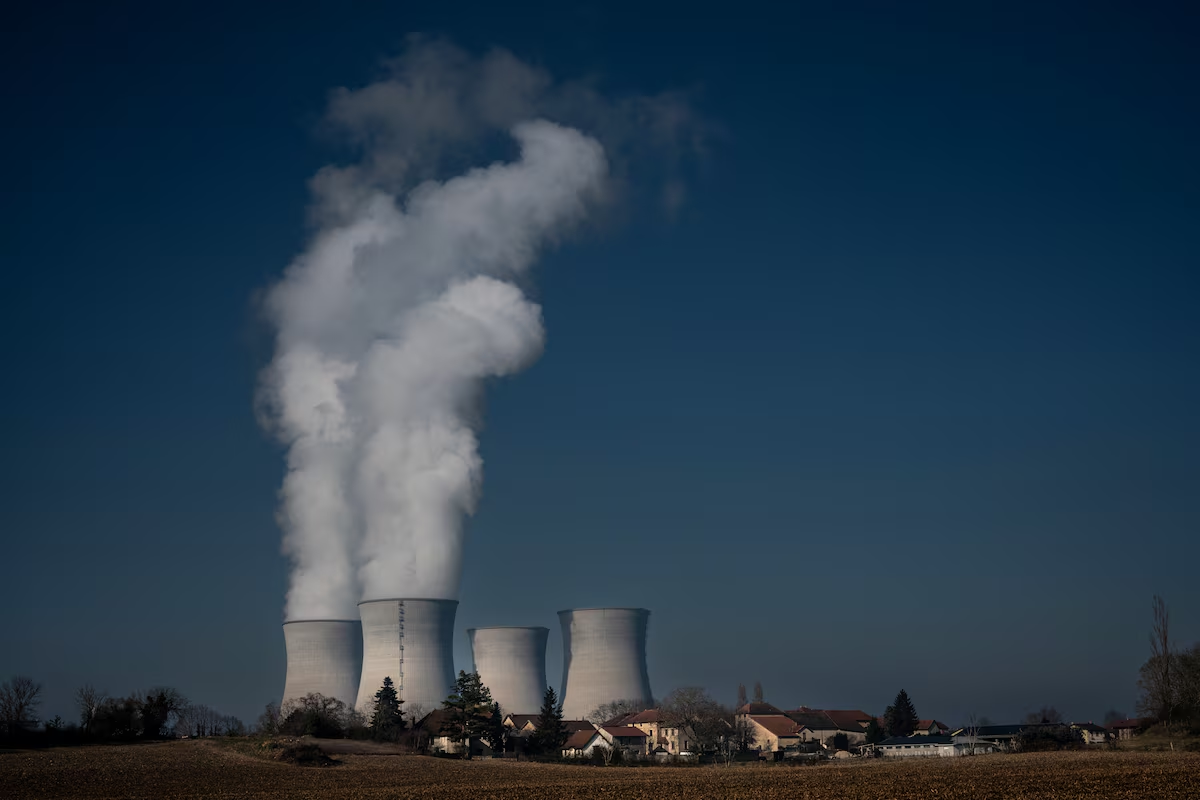
Canada’s ability to harvest a rare isotope of helium from it’s nuclear reactors spells a potential benefit for Canada’s quantum tech pursuits.JEAN-PHILIPPE KSIAZEK/AFP/Getty Images
Chris Cassin is the chief executive of Zero Point Cryogenics.
When Energy Minister Tim Hodgson announced that Canada would build 10 new nuclear reactors, it was an energy announcement – but it can also be a quantum sovereignty story.
The announcement comes with a potential benefit for Canada’s quantum tech potential: the ethical creation of helium-3, one of the rarest and most important elements for the world’s future quantum economy, including quantum computers, quantum sensors and quantum communications. As Canada speeds toward the “new civilian nuclear renaissance” Hodgson laid out, it’s imperative that Canada builds a plan now to harvest and stockpile the helium-3 that nuclear generation can produce.
Quantum technologies – which are critical for Canada’s national security and defence – are exponentially more powerful than today’s technologies. Instead of running on binary ones and zeros, they run on quantum bits (qubits), which are in all states simultaneously.
Qubits require temperatures colder than the coldest part of space. So the global race to expand quantum technologies relies on what’s known as cryogenic infrastructure to create the near-absolute-zero conditions that qubits need. Maintaining that temperature requires helium-3, which is a stable, safe, non-radioactive isotope of helium – one that’s also incredibly rare.
If cryogenic infrastructure is the engine for quantum technologies, helium-3 is the fuel.
Helium-3 is so scarce it is measured in gaseous litres rather than tonnes. It is found at just 7.2 parts per trillion in Earth’s atmosphere. It cannot be synthesized on demand.
But, in a turn of good news for Canada, it is a byproduct of our nuclear power production.
Other nations produce helium-3 for quantum as a byproduct of maintaining nuclear warheads, making global supply both limited and strategically sensitive. In addition to quantum infrastructure, helium-3 is a critical asset for border security and is used to detect illicit nuclear materials being transported between countries. In fact, the industry experienced its first supply chain shock right after 9/11, when the U.S. rapidly scaled up security at its ports and borders.
In 2025, NATO flagged helium-3 supply as critical to any quantum computing supply chain. The United States has been managing its own helium-3 stockpile through the Department of Energy for years.
But the United States and other countries are chasing alternate supply sources. Christopher Landers, director of the United States Department of Energy’s Office of Isotope R&D and Production, told Newsweek: “Helium-3 is needed in cryogenics, which is a huge driver for quantum, it’s needed for fusion and there’s medical applications as well. But helium-3 is really … on a trajectory that’s moving at an exponential rate.”
The extreme scarcity and growing importance of helium-3 has led the United States and European Union to explore missions to the moon to harvest it, where helium-3 accumulates from solar wind. In fact, NASA has signed a deal with Interlune to harvest helium-3 from the moon, with an initial launch targeted for 2028.
But Canada doesn’t have to go to the moon. We can go to Darlington, just east of Toronto.
Canada can harvest helium-3 from CANDU reactors. Ontario Power Generation is already doing so at its Darlington nuclear facility, making Canada a global pioneer in this technology. Not all nuclear power is equal, in this regard. Canada’s CANDU reactors, which use heavy water, produce helium-3 as a natural byproduct of tritium decay. Other nuclear power generation technologies do not, making helium-3 much more complicated and expensive to produce, even in smaller amounts.
If Canada’s 10 new reactors are CANDU designs, we can become the world’s most meaningful non-military producer of helium-3.
Canada has spent hundreds of millions of dollars building a quantum sector that is on the leading edge of the global quantum race. But helium-3 is a potential weakness in Canada’s domestic supply chain if we don’t produce more to meet demand, and protect it. Canada now has an opportunity not only to secure its own supply, but to become a country others depend on.
The physical requirements of cryogenic quantum infrastructure are a constant, and the need for helium-3 will continue to grow. A helium-3 stockpile would protect Canada’s quantum investments and give Canadian companies a supply-chain advantage in one of the most strategically important technologies of the century.
This is an opportunity our country’s leaders should not pass up.
The rules and planning that apply to critical minerals like lithium or cobalt can and must also be applied to helium-3. Canada should act now by designating helium-3 as a strategic critical resource, creating a national reserve to stockpile it, and establishing a domestic allocation mechanism to ensure Canadian companies and researchers building Canadian quantum technologies have reliable and affordable access to it.
Canada’s resources — fresh water, potash, oil and gas, and critical minerals — are the envy of the world. For countless families coast-to-coast-to-coast, our resources are what pays the mortgage and puts food on the table; driving our economy and creating jobs. Helium-3 can help ensure we remain in that position of prosperity for years to come.