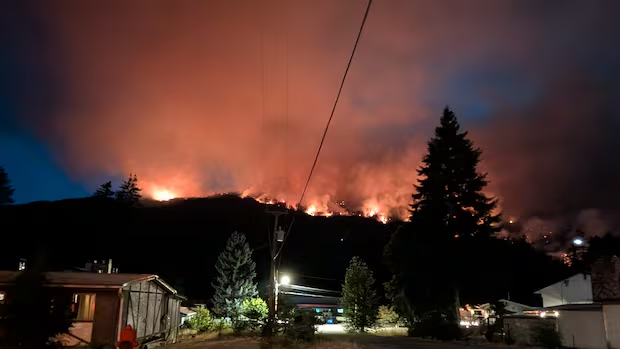
Two of the three out-of-control wildfires threatening Boston Bar, B.C., and surrounding communities have merged.
In a Thursday night update, the B.C. Wildfire Service said the Anderson Creek fire, which broke out Tuesday, had grown to merge with the southern edge of the massive Ainslie Creek fire.
The two covered an area of more than 264.1 square kilometres as of Friday morning.
“This really has not changed our response, it just means they’ve merged together into one incident,” B.C. Wildfire Service fire information officer Jean Strong said.
 A map showing the latest fire perimeters around Boston Bar known as the Brunswick Complex wildfire. The pale pink sections show where the fire was burning as of Thursday, while the red sections show where it spread to on Friday. (Darius Mahdavi/CBC)
The Brunswick Creek wildfire also continues to burn out of control, at 72 square kilometres, on the other side of the Fraser River, leaving the community essentially encircled by fires.
Together, the trio make up the Brunswick wildfire complex.
Highway 1 remains closed between Spuzzum Creek Road and the Jackass Summit, and more than 450 properties in the area are under evacuation orders.
The Fraser Valley Regional District (FVRD), however, said some residents have refused to leave.
“We understand evacuation reluctance, however, these individuals are violating the law. This action leaves them at risk,” the district said in a statement.
 The Brunswick Creek wildfire is seen burning near Boston Bar, B.C., on July 6. (B.C. Wildfire Service)
“With the rapidly changing weather and wildfire behaviour, it significantly increases the risk of not knowing, before it is too late to leave the area, or before exit access is cut off. Leaving the area is for their protection and the protection of first responders.”
Boston Bar evacuee Kyle Wood watched how quickly the Anderson Creek wildfire grew on Tuesday.
“The trees were candling right beside the road,” he said.
“By the time I got to my dad’s, I just looked over and half the mountain was on fire,” he added.
“So we went back to my place, packed up and got out. And by the time we got out we could see the red of the flames coming up over the hill closer to Boston Bar.”
 Boston Bar evacuee Kyle Wood said he saw the Anderson Creek wildfire grow rapidly on Tuesday. (CBC News)
The B.C. Wildfire Service said its number one priority in the area remains protecting the community, and that crews are on the ground “actively defending structures around Boston Bar, the Boston Bar First Nation and Canyon Alpine.”
Personnel are on the ground patrolling for hotspots and maintaining sprinkler systems, the service said.
More than 100 active wildfires across B.C.
The fires around Boston Bar are among 111 burning across British Columbia on Friday, more than half of them out of control.
Most of the fires are burning in the southern half of the province.
“The Cariboo Fire Centre has seen a lot of activity in the last 24 hours and we expect that will continue. There are wildfires in the areas near Williams Lake and Clinton we’re continuing to respond to,” Smart said.
“We expect we will continue to see that aggressive fire behaviour in the coming days, as we continue to see that hot, dry weather continue, we’ll keep seeing those gusty winds.”
The wildfire service said the Fiftynine Creek wildfire northwest of Clinton has grown to more than 167 square kilometres, triggering an evacuation order and alerts.
Overnight, the Thompson-Nicola Regional District expanded an evacuation order south of Clinton, due to the Pear Lake fire.
“We expect we will cibntnue ot see that aggressive fire behavour in the coming days, as we continue to see that hot, dry weather continue, we’ll keep seeing those gusty winds.
 The Fiftynine Creek fire is seen burning on July 21. (B.C. Wildfire Service)
On Thursday, TNRD community and emergency services manager Kevin Skrepnek confirmed that structures on about 20 properties in the region were “impacted” by the fires, with the damage ranging from melted siding to a complete burn-down.
In B.C.’s southeast, the entire city of Kimberley remains under an evacuation alert due to the nearby Bootleg complex of wildfires, including a cluster of wildfires burning west of the city.
Hugh Murdoch, incident commander on the complex, said there are seven fires that firefighters are closely watching in the region, and he is happy to share that the fire behaviour “has been held in check for the most part.”
But Murdoch said the weather forecast was “far from favourable,” with “no rain in sight” and above-seasonal temperatures expected for the foreseeable future.
 Smoke rises from the Matthew Creek wildfire on July 19. (B.C. Wildfire Service)
B.C. Hydro said Friday that some customers were experiencing flickering lights as a result of wildfire activity.
“This is a result of smoke and ash from wildfires in the BC Southern Interior in proximity to our powerlines resulting in short and temporary interruptions in the flow of electricity on the impacted powerline,” spokesperson Susie Rieder said in an email.
Rieder said the grid was performing as expected under challenging conditions, and that the system was capable of self correcting after a fault due to branches on power lines, lightning strikes or smoke or debris.
Pre-register for emergency support, says province
With the wildfire activity increasing, the B.C. government is urging British Columbians to pre-register with Emergency Support Services, regardless of how close they are to an active fire.
The province said registering in advance can reduce wait times and provide quicker access to accommodation, food and other assistance when people are dealing with the stress of evacuating.
Some evacuees may also be eligible to receive $200 per night by e-transfer for accomodation without visiting a reception centre.
As of Friday afternoon, approximately 1,200 properties across B.C. were under evacuation order and another 6,400 were under an alert, according to the province.