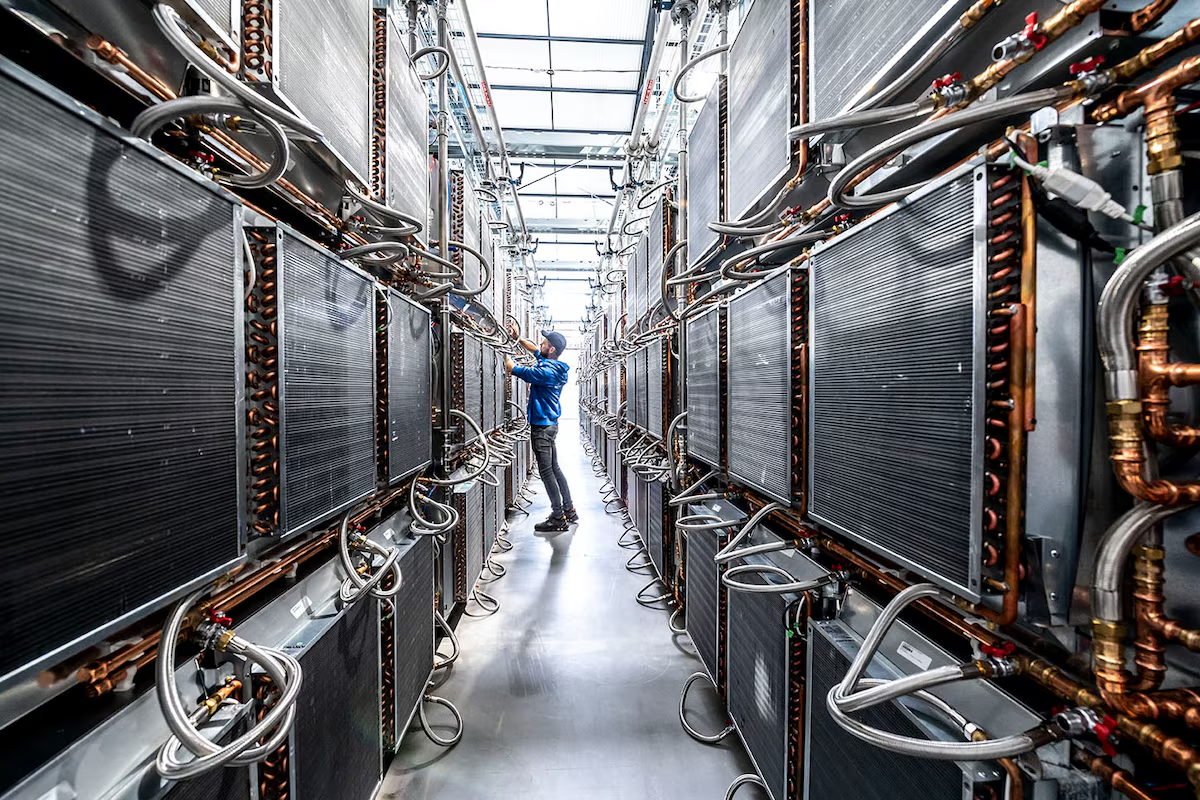

Open this photo in gallery:
OVHcloud’s data centre in Cambridge, Ont., pictured in 2022.Xavier POPY/Supplied
The rapid growth of artificial intelligence has driven a demand for data centres across Canada – a push backed by Ottawa that has sparked significant grassroots opposition because of the vast resources required to operate them.
In June, the federal government unveiled a plan for $2.3-billion in spending on AI initiatives, including $700-million to subsidize the building of large-scale data centres.
The push for infrastructure has been met with debate in some municipalities. In Hamilton this week, city councillors voted down on a proposed one-year moratorium on new large-scale data centres after months of debate and resistance from some residents. Ultimately, city council decided a pause could hold the city back from investments and hinder local research.
Across Canada, the fight against artificial intelligence goes offline
The moratorium would’ve made Hamilton the first Canadian city to temporarily halt such developments. Even though it didn’t pass, the vote highlights the collision of ambitious AI industrial policy with local environmental and energy concerns.
Here’s what you need to know about why there’s such an explosive growth in data centre projects, what advocates and opponents say about them and what the future of AI sovereignty in Canada could look like.
What is a data centre?
Open this photo in gallery:
The Equinix data centre in downtown Toronto, pictured in 2024.Fred Lum/The Globe and Mail
Data centres are facilities that house information technology equipment to store, manage and process data. Cloud storage, online banking, social media and other digital services rely on this infrastructure.
Data centre capabilities are usually measured in watts, which determine how much power a facility can use.
Opinion: AI data centres are becoming the wedge issue of our era
Artificial intelligence often requires the use of hyperscale data centres – larger facilities that can support up to 100 megawatts or more. In comparison, conventional data centres have about five to 10 megawatts of capacity.
What does Ottawa say about data centres?
Data centres are identified as a key element of Canada’s AI ecosystem in the federal government’s national artificial intelligence strategy. The strategy, spearheaded by Canada’s first AI Minister, Evan Solomon, argues that data centres are part of strengthening digital sovereignty, a goal the federal government has prioritized.
Open this photo in gallery:
AI Minister Evan Solomon announces plans for three large-scale AI data centre projects in B.C., in Vancouver in May.Rich Lam/The Canadian Press
Ottawa is concerned that reliance on foreign cloud and computing providers leaves critical infrastructure outside of Canadian jurisdiction. They warn that sensitive data may be left in the hands of “legal regimes beyond Canada’s control.”
To reduce dependence, the federal government wants to expand Canadian-controlled AI infrastructure. The strategy aims to attract private investment toward new computing infrastructure, and support “large-scale” AI data centres with at least 100 megawatts of capacity.
What are Canada’s current data capabilities?
Canada already has hundreds of data centres, with a document obtained by The Canadian Press estimating that the country’s AI data-centre capacity is about 337 megawatts. The document was prepared for Minister Solomon to use when pitching the country’s AI ecosystem to international investors.
Five of these data centres are considered hyperscale, located in British Columbia, Ontario, Quebec and New Brunswick.
In photos: This Canadian data centre helps keep the internet running. The tech world wants more like it, fast
What data centre projects are already under way?
According to data-tracker Aterio, there are currently eight AI-capable centres under construction, and 19 more have been announced. Most are in two provinces – Alberta and Ontario.
The national strategy states that potential partnerships could bring 850 megawatts of compute capacity to Canada by 2030, but does not identify the partners or projects involved. In the recent federal budget, the government committed to providing $925.6-million over five years to support the development of large-scale AI infrastructure.
Open this photo in gallery:
Meta says it plans to build a new AI data centre in Sturgeon County, Alta., shown in this rendered image.Sturgeon Data Centre/The Canadian Press
Earlier this month, Meta confirmed its plans to build a $13-billion-plus artificial intelligence data centre in Sturgeon County, Alta., on 1,750 acres of land. The project is estimated to consume three-quarters as much electricity as the city of Edmonton requires, and promises to create more than 3,000 jobs.
In March, Bell Canada parent company BCE Inc. and Saskatchewan’s government announced plans to build a $1.7-billion AI data centre. Last year, BCE said it intends to build six AI facilities in Canada.
What are the concerns?
Resource and environmental concerns have caused apprehensions about data-centre developments, largely because of the sheer amount of energy required to power them.
Local utilities are already sounding the alarm. Last month, Hydro Ottawa warned it was handling the “largest volume in our history” of requests from customers seeking large amounts of electricity, with data centres accounting for about 60 per cent of that demand. CEO Bryce Conrad said the utility was being asked to build, in the next two to three years, what took “the best of 110 years” to develop.
Open this photo in gallery:
People in opposition to AI data centres demonstrate outside the council chambers at city hall in Hamilton, on July 15.Nick Iwanyshyn/The Canadian Press
The process of cooling data centres has also sparked concerns. Depending on the system used, cooling can add to electricity demands or require significant amounts of water. These cooling systems also emit a humming sound, while turbines contribute to air pollution by burning natural gas. The federal government argues Canada has an advantage because its “northern climate” can reduce the cost and energy needed to cool facilities.
Opinion: AI data centres’ voracious thirst for water makes their environmental footprint even bigger
The size of some projects has also raised concerns about land use. In June, Manitoba Premier Wab kinew turned down a proposal for a data centre in Île-des Chênes, after hearing concerns from community members about potential pollution and threats to farmland preservation. The proposed data centre was to be built on 141 hectares of farmland south of Winnipeg.
What’s next?
On Tuesday, New York became the first state to impose a one-year moratorium on new data centres requiring 50 megawatts of power or more. In Canada, Mississauga, Ont., and Vancouver are expected to debate similar proposals this month.
The document prepared for Minister Solomon that estimated Canada’s existing AI data centre capacity also says Canada has 20,000 megawatts worth of projects that are “under planning or development.”
A statement from Mr. Solomon’s office said not all of the projects are expected to proceed, stating that they “remain subject to commercial decisions, financing, electricity availability, regulatory approvals, and engagement with provinces, municipalities, utilities, Indigenous communities and local communities.”
With reports from The Canadian Press