
Open this photo in gallery:
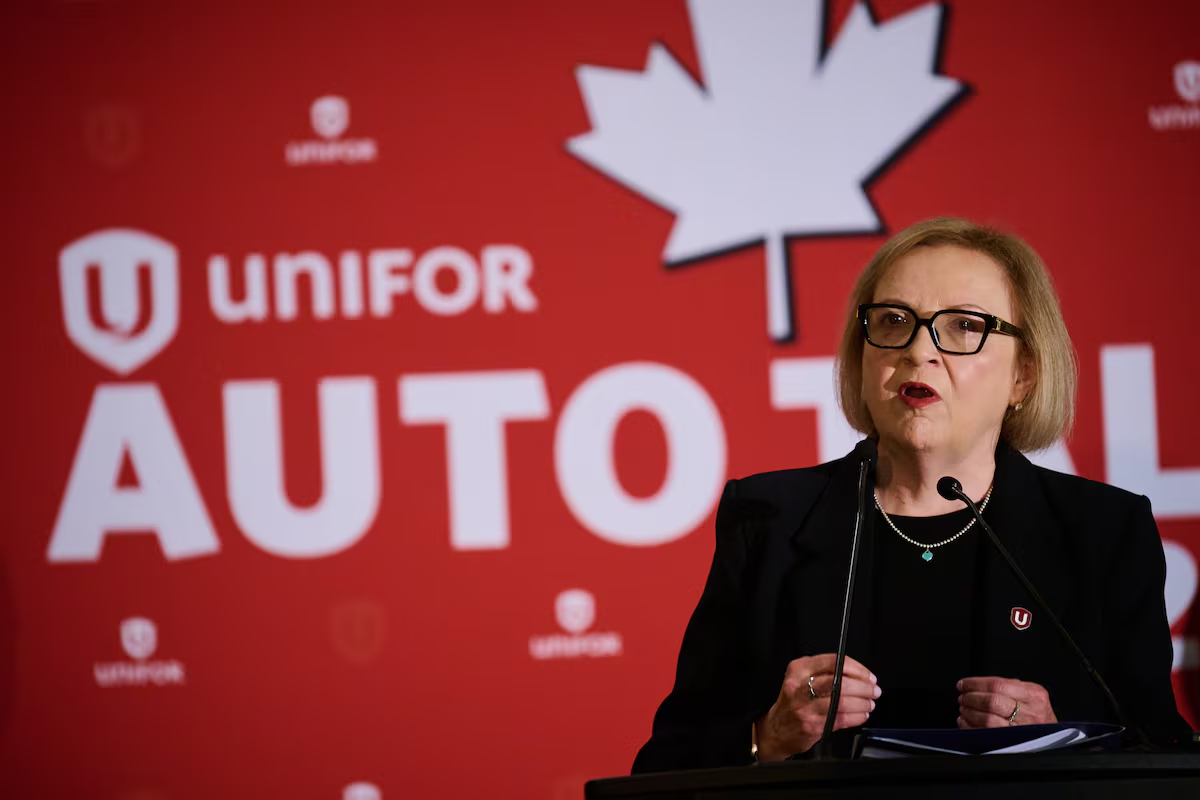
Unifor National President Lana Payne speaks to media after the opening of bargaining between Unifor and Ford Motor Co., in Toronto, on June 22. Ford workers will vote this weekend on an agreement that Unifor and the automaker reached on July 11.Sammy Kogan/The Canadian Press
More than 5,000 Ford Motor Co. workers are voting this weekend on a three-year tentative agreement that provides wage raises of three per cent in each year and improved benefits.
Unifor and the automaker reached the agreement on July 11 after three weeks of bargaining against a backdrop of tariffs and uncertainty over the future of the U.S.-Mexico-Canada free trade agreement.
The tentative agreement covers hourly workers at Ford’s Oakville assembly plant, engine factories in Windsor and Essex, and parts warehouses in Ontario and Alberta. It increases the base wage for production workers to about $50 an hour by year three of the deal. Workers in the skilled trades will make a base wage of almost $63, according to a report posted on Unifor’s website on Saturday.
The tentative agreement includes bonuses of $12,000 in year one, $10,000 for laid-off Oakville workers, and pension-plan improvements.
Ford’s Oakville heavy-duty pickup plant is returning to production this year, employing 2,100 after being closed since 2024 for retooling.
Results of the ratification vote are expected after balloting ends on Sunday. The union will then announce which automaker it will bargain with next, Stellantis N.V. or General Motors. The union employs pattern bargaining, and will work to reach the same agreement with the other carmakers.
Steven Tufts, a professor at Toronto’s York University, said the tentative Ford deal provides “pretty good gains,” including retiree benefits, wages and bonuses, considering the trade uncertainty.
Trade limbo is quietly taking a heavy economic toll
“I’m a little bit surprised they reached an agreement so quickly,” Prof. Tufts said. “I thought that Ford might try to roll back a few things in this round given the level of uncertainty.”
The question, he says, is can Unifor win these gains in talks with the other automakers?
U.S. President Donald Trump has applied 25 per cent tariffs on the non-U.S. content of Canadian-made cars, saddling automakers with billions in additional costs and jeopardizing production in Ontario.
Unifor has declared this a violation of USMCA, which allows cars and other goods to move tariff-free among the countries. However the future of USMCA is in doubt after the U.S. declined to renew it on July 1, citing dissatisfaction with the deal signed by Mr. Trump in his first term. The agreement will be reviewed annually, and the U.S. has begun bilateral talks with Mexico.
Other headwinds faced by the Canadian auto sector include the stalled electric-car industry and the arrival of Chinese EVs.
“To say Canada’s auto industry is in challenging times, is an understatement,” Unifor said in a statement to members in its report on the Ford tentative agreement. “Unwarranted U.S. trade aggression towards Canada is hindering investments in assembly plants. Tariffs have already resulted in job loss throughout the supply chain, on both sides of the border.”
The two small, sub-$35,000 EVs Chinese automaker Dongfeng hopes to sell in Canada next year
The union, which represents nearly 19,000 workers at the Detroit Three and 20,000 at parts makers, is recommending members approve the deal.
The previous contract with the automakers provided $10,000 signing bonuses and raises of 10 per cent in the first year, and 2 and 3 per cent in the following years.
Larry Savage, a labour studies professor at Brock University, predicted the new proposal’s approval rate at Ford will exceed the 54 per cent reached last time.
The stronger vote is because Unifor leadership is framing the deal as a stability amid industry upheaval, Prof. Savage said. “A crisis dynamic tends to produce much higher ratification votes because fear usually supersedes anger when workers fear their jobs are at risk.”
“The political and economic landscape has changed so dramatically over the past three years that autoworkers are now voting primarily to protect their jobs rather than to dramatically improve their contracts.”