
Open this photo in gallery:
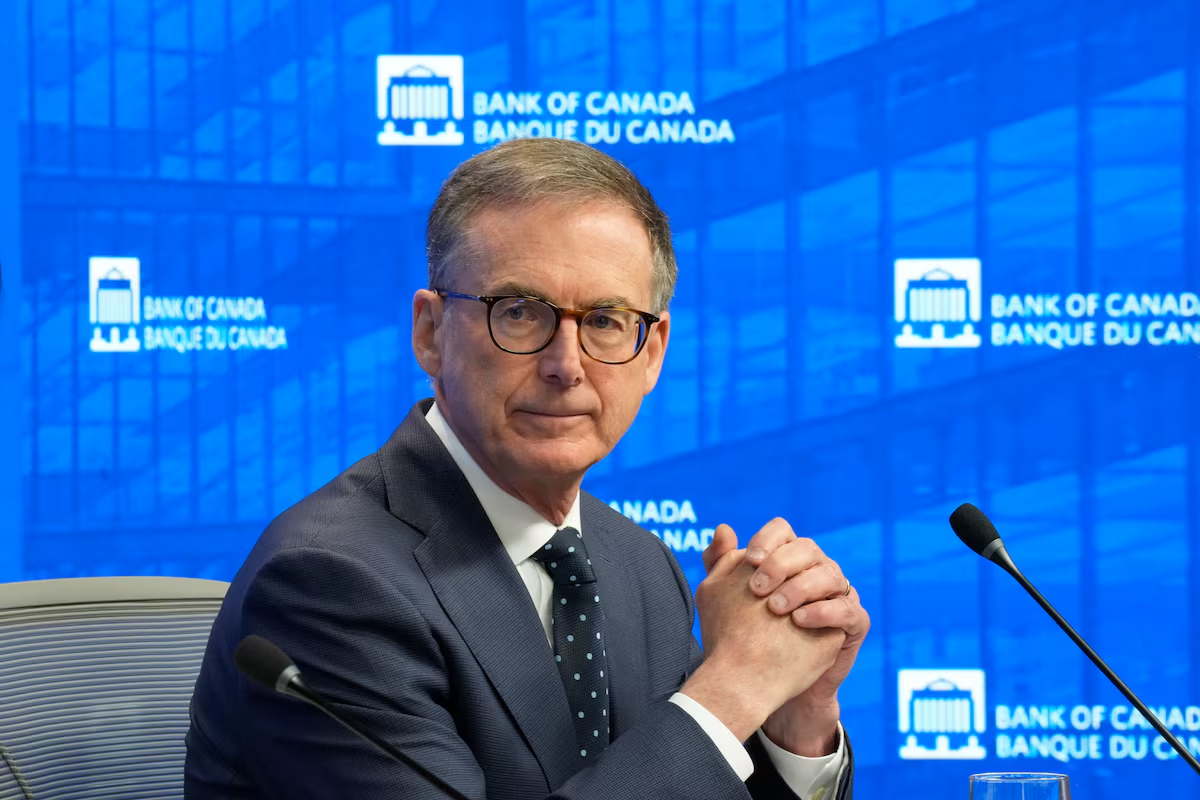
Bank of Canada Governor Tiff Macklem at a news conference in Ottawa, June 10. ‘It is a more fraught world. There is more volatility. There is more unpredictability,’ Mr. Macklem says.Adrian Wyld/The Canadian Press
When Tiff Macklem became head of the Bank of Canada in June of 2020 the country was in the depths of COVID-19 lockdowns.
The central bank had cut interest rates almost to zero and was buying billions of dollars of government bonds every week to try to ratchet borrowing costs even lower: unconventional monetary policy for an extraordinary time.
“Maybe I was a bit naive, but I saw the COVID shock as a once-in-a-hundred-year shock. While we all knew that it would have lasting consequences, I thought, ‘Okay, we’ll get through this big shock and we’ll go back to something that looks more normal,’” Mr. Macklem said in an interview with The Globe and Mail this week in Ottawa.
“But the world’s not looking like it looked before COVID. It is a more fraught world. There is more volatility. There is more unpredictability.”
Over the course of Mr. Macklem’s six years in the governor’s chair, the world has careened from one crisis to another: a pandemic, a major European war and the surge of inflation that followed; the return of Donald Trump and the breakdown of free trade; now a war in the Middle East that’s disrupted global energy flows.
Each crisis involved a supply shock: a disruption to the normal flow of goods that pushes up prices and slows economic growth, and which is particularly tough for central bankers to handle. They can raise interest rates to head off inflation, but at the cost of worsening the economic downturn. Or they can cut rates to support the economy at the risk of juicing inflation. They can’t do both.
With just under one year left in his seven-year term as governor, Mr. Macklem is hoping to leave the institution in a better position to navigate this shock-prone world.
The bank is rolling out a new economic forecasting model in the coming months, designed to help central bankers trace how a shock in one part of the economy ricochets through supply chains and affects prices in another. Part of the reason the bank misread the rise of inflation in 2021 and early 2022 was because its models weren’t attuned to supply-side disruptions caused by the start-and-stop of pandemic lockdowns.
Opinion: Does the Bank of Canada need to stimulate the economy?
Later this year, the bank and the federal government will conduct a five-year mandate review, which will focus on questions about how to conduct monetary policy and measure inflation in a more volatile environment, as well as how monetary policy impacts housing affordability.
Mr. Macklem is also using his pulpit to spell out risks to the global economy.
In a speech last month in Paris, he argued that massive investment flows into the United States, resulting from global macroeconomic imbalances and enthusiasm for artificial intelligence, are inflating a financial bubble. And developments in opaque corners of finance – including the dominant role highly leveraged hedge funds have taken in government bond markets – risk spreading mayhem if that bubble pops.
AI and semi-conductor stocks sold off sharply on Friday on reports that a new AI model from Chinese startup Moonshot had achieved similar results to cutting-edge U.S. models, once again sowing doubts about the massive data centre spending in the U.S.
“I do think there are some building financial stability risks globally. There is a tremendous amount of optimism in the market, and I worry that the market is not sufficiently focusing on some of these building risks,” Mr. Macklem told The Globe on Wednesday.
What’s doubly concerning, he said, is that international co-operation is becoming more difficult and the multilateral bodies meant to work together in the event of a crisis are breaking down.
“The G20 is much less effective than it was,” he said. “I was there when the G20 first started among central bank governors and finance ministers, and then at the leaders’ level. I think it did play an important role in the global response to the 08/09 financial crisis. I’m not as confident that it would today, if something similar happened.”
At International Monetary Fund meetings these days, there are often more “statements than discussions,” he added.
Thankfully, the global community of central bankers continues to work well together, he said.
Opinion: The Bank of Canada faces a growing credibility challenge
Mr. Trump’s decision to appoint experienced central banker Kevin Warsh as chair of the U.S. Federal Reserve – rather than some of the kookier options on his shortlist – was met with palpable relief in central banks around the world.
And Mr. Warsh struck a collegial tone at the annual jamboree of central bankers in Sintra, Portugal, earlier this month, where he shared the stage with Mr. Macklem, European Central Bank President Christine Lagarde and Bank of England Governor Andrew Bailey.
Still, Mr. Warsh appears set to usher in a new era at the world’s most important and influential central bank.
He’s already begun to change how the Fed communicates, declining to offer any guidance about where he thinks the U.S. economy and interest rates are going. And he has struck five task forces to re-examine central bank communications, its balance sheet, its inflation targeting framework, its use of data and broader economic issues such as artificial intelligence and productivity.
Open this photo in gallery:
For all the big-picture thinking, Mr. Macklem’s day job remains the same: Following the ups and downs of Canadian economic data, and deciding whether to adjust interest rates to keep annual inflation ticking along at 2 per cent.Ashley Fraser/The Globe and Mail
Mr. Macklem said he’ll be watching these efforts with interest, but doesn’t expect them to have a major impact on the Bank of Canada. For one thing, he has made the bank more, not less, communicative over his term as governor – adding press conferences and introducing a summary of rate decision discussions.
“With respect to the forward guidance question, central banks all need to find the right balance in their communication. I’m comfortable with our balance,” Mr. Macklem said.
The Fed and the Bank of Canada may also diverge in their interpretations of the inflationary impact of artificial intelligence.
The new Fed chair has leaned into the idea that AI will revolutionize productivity, allowing for rapid economic growth without inflationary pressures. This argument may be how Mr. Warsh, an erstwhile inflation hawk, convinced the rate-cut obsessed Mr. Trump to give him the top job at the Fed.
For Mr. Macklem, it’s largely a question of timing. In the near-term, surging demand for semiconductors, computers and electricity will push up consumer prices and add to inflation. In the longer term, the spread of AI could boost productivity and become disinflationary.
“I don’t think anybody really has a clear answer to at what point does it roll over from being more inflationary to more disinflationary. And I think that’s something we’re just going to have to do our best to judge in real time,” he said.
For all the big-picture thinking and confabs with economic leaders around the world, Mr. Macklem’s day job remains the same: Following the ups and downs of Canadian economic data, and deciding whether to adjust interest rates to keep annual inflation ticking along at 2 per cent.
On Wednesday, the Bank of Canada held its benchmark interest rate steady at 2.25 per cent for the sixth consecutive time. It also published a new forecast which sees economic growth recovering in the second quarter and through the back half of the year, while headline inflation is expected to decline to around 2.5 per cent by August from 3.2 per cent in May.
“If I tried to put it in a word or two, I’d say [I’m] cautiously optimistic – and both those words are important,” Mr. Macklem said of the outlook for the Canadian economy.
The surge in global oil prices earlier this year doesn’t seem to have morphed into broader inflationary pressures in Canada.
And after a year of essentially zero economic growth – owing to a combination of U.S. tariffs, weak business investment and an unprecedented population decline – the Canadian economy seems to be perking up. Companies are acclimatizing to trade uncertainty and moving ahead with investment. Exports are being supported by high oil prices, a weak loonie and data centre-related demand. Consumer and government spending remains strong.
Of course, things could go quickly sideways.
The resumption of fighting between the U.S. and Iran around the Strait of Hormuz over the past week has sent oil prices sharply higher. Brent crude hit US$88 on Friday – still well below the US$120 reached in April, but up around 20 per cent over the past two weeks.
If oil prices keep rising and remain high, rate hikes could be needed to control inflation, Mr. Macklem told reporters in a press conference after Wednesday’s rate announcement.
Likewise, the nascent recovery in exports and investment could be knocked off course by new U.S. tariffs.
On July 1, the Trump administration decided not to renew the United States-Mexico-Canada Agreement for another 16 years, moving it into a period of annual reviews until 2036. That gives Mr. Trump an extended runway to threaten and cajole his neighbours.
Mr. Macklem sounded almost bemused by the situation. “I mean, it kind of feels like it was under weekly reviews, anyway. So, is that really much different?”
There’s still a long road ahead for the Canadian economy as it adjusts to U.S. protectionism, geopolitical rivalry between America and China, rewiring global trade and energy networks and the rise of artificial intelligence.
“What we’ve seen more so far is mostly companies are adapting. They’re adapting to a world of more uncertainty. They’re adapting to more friction at the border,” Mr. Macklem said.
But actually restructuring the Canadian economy will take some time, he said. That will involve governments building new transportation infrastructure, companies rethinking their product mix and both working together to open new markets. “Those are multiyear investments, multiyear projects.”
For the next 11 months, Mr. Macklem has the best seat in the house to watch this play out, offering prompts and nudges, while focusing on his mandate of price stability.
As for his successor: Is there a shortlist?
“No, there’s been no process,” he said. “I’ve still got a full year. I think it’s a bit early for that.”