
Listen to this article
Estimated 5 minutes
The audio version of this article is generated by AI-based technology. Mispronunciations can occur. We are working with our partners to continually review and improve the results.
Ontario Premier Doug Ford defended his government’s budget for wildfire response Thursday as the province asked the federal government to be ready to help evacuate northern communities where nearby fires are burning out of control.
Ford, speaking at an unrelated news conference in Windsor, Ont., said over 150 fire crews are responding to more than 180 wildfires across northern Ontario, including crews from the Yukon and Alberta. He added the province will spare no expense in keeping people safe.
Ford also defended against criticisms his government hadn’t properly budgeted for this year’s fire season after fires tore through the province last summer.
“We’d never underfund our firefighters. Never, ever, ever,” he said.

Doug Ford asked about support for wildfire evacuees
Ontario Premier Doug Ford, speaking from an unrelated event in Windsor on Thursday, praised emergency services but noted more help is needed as people are forced from their homes in northern communities by wildfires. ‘We aren’t going to spare a penny,’ he said.
This year’s budget shows the province spent $271 million on emergency firefighting in 2025-26, but plans to spend $150 million in 2026-27. The province had initially planned last year to spend $135 million, but went well over budget due to a difficult fire season.
Ford said the province would spend more than the $150-million base funding if needed, but NDP MPP Lise Vaugeois, who represents Thunder Bay-Superior North, told reporters this year’s budget doesn’t properly respond to Ontario’s worsening fire seasons.
“If they started with a higher number, the service would be able to better prepare,” she said.
PM says Ottawa ready to help Ontario with evacuations
Ontario Emergency Preparedness Minister Jill Dunlop said in a letter to federal Emergency Management Minister Eleanor Olszewski that 15 communities in the north have already started evacuations or are considering them. The situation may continue to escalate rapidly, she said.
Dunlop said it is likely that simultaneous evacuations will need to be done by air, given several communities in the north are not accessible by road and Ontario may not have enough resources to meet theneed.
Ontario is asking the federal government to ensure aircraft and crews could be deployed in 24 hours or less in case the province needs assistance.
Olszewski said in a social media post that Ontario’s request was “precautionary in nature” and she is in close contact with Dunlop to ensure that federal resources are quickly mobilized if needed.
She noted that four federally funded wildfire-fighting helicopters have been sent to Ontario and that Indigenous Services Canada is helping affected First Nation communities.
WATCH | CN train passes through flames as wildfires sweep across north Ontario:
CN train crew surrounded by flames as wildfires sweep northern Ontario
A CN crew captured dramatic video of wildfire flames nearly engulfing their train in northern Ontario, where at least 150 wildfires have destroyed homes, forced evacuations and unleashed smoke thick enough to make Toronto’s air quality among the worst in the world.
Prime Minister Mark Carney, speaking in London, Ont., opened his remarks Thursday by acknowledging those whose lives are being upended by the fires. Carney thanked firefighters, first responders as well as local leaders for their efforts.
He vowed the federal government would “stand ready” to help in both Ontario and Manitoba, which has been dealing with flooding.
“Canadians always look after each other,” he said.
Carney said his government is in close communication with provinces and municipalities and will provide additional assistance as needed.
‘So many fires and so little resources’
The fires have prompted evacuation orders for several communities, including Armstrong, Lac La Croix First Nation, Whitesand First Nation, Gull Bay First Nation and Lac des Mille Lacs First Nation. Environment Canada said the community of Armstrong could expect widespread smoke with wind gusts of up to 40 km/h for most of Thursday.
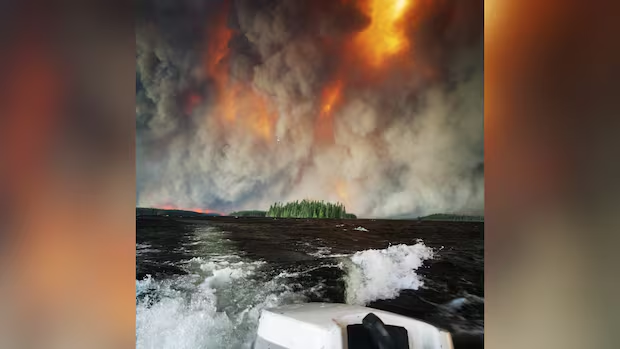
Winds out of the northwest could fan the flames of dozens of forest fires that have already devastated communities, including one fast-moving blaze that damaged and destroyed homes and buildings on Namaygoosisagagun First Nation, also known as Collins First Nation, north of Thunder Bay.
Evacuees from Whitesand First Nation told reporters in Thunder Bay on Thursday that their evacuation felt rushed and the province should have requested federal help sooner.
“While firefighters and emergency personnel have worked tirelessly on the ground, the response from the Ontario Ministry of Natural Resources did not reflect the urgency of the situation facing Whitesand First Nation and surrounding areas,” said Devon Wanakamik, the incident commander for the evacuation.
“With so many fires and so little resources, the Ministry of Natural Resources didn’t see the fire that raged through Collins until it was too late,” he said of the neighbouring community, where residents fled in boats as the fire approached.
The ministry did not address that criticism directly, but told CBC News it continues to assess active fires and its priorities based on conditions, anticipated fire growth, new fire starts and public safety considerations.
“The safety of the public and firefighting personnel remains the top priority, and we will continue to provide the resources necessary to respond to active wildland fires and protect communities and critical infrastructure,” it said in a statement.
WATCH | Collins residents describe wildfire evacuation by boat:
Teens describe fleeing wildfires by boat
Four teens narrowly escaped the raging wildfires burning in Namaygoosisagagun First Nation, also known as Collins First Nation, west of Armstrong, Ont. They describe escaping the fires – which burned their entire community to the ground – by boat.
Meanwhile, residents of Hutchison, Ramsay Wright, Trottier and Weaver townships are under an evacuation alert as officials warn people in those areas to prepare to leave on short notice. The alert comes as wildfires west of Thunder Bay saw significant growth earlier this week.
Ontario forest fire officials say there are 136 active fires in the northwest region, with 63 out of control. Another 44 fires are burning in the northeast, nine of which are out of control.
The province has said there have been 483 fires in Ontario so far this year, up from 351 as of this time last year and above the province’s 10-year average by mid-July of 320.