
Open this photo in gallery:
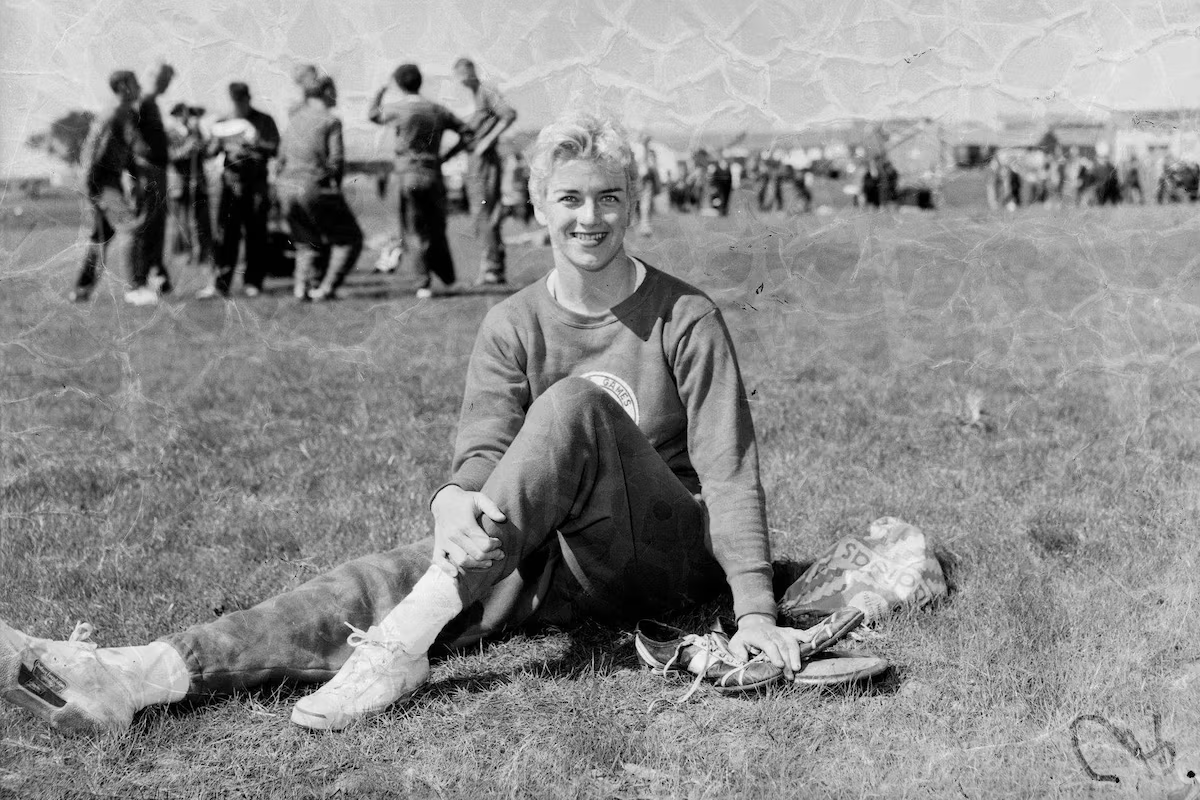
Canadian shot putter and discus thrower Jackie MacDonald sits on the grass in front of the Olympic village and training grounds in Heidelberg West, Melbourne in November, 1956.James Cooke/Supplied
A year after Jackie MacDonald first picked up the heavy ball used in shot put, she won a silver medal at the British Empire and Commonwealth Games.
The 21-year-old Grade 5 teacher from Toronto was a sensation at Empire Stadium in Vancouver, an unknown who suddenly stood among the world’s best at propelling a four-kilogram metal ball.
Ms. MacDonald, who has died at 93, won five national championships in shot put, as well as two more in discus, making her the dominant Canadian woman in those disciplines in the 1950s.
She might also have won a medal in discus in Vancouver, except Canadian officials barred her from the event in a panic over a photograph they feared violated her status as an amateur. By the time she was exonerated, the event was over.
Holocaust survivor Ted Bolgar devoted his life to education
The novelty of a Canadian woman succeeding in shot put garnered a lot of media attention, much of it reflecting anxieties held by male sports editors, writers and photographers about the nature of femininity.
She was inevitably described on the sports pages as “pert,” “comely,” “shapely,” “statuesque,” “Junoesque,” “a glamour girl,” “Canada’s blonde bombshell” and “the world’s most beautiful shot-putter.” She was heralded as a “glamazon,” unlike the dour “muscle molls” from Communist countries.
She was compared to Marilyn Monroe and Princess Grace. She was also photographed tackling domestic chores.
The athlete sought only recognition of her dedication to the sport.
“Strong women have great prestige in the Soviet Union, and they are admired by men and women alike,” Ms. MacDonald once said. “But here you are often looked on as some sort of circus freak.”
Jacqueline Donalda MacDonald was born in Toronto on Oct. 12, 1932, the only child of the former Margaret May Edwards and Donald Norman MacDonald, a travelling sales representative for a chemical company who became a pharmacist.
The girl learned to swim at age five before taking ballet and acrobatic lessons at 10. At age 15, she took up diving with the Dolphinets club, winning the Ontario junior diving championship a year later by beating the felicitously named Barbara Bath (later Laughland) and Irene MacDonald (no relation), both of Hamilton, the latter an orphan who eight years later would become the first Canadian to earn a diving medal at the Olympics.
Jackie MacDonald also excelled on the basketball court, once scoring a playoff record 38 points in leading her Toronto Globetrotters (unrelated to the famous barnstorming troupe) to a 64-34 victory over the Niagara Falls St. Pats. The Trotters then went on to win the junior ladies’ Dominion title by defeating Montreal Park Extension 36-25 and 38-22 in a two-game, total points showdown. At centre, Ms. MacDonald was top scorer in both games with 11 and 13 points.
Athletic options for her were limited in the 1950s, an era when women were forced into accepting traditional gender roles and amateurism made it difficult for all but the wealthy to dedicate themselves full-time to their sport.
“She had decided her 38-point record in basketball wasn’t going to take her further,” her husband Bill Gelling said recently in an interview.
One of her fellow teachers suggested she try athletics. She settled on the throwing events, knowing she needed to work on strength training for her upper body.
“Can you help get me started?” she asked Lloyd Percival, the famed coach and author of The Hockey Handbook.
A regimen of weightlifting was met with disbelief and cries of “Ladies don’t do that!” at Toronto gyms. She was not deterred. Ms. MacDonald made her own rules. She enjoyed poetry and Tchaikovsky, sewed her own clothes and rode a second-hand 1948 Harley-Davidson motorcycle, causing a sensation at a time when women riders were rare.
Asked once how fast she travelled, she replied: “It only goes 80 miles an hour.”
David Cayley, radio documentary maker for CBC’s Ideas, never stopped reading
An unknown in the track and field world, she soon broke the Canadian shot put record by more than two feet.
Shot put for women made its debut and was the first event to be concluded at the 1954 British Empire and Commonwealth Games. At Empire Stadium, New Zealand’s great Yvette Williams, an Olympic gold medalist in the long jump, threw 45 feet, 9½ inches, while Ms. MacDonald threw 42 feet, 7 inches to claim the silver, the first medal won by Canada at the Games. Under great pressure, she had missed matching her Canadian record by one-quarter inch.
Six days later, the two women were again to compete head-to-head in the debut of the discus, a showdown for which there was much anticipation. But on Ms. MacDonald’s arrival at the stadium, she was told by Canadian officials she had been withdrawn from competition.
In a whirl of publicity before and after the games, she had appeared in newspaper photographs several times, including posing with B.C. Lions quarterback Johnny Mazur as though learning to throw a football. Three days before the discus event, the Vancouver News-Herald published a photograph of her in her official games blazer, holding a bottle of Orange Crush while looking at one of her coach’s handbooks alongside a soft drink executive.
Canadian team officials, who had been squabbling with her coach, felt the image violated her status as an amateur and forced her to be a last-minute scratch.
A “cloud has been placed over my amateur standing and I want a hearing to present the facts of the case,” she said. Her father retained a lawyer.
She issued a statement explaining the circumstances: “While at a sports clinic … in Vancouver, a picture of me was taken which I understood was to be used for a news release. Later I gave permission for the use of this picture in the newspapers.
“I wish to state emphatically that I felt on giving such permission, and I feel equally sure now, that, not having accepted renumeration, nor endorsed the product in the picture, I have not at any time violated in any manner the amateur code.”
The Amateur Athletic Association of Canada cleared her in a meeting that night, just hours after Ms. Williams of New Zealand won the discus gold.
A year later, Ms. MacDonald had to pay her own way to the Pan American Games in Mexico City, where she finished fifth in the discus with a heave of 122 feet, 5¾ inches, more than three feet shorter than her best. After many weeks of training in the darkness of a Toronto winter, she fell in love with the city, learning the language and revisiting many times.
The 5-foot-11, 155-pound athlete, whose other bodily measurements were also regularly found on the sports pages, continued weight training in preparation for the 1956 Olympics to be held in Melbourne. The top Soviet, Czechoslovakian and Yugoslavian shot-putters weighed about a third more. In the end, she finished a credible tenth in shot put, though failed to reach the qualifying mark in discus.
A highlight was to have been selected to share a table with Prince Philip at a banquet for 500 to celebrate the opening of the games.
At the end of the year, she tied for third in Canadian woman athlete of the year honours, won by the golfer Marlene Streit.
Ms. MacDonald took a leave of absence from her teaching job for the remainder of the school year to travel across Europe. She attended an opera, her first, in Paris and reveled in the art, sculpture and architecture of Florence. She had a revelation about language while hitchhiking in Italy, as she began to understand Italian by breaking words down to their root. She would eventually earn a bachelor’s degree from Carleton University in Ottawa, followed by an education degree from the University of Ottawa, and a master’s in linguistics from the French-language University of Montreal at age 61.
While on her continental sojourn, she received an all expenses-paid invitation from the Soviets to compete at an athletic meet coinciding with the World Festival of Youth and Students, which attracted 30,000 young people to what at the time was a forbidden city to Westerners during the Cold War. She was the only Canadian to compete.
In 1958, Ms. MacDonald won a bronze medal in the shot put on the opening day of the Commonwealth Games in Cardiff, Wales, with a toss of 46 feet, 1/2 inch. She retired from competition later that year after once again finishing third in a two-day meet in London pitting Commonwealth athletes against the British. By then, she was competing under her married name.
Not surprisingly, the athlete’s love life garnered some attention over the years. It was reported she was engaged to a distance runner who was a law school student. Instead, she married Mr. Gelling, an aeronautical engineering student from Victoria who was a middle-distance runner on the University of Toronto’s track team. The university coach encouraged the runner to woo the slightly older Ms. MacDonald, though Mr. Gelling balked.
“I don’t think I’m in her league at all,” he thought at the time.
The coach then made the pair co-social directors of his track team. A friendship became a romance, and they were married in Toronto 68 years ago.
Her husband survives her, as does a son, Andy Gelling, both of Ottawa. She was predeceased by their first-born son, Steven Charles Gelling, who died at age 50 in Toronto in 2010.
The young family moved often. As an officer in the Royal Canadian Air Force (later the Canadian Armed Forces), Mr. Gelling was posted to Pennsylvania, Maryland, England, Ottawa, Winnipeg, back to Ottawa, Montreal, and yet again back to Ottawa, where the family settled for good.
She was a physical education consultant and a coach of the Ottawa Kingfish Swim Club. In 1973, she managed the Ontario swim team to the championship at the Canada Summer Games over host British Columbia in the pool in New Westminster.
Ms. MacDonald took up swimming, cycling, water polo and rowing after arthritis in her knee made running and other impact activities painful.
More than a year ago, Ms. MacDonald was diagnosed with cancer of the red blood cells, which meant she underwent a complete blood transfusion every few weeks. She died in Ottawa on June 25 after seeking medical assistance in dying.
You can find more obituaries from The Globe and Mail here.
To submit a memory about someone we have recently profiled on the Obituaries page, e-mail us at obit@globeandmail.com.