
Ontario and the Assembly of First Nations are appealing for more federal assistance to deal with the province’s deepening wildfire crisis, as fires that incinerated one community earlier this week prompted evacuations in several more settlements and spewed smoke across eastern parts of the continent.
Namaygoosisagagun First Nation, located about 210 kilometres north of Thunder Bay, burned to the ground on Monday, forcing residents to flee by small boats. The first photos of their devastated community emerged on Thursday showing little but empty roads and smouldering ruins.
“We lost everything,” said Chief Helen Paavola, who says her request for evacuation assistance to the provincial Ministry of Natural Resources went unheeded before flames overtook the settlement.
The ministry did not directly answer questions about its response to the community but said it “continues to assess active fires and adjust response priorities based on current conditions, anticipated fire growth, new fire starts, and public safety considerations.”
The acrid smoke and orange-yellow haze spreading across many cities in Ontario and in the eastern part of the United States has led to increasingly poor air quality, which is particularly harmful for children, seniors and those with respiratory conditions.
Opinion: Why did Collins First Nation members have to be ‘their own heroes’ amid wildfire?
On Thursday, evacuees from Namaygoosisagagun First Nation provided harrowing accounts of how they escaped the blaze with no fatalities.
Wayne Wastaken said that within about two hours of when he saw smoke, the wildfire had crept to the edge of the community. It was a scramble to get down to Collins Lake and load up 10- and 12-foot aluminum boats.
“We have a dump back there and you can hear the propane cans, empty barrels, whatever is flammable just blowing up,” he said.
Fires across northwestern Ontario force evacuations, trigger air quality warnings
By the time they were about halfway across the lake, Mr. Wastaken said they watched the wildfire consume the church and then his house.
“There was no help.”
Seventy-five-year-old elder Helen Paavola, the chief’s mother, who has lived in Namaygoosisagagun her entire life, said her future is now uncertain.
“It doesn’t seem too real because you know, I think I need to see it before I know that there’s nothing there, that I can’t go back,” she said.
At its national assembly in Ottawa, the Assembly of First Nations passed an emergency resolution calling on the Prime Minister to rebuild Namaygoosisagagun.
Open this photo in gallery:
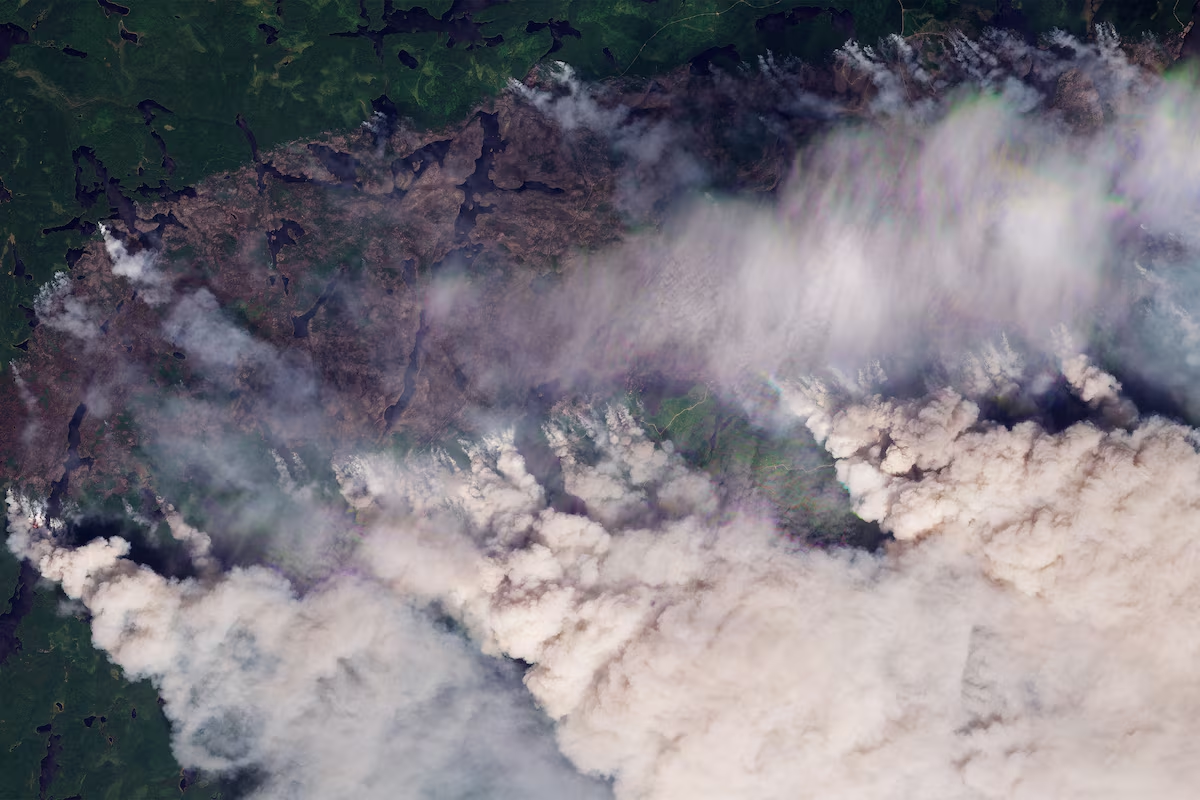
Satellite imagery from Tuesday shows the Fort Frances 14 wildfire, located roughly 130 kilometres northwest of Thunder Bay, Ont.Planet Labs PBC
Speaking at a defence-related announcement in London, Ont., Mark Carney acknowledged the dire wildfire situation and affirmed federal help.
“We’re in close communication with our provincial, municipal counterparts, and we will stand ready and will be providing additional assistance as needed because Canadians always look after each other,” the Prime Minister said.
As of Thursday afternoon, there were 125 fires blazing across Ontario’s northwest region, said Victoria Lee, an Information Officer with the province’s Forest Fire and Emergency Services, by e-mail. Of those, 58 remain categorized as out of control.
CN Railway evacuates workers, suspends operations in area hit by wildfire
Dry, windy conditions are expected to keep the fire hazard high or extreme throughout the region over the coming day and a half, she added.
Ontario Emergency Preparedness Minister Jill Dunlop laid out an increasingly complex scenario in a letter posted publicly Wednesday and sent to her federal counterpart: 15 northern communities being evacuated or considering evacuations, raising the possible need for simultaneous extractions.
She told Emergency Management Minister Eleanor Olszewski in the letter that the province may need to enlist the Canadian Armed Forces for help.
In one of the affected communities, Cat Lake First Nation, residents faced a challenging journey to safety after an evacuation order was issued on Wednesday, said Chief Russell Wesley.
The fly-in community is located about 400 kilometres northwest of Thunder Bay and has a population of about 680 people. On Wednesday, one plane carried 55 evacuees to Thunder Bay, who then caught a connection to Toronto.
Two planes were scheduled out of Cat Lake on Thursday, with a total of 77 evacuees. They will take a journey with stops in Thunder Bay, Barrie and then a final leg via bus to Toronto.
Opinion: As Canada burns, defence spending must go toward fighting wildfires
“Because of the sheer volume of evacuations happening in Ontario, the airplane supply is stretched to the max,” said Mr. Wesley, who called on Ontario to declare a state of emergency and for a more co-ordinated approach to crisis management.
Speaking at a hospital announcement in Windsor on Thursday, Premier Doug Ford thanked the emergency crews and first responders who are fighting the wildfires, including, he said, members of the Canadian Armed Forces who helped rescue YMCA campers who were stranded on a lake.
He also said there were no fatalities “which is pretty remarkable, considering the size of the fires.”
Mr. Ford also addressed criticisms that his government is not spending enough on wildland fire response, saying he would never underfund firefighters. He said in addition to base funding, his government has spent hundreds of millions more to protect communities. Mr. Ford said Ontario added 68 new permanent positions and increased compensation for front-line staff, including firefighters, pilots and engineers.
“Our government will continue to spare no expense to protect the people and the communities ahead of the fire season,” he said.
The Premier added that his government has spent $650-million on five new helicopters and five new water bombers. He said he’s requesting more support from Ottawa for additional water bombers and will bring up the topic at next week’s Council of the Federation meeting with other premiers in Prince Edward Island.
Smoke from the fires spread across much of the eastern half of the continent. A Philadelphia Major League Baseball game between the New York Mets and the Phillies was moved up an hour because of air-quality concerns and a Major League Soccer game in Chicago was postponed.
Officials in many U.S. cities across the Midwest and East urged residents to stay inside or wear masks outside as air quality reached unhealthy to hazardous levels, affecting millions of people. All of Michigan and much of Minnesota were under a hazardous air-quality alert.
In northwest Ontario, dotted with hunting and fishing lodges, Rylie Isaacs, an owner of Lac Des Mille Lodge, first evacuated her resort with her family on Monday night.
Speaking from Thunder Bay, 120 kilometres southeast of her lodge, Ms. Isaacs said Ontario’s Ministry of Natural Resources should have issued an evacuation order for the area sooner. Along with the frightening scene, her business needed the official order to be insured for lost wages and revenue.
Overnight on Monday, the fire shifted and raged in a different direction, leaving the property standing and the entry road safe enough to pass through by Tuesday, she said. However, small spot fires remained, burning two campers and two boats.
The nearby Open Bay Lodge burned down.
“The firemen and helicopter pilots are heroes. They’re brave, but we need more resources from the government to fight these fires because we felt abandoned,” Ms. Isaacs said. “… We were terrified.”
Carlo Meo, the owner of another lodge on Lac Des Mille Lacs, Pine Point Resort, evacuated along with his guests on Monday. Relocated to Thunder Bay, Mr. Meo said he knows there’s a possibility that any day, his resort could be gone.
“You’re just in limbo,” he said. “It’s kind of a numb feeling almost. You don’t think it’s real.”
With reports from the Associated Press
Editor’s note: This article has been updated to correct the distance of Cat Lake First Nation from Thunder Bay.