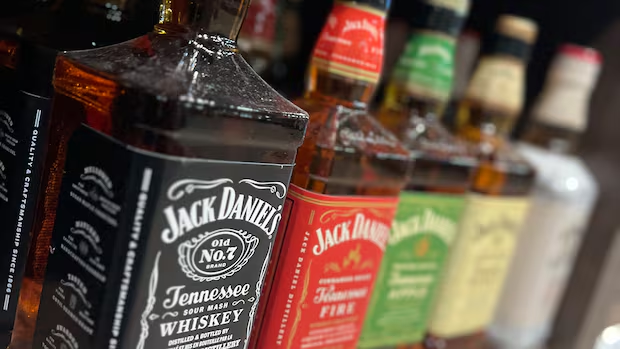
Sixteen months after Ontario pulled nearly $80 million worth of American alcohol from Liquor Control Board of Ontario (LCBO) shelves in response to U.S. tariffs on Canadian goods, the province still won’t say what it plans to do with it.
“The majority of the product, roughly 97 per cent, remains in good condition and [is] within its normal shelf life,” Sebastian Skamski, an LCBO spokesperson, wrote in an email to CBC News.
The LCBO said taxpayers have spent about $8 million storing the inventory, lower than an outside estimate previously reported by CBC News. The provincial liquor board also said roughly $2.6 million worth of stranded American alcohol has expired to date — about 3.3 per cent of the original stockpile.
Newly disclosed records obtained by CBC News provide the clearest picture yet of the size of the stockpile and the products identified as being at risk of expiry. They still don’t explain what the provincial government ultimately plans to do with $79 million worth of American alcohol that has been sitting in LCBO warehouses.
“LCBO will continue to store these products in accordance with our standards and monitor their expiration, working with the provincial government to review the best course of action,” Skamski wrote.
CBC News had previously requested records related to the province’s plans to dispose of the unshelved liquor, but those plans were redacted in a 50-page set of LCBO internal records provided earlier this year.
Following a nine-month freedom of information appeal, the LCBO removed some redactions but continued to withhold passages over specific plans it says contain “advice to government.”
 Staff at a Toronto LCBO outlet remove U.S. wine and spirits from shelves on March 4, 2025. (Evan Mitsui/CBC)
Some provinces return alcohol to shelves
Ontario’s approach now differs from almost every other province.
While Quebec, Manitoba, Nova Scotia, Prince Edward Island and Newfoundland and Labrador eventually returned at least some U.S. alcohol to store shelves — in several cases donating proceeds to charity — Ontario continues to warehouse the inventory while the government says it is still reviewing options.
Marvin Ryder, an associate professor of marketing at McMaster University’s DeGroote School of Business in Hamilton, said Ontario’s decision to abruptly remove U.S. alcohol from store shelves in March 2025 created an unprecedented logistical challenge for the LCBO — and 16 months later, that uncertainty hasn’t disappeared.
“The fog of war continues because I haven’t seen anyone talk about what’s going to happen with that inventory,” he said.
Ryder said the records suggest the LCBO was forced to answer questions it had never faced before after Premier Doug Ford ordered U.S. alcohol removed from shelves at more than 660 LCBO outlets across the province in response to tariffs levied by the Trump administration.
“The word comes down from on high: ‘Remove American product from the shelves.’ The first thought is: ‘OK, how the hell do we do that?'”
 Marvin Ryder, associate professor of marketing at McMaster University, says the LCBO faced an unprecedented logistical scramble when it was ordered to remove all U.S. alcohol from its shelves in March 2025. (CBC)
The newly disclosed portions of internal records reveal officials quickly began identifying which U.S. products were most at risk of expiring, estimating in June 2025 that about $2.9 million worth of inventory could spoil within six months. A month later, after a more detailed review, that estimate had fallen to about $2 million over the following nine months.
Newly uncovered portions of the records also show Ontario’s Ministry of Finance requested a more detailed breakdown of products nearing expiry as officials assessed the financial impact of the unprecedented move.
“Never have we tried this thing where we take a country of origin — remove all American product. And so I’m sure there was a lot scrambling at the LCBO to make that a reality,” Ryder said.
“I’m going to give them credit for being able to respond that quickly. It is a very large organization.”
Removing inventory ‘absolutely chaos’
The scale of that challenge is immense, said Stacy Kyle, executive director of the Import Vintners and Spirits Association, based in Vancouver.
Warehouses are designed around predictable inventory flows — especially when it comes to beverage alcohol, which is often purchased three to six months in advance, said Kyle, whose group represents importers and producers in British Columbia and Alberta.
 American wine is removed from B.C. liquor store shelves in Vancouver on March 10, 2025. (Ben Nelms/CBC)
Asked what the first few weeks would look like if a warehouse suddenly had to receive millions of dollars worth of returned inventory, Kyle replied, “Chaos,” adding that British Columbia’s experience illustrates the logistical challenges of suddenly removing large amounts of American alcohol from store shelves.
She said the B.C. Liquor Distribution Branch, the provincial liquor wholesaler and public retailer, grappled with wine inventories that weren’t neatly grouped by vintage. Combined with limited warehouse space, staff spent months sorting inventory after U.S. alcohol was removed from shelves.
“It was just absolutely chaos trying to figure out what was what,” Kyle said. “So much time and and energy and labour hours went in to figure that out. It took them months.”
B.C. pulled U.S. alcohol from government liquor stores but continued supplying private retailers from existing inventory. Ontario, by contrast, removed the products from LCBO stores and continues to warehouse most of the stranded inventory.
 Jennifer Kelly, a senior scientist in oenology at Brock University’s Cool Climate Oenology Viticulture Institute, says temperature is the ‘most important consideration’ when storing wine. (Brock University)
Whether 16 months in storage affects the quality of the stockpile, especially wine, depends less on the calendar than on how it has been stored, said Jennifer Kelly, a senior scientist in oenology at Brock University’s Cool Climate Oenology Viticulture Institute in St. Catharines, Ont.
“Temperature, I would say in this conversation, is going to be our most important consideration. If we can hold the wine between 15 to 20 C and keep it at that level, relatively like room temperature or a little bit cooler, that’s the optimal conditions.”
Kelly said if Ontario one day decided to return the products to store shelves, the inventory may first need to be reassessed.
“They’ll need to do some quality testing after they’re released,” she said. “Just to see if they’re able to go back on the shelves, if that’s what they choose to do with them.”