

Listen to this article
Estimated 4 minutes
The audio version of this article is generated by AI-based technology. Mispronunciations can occur. We are working with our partners to continually review and improve the results.
Saskatchewan could see more speeding, crashes and dangerous roads while the province works to secure a new contract with a speed camera vendor, experts say.
On June 25, SGI said speed cameras would be “temporarily inactive at points” after the vendor providing them made a “business decision” to prematurely end its contract with the province at the end of May.
WATCH | Cameras off along construction sites and school zones:
Photo speed enforcement ‘temporarily inactive’ in Sask. as company ends contract early
There were nine cameras located across the province along highways and construction sites and school zones. SGI has confirmed the cameras will be ‘temporarily inactive at points’ during the transition to a new vendor.
Redflex Traffic Systems Limited, which was operating as Verra Mobility Systems, provided nine cameras in Saskatchewan starting in 2020. They were deployed to catch speeding drivers on highways, in work areas and in school zones in Saskatoon, Regina and Moose Jaw.
SGI said police across the province continue to enforce speed limits, “as they always have.”
What happens on roads without speed cameras?
Saskatchewan can look east to see what happens when speed cameras are shut off.
In Ontario, the cameras have been off since Premier Doug Ford banned them in November, calling them a “cash grab.”
Since then, speeding has gone up and the number of fatal crashes has also increased, according to Matti Siemiatycki, a professor of geography and planning, and the director of the Infrastructure Institute at the University of Toronto.
“You can see it on the roads in Toronto and in Ontario, where I drive, that now that the cameras are gone, people are just taking liberties,” Siemiatycki told CBC Saskatchewan’s Blue Sky. “Police enforcement hasn’t kept up.”
A June 23 report by the City of Toronto found the average percentage of vehicles traveling 11 km/h or more over the speed limit rose to 8.1 per cent after the cameras were gone from two per cent.
WATCH | Ontario’s photo speed enforcement ban, months later: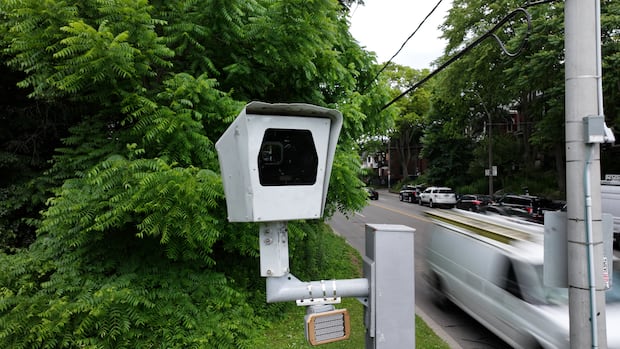
More Toronto drivers are speeding after camera removals, says city report
Toronto has seen a significant increase in the number of drivers speeding since the Ford government removed cameras late last year. CBC’s Naama Weingarten breaks down the numbers and the reaction.
Instead of speed cameras, Ford promised to invest in traffic-calming measures, including speed bumps, roundabouts and flashing signs.
The premier was “half right” in promoting those measures, Siemiatycki said, but while they are effective, they don’t work on larger roads.
Concerns about road safety in Sask.
A ticket and fine from a camera can teach people not to speed, Siemiatycki said.
A July 2025 study from Toronto’s SickKids hospital — frequently cited by proponents of cameras in Ontario’s debate — found cameras reduced the proportion of speeding vehicles in urban school zones by 45 per cent.
Siemiatycki said he’s worried about road safety issues in Saskatchewan now that cameras are temporarily off.
“We know that speed kills,” he said. “We know that it means that motorists have less time to slow down and that when you hit someone or you hit another vehicle at higher speeds, the risk of serious injury or fatality goes up.”
WATCH | With speed cameras down, will Sask. drivers go faster?:
Chief Robert Duttchen of the Corman Park Police Service said the loss of working speed cameras is “disappointing,” because they do change how people drive.
Police have the tools and know-how to stop speeding drivers, Duttchen told CBC Saskatchewan’s Blue Sky. But in rural municipalities, the vastness of the area officers have to cover can limit their effectiveness, he said.
“In the Rural Municipality of Corman Park, we have 2,000 kilometers of roads and we have 13 police officers,” he said. “I don’t get any more officers because cameras … are turned off.”