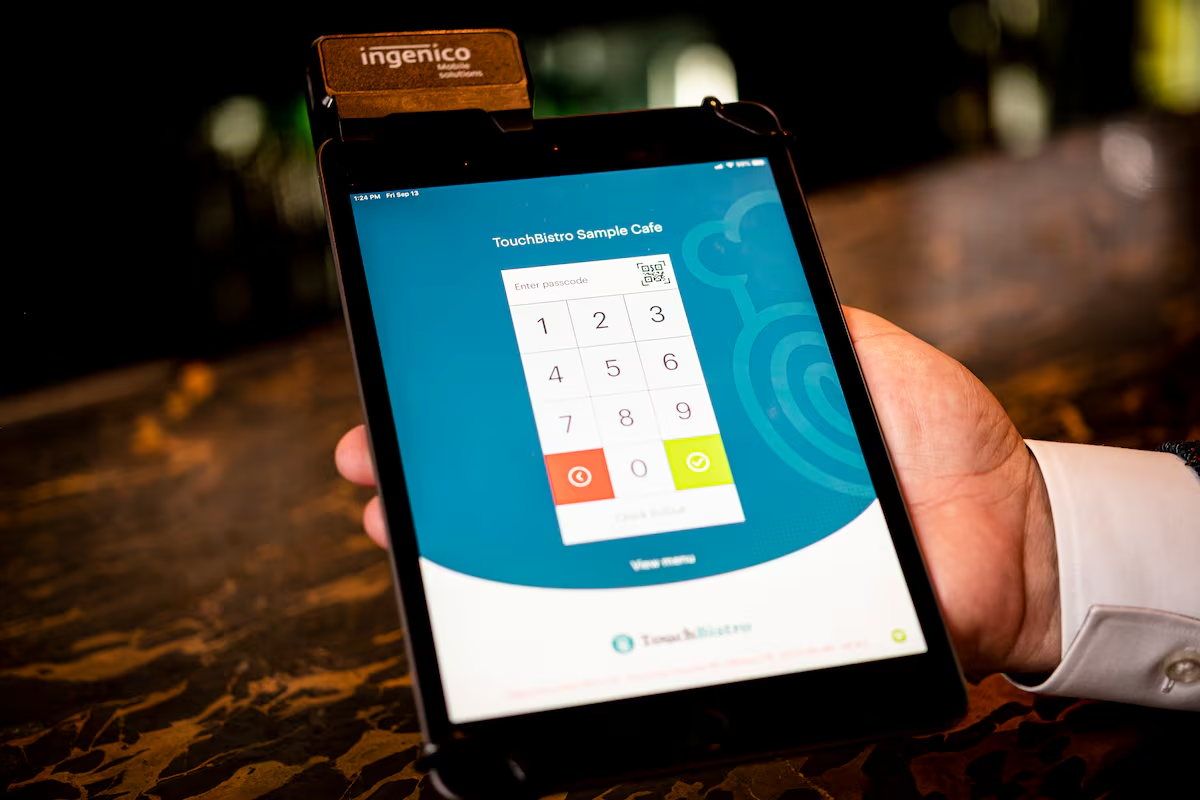

Restaurant point-of-sale software vendor TouchBistro Inc., a one-time Canadian tech darling, has been bought by Constellation Software Inc. subsidiary Harris Computer for $100-million, two sources say.
The deal, which was announced this week without mention of the value, represents a significant capital loss for several Canadian venture capital financiers that had backed Toronto-based TouchBistro, including Relay Ventures, Kensington Capital Partners, Business Development Bank of Canada, RBC Ventures and BMO Capital Partners, plus foreign investors including JP Morgan Chase & Co., Barclays Bank, Ten Coves Capital, and Recruit Holdings Co. Ltd.
Open this photo in gallery:
Christopher Katsarov/The Globe and Mail
But pension giant Ontario Municipal Employees’ Retirement Systems, which invested about $140-million in TouchBistro in the 2010s, sustained the biggest loss. It will get about $2-million from the sale. An OMERS spokeswoman declined comment. Employees got nothing for their common shares.
OMERS was a leading backer of Canadian tech startups as the sector rebounded in the 2010s, generating big returns from early bets on Shopify, Wattpad, Hopper, Xanadu Quantum Technologies Ltd. and others through its venture capital arm. More recently it has backed emerging domestic tech stars Cohere Inc. and Dominion Dynamics Inc.
OMERS’ venture capital arm invested about $40-million in TouchBistro, while its growth equity unit put $100-million into the company when it led a $158-million financing in 2019.
Details about the deal and events that preceded it were shared by three sources familiar with the matter. The Globe and Mail is not identifying the sources as they are not authorized to discuss the matter.
The deal follows a recapitalization in December that left U.S. lender Francisco Partners in control of TouchBistro. The financier had provided $150-million in convertible debt to TouchBistro in 2022, but continued losses put the company offside of its debt covenants, two sources said. In response, Francisco opted to convert its debt plus accrued interest into a new class of preferred shares.
OMERS streamlines leadership structure after investment chief departs
Francisco ended up with more than 90 per cent of that share class, while all past equity financiers saw their prior holdings replaced by the balance of the preferred stock. Several directors, including two OMERS appointees, left the board following the recap and were replaced by Francisco representatives.
The recap left TouchBistro valued at more than $200-million, a significant drop from its peak valuation of $650-million in 2019. Because of investor rights in the preferred shares Francisco and the other financiers got all of the proceeds in the sale. But with the takeover valued at less than half last December’s mark, even Francisco, which got most of proceeds, lost money.
With TouchBistro, Ottawa-based Harris is buying a company that sells digital tools for restaurants including a table-side ordering system and business management platform on Apple iPad tablets. Revenues are roughly $70-million a year.
TouchBistro was co-founded in 2010 by former CEO Alex Barrotti. It was one of Canada’s fastest growing tech startups that decade, raising about $270-million in venture capital in that period.
But despite securing a sizeable investor backing, U.S. rival Toast, Inc. raised much more and spent more aggressively to expand at a faster clip. Toast invested in its own customized handheld devices with integrated payments capabilities that ran on an Android operating system and were provided free to customers. Toast became the dominant player, went public and is now worth more than US$17-billion. Its success ultimately prompted Montreal-based Lightspeed Commerce, another rival, to retreat from serving U.S. restaurants.
Why Canadian startups struggle to pass the ‘valley of death’ – how Ottawa can help them cross it
TouchBistro also had other challenges. The COVID-19 pandemic hit its customer base in 2020. Interest rate hikes following an inflation spike led to a pullback in venture capital funding in 2022 that had fuelled unprofitable high growth companies like TouchBistro.
In April, 2021 the board replaced Mr. Barrotti with director Samir Zabaneh, who had previously worked as a chief financial officer for Q9 Networks, Moneris Solutions and Element Fleet Management. The board also rebuffed takeover enquires from Lightspeed and another company that valued TouchBistro at hundreds of millions of dollars.
Under Mr. Zabaneh’s leadership, which ended with the sale, the company cut spending and halved its workforce from a peak of about 600 people. Its previously buoyant revenue growth slowed to a crawl and venue count deteriorated, to 16,000 from a peak of 23,000.
Like other subscription software companies, TouchBistro was hit by a downdraft in valuations across the sector as investors worried generative AI tools would disrupt the market, threatening incumbent players. One of the reasons the board opted for a convertible debt financing in 2022 was that if it had instead raised equity it could have reduced TouchBistro’s valuation, another source said.
Mr. Zabaneh said in a LinkedIn post Friday that on his watch TouchBistro had “successfully navigated transformation” of its products, internal operating capabilities and sales and marketing efforts “all while securing significant improvements in unit economics and operating margins.” He joined payments giant Nuvei Corp. as chief operating officer this month.
He declined to comment when contacted by The Globe.
Mr. Barrotti told The Globe he was “saddened to hear the direction the company took after I left. Founding TouchBistro and taking a back-of-the-napkin idea and growing it to over 23,000 venues and hundreds of employees was the highlight of my career.”
Harris’ parent company, Toronto-based Constellation, has traditionally been a serial acquirer of smaller, slow-growing, founder-led software companies with high recurring revenues and solid cash flows. Two years ago it adopted an additional strategy, seeking to buy unprofitable venture-capital backed companies that had fallen short of their original lofty goals, burned through their investor capital and were struggling to grow.
The TouchBistro purchase is one of the biggest Constellation has made under the strategy, and at least its second in Canada, after Harris bought Winnipeg-based Librestream Technologies in 2025.
With files from James Bradshaw
Editor’s note: This article has been updated to correct the dollar value of the 2019 financing of TouchBistro by the growth equity unit of OMERS.