
Listen to this article
Estimated 3 minutes
The audio version of this article is generated by AI-based technology. Mispronunciations can occur. We are working with our partners to continually review and improve the results.
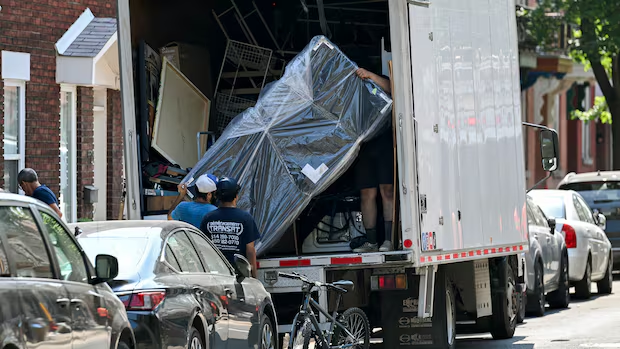
More than 2,000 Quebec households are still without a place to live following the province’s July 1 moving day.
Housing advocates say the increase compared to last year shows that building more apartments isn’t enough to solve the affordability crisis.
According to new data from the Société d’habitation du Québec, 2,039 renting households are currently receiving assistance from housing search services — up from 1,899 households at this time last year.
Of those, at least 476 are living in temporary accommodations, such as municipal shelters or couch-surfing with friends and family.
The tenants’ rights group FRAPRU says the rise in displaced families comes despite a rising provincial vacancy rate.
“If we want to have any chance of driving prices down and meeting the needs that the private market is failing to address, we cannot simply assume that building more will solve the problem,” FRAPRU spokesperson Véronique Laflamme, said in a statement Friday.
“We need to ensure that a good number of the units being built are actually cheaper than the median market rent, which has itself skyrocketed.”
The Montérégie region had the highest number of displaced renting households this year, at 411, followed by the Quebec City region with 299. There are 279 cases in Montreal.
Montreal Mayor Soraya Martinez Ferrada said Thursday that eviction rates in her city are climbing, with roughly 35 per cent of the households in city-funded hotels having been evicted for non-payment of rent.
“We can see that there is still a lot of work to do on the issue of tenants’ right to stay in their homes,” Martinez Ferrada said at a news conference.
WATCH | Why are there so many vacant apartments?:
Why are there so many vacant apartments in Montreal?
According to a recent Radio-Canada investigation, the island of Montreal has nearly 25,000 vacant dwellings ahead of moving day, but rents remain largely steady. What’s behind the disconnect?
With the provincial election only months away, FRAPRU said the next government needs to make affordable housing a priority.
The group said the ruling Coalition Avenir Québec (CAQ) has abandoned traditional social housing in favour of market-driven “affordable” models that are leaving low- and moderate-income families behind.
The office of Karine Boivin Roy, the CAQ’s housing minister, opposes this view, saying since 2018, the government has invested $11.6 billion in housing, including $4.3 billion for social and affordable housing.
“The results speak for themselves. 14,785 social and affordable homes have been completed, another 15,870 are under construction or in the pipeline, and nearly 9,000 affordable homes will be completed by 2026 — a record high,” spokesperson Arslan Tifouri said in a statement.
Tifouri says the government has also modernized the rent-setting regulations, strengthened protections against unfair evictions and given municipalities greater powers through Bills 31 and 39.
“Social and community housing is an integral part of our strategy, as evidenced by the historic levels of investment in this sector. However, the housing crisis requires a range of solutions,” the statement continues.