Open this photo in gallery:
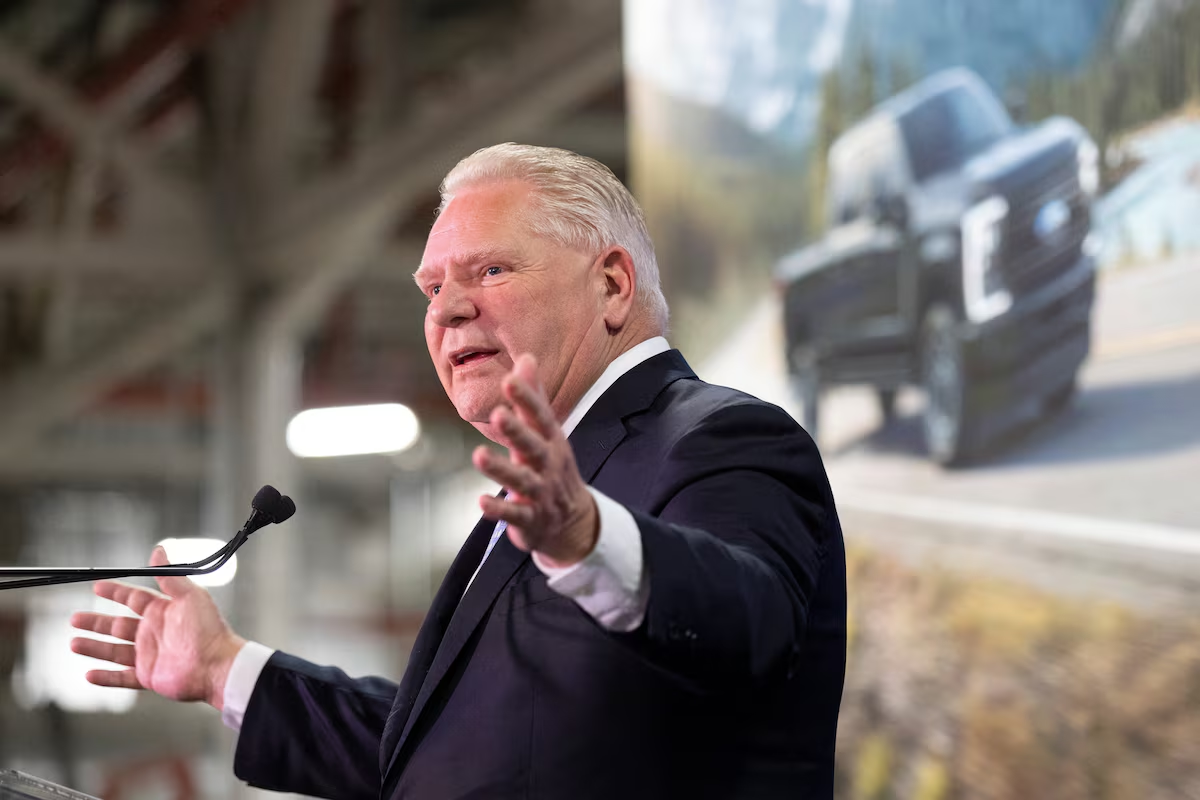
Ontario Premier Doug Ford and Unifor President Lana Payne say Canada’s environmental regulations, in addition to Trump’s tariffs, are hurting the domestic auto sector.Carlos Osorio/Reuters
Ontario Premier Doug Ford and Unifor national president Lana Payne are calling on the federal government to exempt Canadian automakers from tailpipe emissions rules and other greenhouse gas regulations, arguing they threaten the viability of operations in this country.
The unusual joint statement from the Progressive Conservative Premier and the union leader was issued as federal and provincial politicians are attempting to reverse the sale of the Stellantis assembly plant in Brampton, Ont., to armoured-car maker Roshel Inc.
Future of Stellantis Brampton plant remains in limbo as parties agree to more talks
In the statement, Mr. Ford and Ms. Payne say Canada’s environmental regulations are hurting the domestic auto sector, calling them an “own goal” that helps U.S. President Donald Trump achieve his aim of seeing every Canadian auto worker out of a job.
“In response to President Trump’s direct attacks on Canadian auto workers, the federal government must address the significant costs that its own greenhouse gas emission regulations impose on domestic auto manufacturers that, along with U.S. tariffs, threaten the jobs of Canadian auto workers and the viability of Canadian automaker operations,” the statement says.
“Together, we are calling on the federal government to exempt non-compliance penalties for passenger automobile greenhouse gas emission regulations for Canadian automakers.”
Polluters in Canada face a web of regulations and taxes aimed at reducing the emissions that cause climate change. The leaders are seeking breaks for automakers on the carbon tax and tailpipe emissions rules.
Canada’s tailpipe emissions system requires companies whose cars don’t meet federal emissions standards to buy credits from those whose automobiles do. It is designed to encourage the sale of low-emissions vehicles and to make it expensive to sell gas guzzlers.
Stellantis’s most popular vehicles in Canada include Ram trucks and Jeeps.
In the letter, Mr. Ford and Ms. Payne say the system rewards companies that do not manufacture in Canada.
The two leaders said the penalties will force companies that build in Canada to pay out billions in non-compliance costs, adding that an exemption for Canadian automakers must come with “a firm commitment that automotive production will be preserved in Canada, including a full reversal of the sale of the Stellantis Brampton Assembly Plant.”
Hannah Jensen, a spokeswoman for Mr. Ford, said the non-compliance regulations are costing Stellantis $300-million a year. Stellantis declined to comment.
On Wednesday, officials from Stellantis, the federal and Ontario governments and Unifor met in Toronto and agreed to continue discussions another day.
Stellantis sues Unifor, alleging obstruction of environmental work at Brampton plant
A spokesperson for federal Industry Minister Mélanie Joly did not immediately respond to a request for comment.
Brian Kingston, head of the Canadian Vehicle Manufacturers’ Association, which represents Stellantis, Ford and General Motors, said the tailpipe rules can be costly for car companies.
There are a variety of ways car companies can make their overall fleets more efficient, he explained, including using lighter materials, installing smaller engines or offering fewer trucks for sale.
“But at the end of the day, if you can’t meet it with your fleets, you have to purchase credits,” he said. “If you can’t purchase credits, you have to restrict sales. So it’s a quite impactful regulation that can have real cost consequences on manufacturers.”
The credit sales are private and prices are not disclosed. Tesla is the main seller in Canada, followed by Honda and Toyota, Mr. Kingston said.
Joanna Kyriazis, director of policy and strategy at Clean Energy Canada, a think tank at Simon Fraser University, said Canada is already offering many incentives to retain auto manufacturing, including billions of dollars in grants and subsidies, plus tariff remissions for manufacturing here.
“If the idea is that it costs too much to produce vehicles in Canada, then removing a policy that applies to the vehicles sold in Canada is not helping Stellantis’s Brampton plant that only sells 10 per cent of its vehicles here,” she said. “It’s actually disproportionately going to help Stellantis’s American plants that sell more of its vehicles into the Canadian market.”
Open this photo in gallery:
Mr. Ford and Vic Fedeli, Ontario Minister of Economic Development, Job Creation and Trade, participate in a news conference in Ottawa earlier this year.Justin Tang/The Canadian Press
Vic Fedeli, Ontario’s Minister of Economic Development, told reporters on Thursday that giving Stellantis a break on tailpipe emissions would help defray some of the expense of keeping the Brampton plant warm.
The emissions costs “don’t make us competitive with the United States,” Mr. Fedeli said. “They’re costs that Canadian companies, Canadian manufacturers bear that are not available in the States. We’re not aligned with the cost structure in the United States, and it makes it very difficult for companies to be here.”
Stellantis announced it had sold the plant, which employed about 3,000 people when it was idled in 2023, to Brampton-based Roshel earlier this month. Government and union officials are trying to reverse the transaction and save the auto workers’ jobs.
Ms. Joly has said Stellantis must repay the government “hundreds of millions” of dollars if it sells the plant, referring to aid the government has given the company since 2022 for work on car plants in Brampton and Windsor, Ont., plus the NextStar Energy EV battery plant in Windsor.
Opinion: On Stellantis, does the government even know what it’s doing?
The Globe and Mail has reported the exact amount the government wants Stellantis to return is $831-million. The automaker has offered to pay $24-million, the amount it said it received for work on the Brampton plant. Ms. Joly has said she is prepared to offer Stellantis an “aggressive package” to reverse the plant’s sale.
Speaking to reporters in Ottawa on Thursday, Conservative Leader Pierre Poilievre called the government’s tailpipe emissions rules a “backdoor” electric vehicle mandate. He said the regulations benefit American-made Teslas while putting Canadian vehicle manufacturing under water.