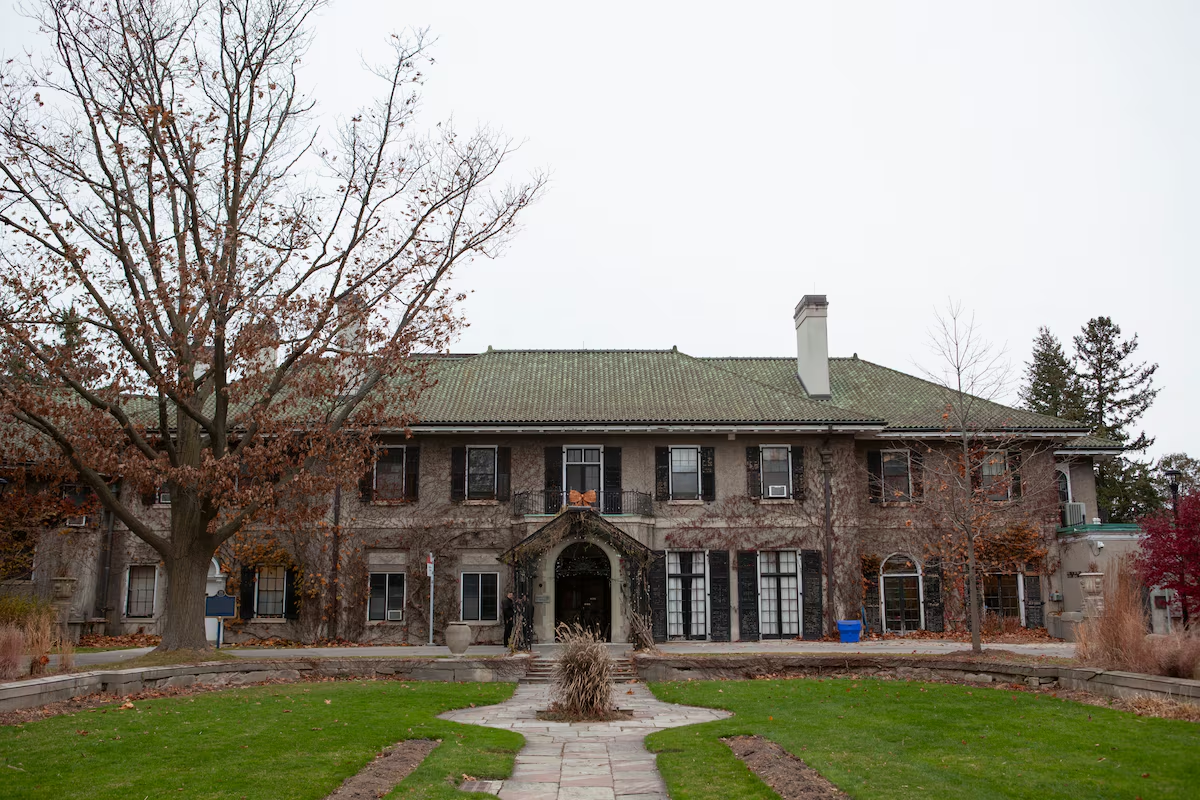

Open this photo in gallery:
The historic mansion is seen at York University’s Glendon Campus, home to the university’s bilingual liberal arts school.Azad Amin/The Globe and Mail
Glendon College, York University’s bilingual liberal arts school, will stay put at its long-time home in midtown Toronto after the college’s faculty council rejected a move to York’s huge main campus on the edge of the city.
The Glendon Faculty Council voted 61-8 against a York proposal that would have dissolved Glendon as a stand-alone faculty and would have relocated the university’s bilingual offerings to a dedicated building on the Keele Street campus.
“I think the vote could not be any clearer,” Marco Fiola, the principal of Glendon College, said after secret ballots were tallied on Friday afternoon. “We’ve learned a lot of things during this process. We’ve gathered such an amazing momentum for Glendon. We have to be able to seize that and to move forward in a positive way.”
Friday’s vote spelled the end of one specific idea for reviving York’s bilingual mission, but it’s unlikely to end debates over the future of the Glendon site, or the future of bilingual postsecondary education in Canada’s largest city.
Open this photo in gallery:
Bilingual signage is seen at York University’s Glendon Campus in Toronto.Azad Amin/The Globe and Mail
Glendon Campus, a leafy oasis in one of Toronto’s most exclusive neighbourhoods, was the founding site of York University. The land was originally bequeathed to the University of Toronto for educational purposes by a wealthy widow. In the late 1950s, U of T transferred the land to a fledgling York.
Glendon has for decades offered liberal arts courses in either French or English, all while enveloping students in a bilingual atmosphere. Professors, staff, clubs, campus signage and the student newspaper all cater to students in both official languages.
But Glendon’s enrolment has been dwindling. The number of students dropped to 1,419 in 2025-26, down nearly 50 per cent from a peak of 2,770 in 2016-17. Glendon’s accumulated deficit hit $52.4-million at the end of the past academic year.
York University’s Glendon College to vote on the future of its bilingual location
York as a whole is trying to claw its way out of a deficit, partly caused by the loss of revenue from international students after the federal government restricted student visas beginning in 2024.
The proposal that Glendon Faculty Council rejected on Friday was pitched as a way to revitalize York’s bilingual mandate. The plan, submitted by York’s interim provost Laina Bay-Cheng, argued that more students would be willing to take classes in French at the main campus, where 70 per cent of York’s francophone students are enrolled.
The Glendon Faculty Council – which includes all full-time faculty and a mix of students, staff and contract faculty – disagreed.
Everyone who spoke in person and online at the Friday meeting praised Glendon as a tight-knit community where bilingualism flourished. Speakers switched from French to English with ease. There was no simultaneous translation. Members who voted received an “I voted/J’ai voté” sticker to wear on their shirts.
Natasha Hameed, 20, a member of the faculty council’s student caucus, told the meeting that she wouldn’t have become a fluent French speaker without the chance to regularly converse in the language at Glendon.
She arrived at the campus having only taken core French classes at her high school in Scarborough. Now, she plans to be a French teacher.
“I really encourage everyone to please vote against this proposal for students like myself who would not know what they were doing with their lives if they hadn’t come to a place like this,” Ms. Hameed told the meeting.
Open this photo in gallery:
The Whole Person, a sculpture by Canadian artist Lionel Thomas, covers part of the exterior wall of Glendon Theatre.Azad Amin/The Globe and Mail
Members of the faculty council burst into applause when the results of the vote were announced.
Then, Samuel Nieva, president of the Glendon College Student Union, addressed the room.
“Now that we have showcased that we, as a collective group, do not support this current proposal,” he said, “I want us to ensure that we’re able to build that momentum, and we’re making sure that not only are we just surviving, but we’re here to thrive.”
Yanni Dagonas, deputy spokesman for York, said in a statement Friday that discussions about Glendon’s future had underscored the importance of expanding the university’s bilingual mandate.
“The York community’s focus must now turn to making the most of these opportunities, including finding ways to highlight Glendon and bolster its academic community so that people, programs and ideas thrive on the campus,” he said.
“This is a shared priority across York.”