
Open this photo in gallery:
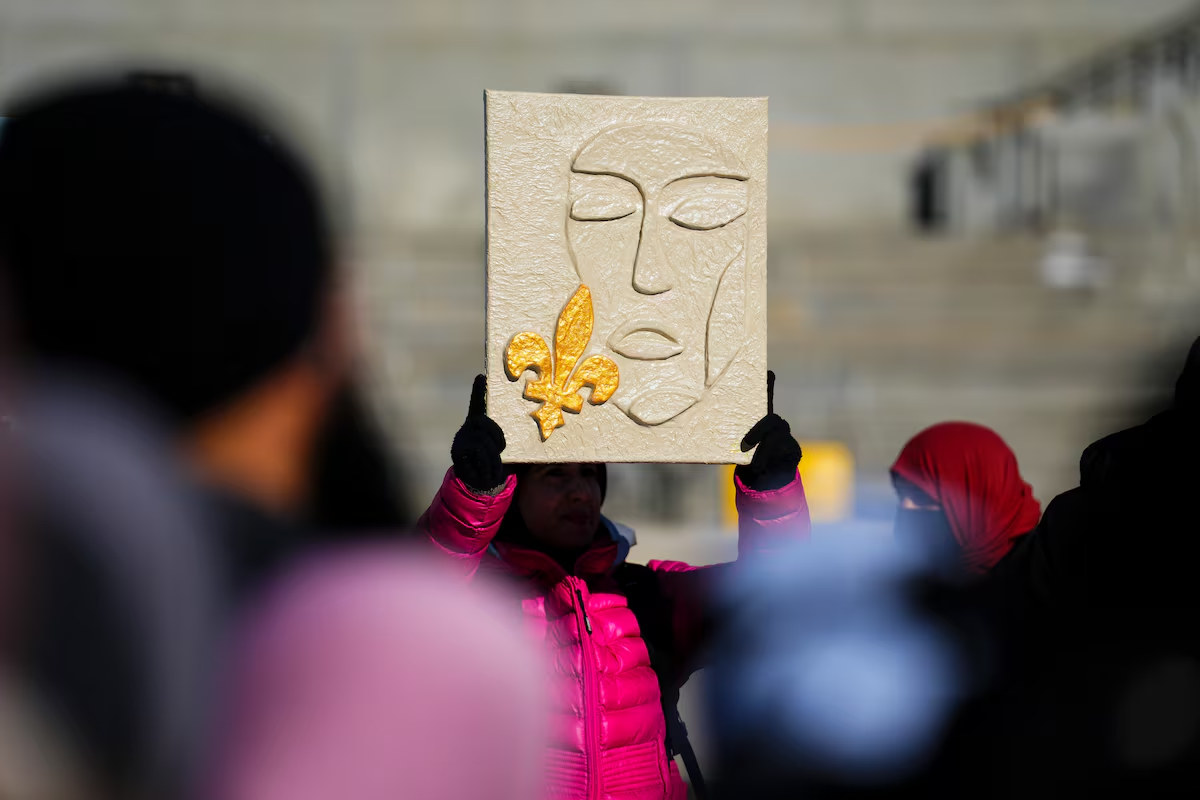
People gather outside the Supreme Court as it hears appeals on Quebec’s secularism law, also known as Bill 21, March 23.Sean Kilpatrick/The Canadian Press
Quebec has its eyes on the Supreme Court of Canada this week in anticipation of Friday’s ruling on Bill 21, the province’s law banning religious symbols for certain public servants.
The judgment, which could restrict the use of the Charter of Rights and Freedom’s notwithstanding clause and expose the legislation to being overturned in the courts, has the potential to upend the province’s politics and strain national unity.
If the Supreme Court produces a bombshell decision, the shrapnel will hit Quebec the hardest. The minority Parti Québécois government could use any reproach to fuel support for independence. That’s an outcome that the sovereigntist movement has been seeking since the law passed in 2019, with the notwithstanding clause as a shield.
“They’re hoping that this ruling will be controversial,” said former Liberal premier Jean Charest at an event in Toronto on Tuesday.
Such a decision would take place at a moment of constitutional turmoil in the province, after a court ruling on Monday required Quebec legislators to swear allegiance to the King, suspending a 2022 law replacing the age-old requirement with an oath to the Quebec people. The government is appealing and seeking a way to move ahead with next week’s scheduled sitting of the National Assembly, a first since the Oct. 5 election that brought the PQ to power.
Controversy about the Supreme Court’s ruling on Bill 21 risks further embroiling the province in constitutional arguments at a time when bread-and-butter issues are seen as a priority by most Quebeckers.
Premier Paul St-Pierre Plamondon was elected – albeit with only 28 per cent of the popular vote, a record low – promising to focus on pragmatic governance amid a cost-of-living surge and trade war before embarking on an independence referendum years down the road.
Instead, his first weeks in office have been consumed with federal-provincial disputes about largely symbolic matters, such as whether Quebec would be allowed to publicly address the Canada-EU summit in Montreal, and the appropriate site of a first meeting between Mr. St-Pierre Plamondon and Prime Minister Mark Carney.
Even so, the PQ government would likely welcome a decision limiting the use of the notwithstanding clause or even invalidating parts of Bill 21.
Influential separatist commentators such as Richard Martineau have been openly “praying” for the Supreme Court to rule Bill 21 unconstitutional this week. “It would clarify things,” he wrote in his popular Journal de Montréal column Wednesday.
Such a ruling would be deeply unpopular in Quebec, where the law has broad support and state secularism is a cherished value, likely converting many soft nationalists to the separatist cause, said Jean-Christophe Jasmin, Quebec director of the Christian think tank Cardus.
“A lot of nationalists have come to the conclusion that the best way to preserve the Quebec nation is within the Canadian constitutional order. It is a safe place for the Quebec nation to flourish,” said Mr. Jasmin. “A very restrictive decision would give ammunition to the separatist nationalists.”
Although many religious minorities would cheer the defeat of Bill 21, some devout Quebeckers dread the possible backlash such a result could produce.
Bill 21 brings Chief Justice Richard Wagner to the decision of a lifetime
Mr. Jasmin pointed to the legislation defunding religious schools in the wake of alleged Islamic influence at a Montreal public school, and restrictions on public prayer after concerns about the religiosity of some street protests against the war in Gaza.
Bill 21 was just the beginning of a suite of secularism legislation by the conservative, nationalist Coalition Avenir Québec, which was ousted in October’s election. In the spring, the CAQ extended the ban on religious symbols to public daycare workers, banned most prayer spaces in public institutions such as universities, and forbade those institutions from only offering halal or kosher food.
The government invoked the notwithstanding clause to shield that law, Bill 9, from judicial review as well, although it was sharply criticized by religious and civil-liberties groups.
The new PQ government is promising to go further still, barring elementary-school students from wearing religious symbols.
If such legislation is widely seen as infringing on religious freedom in the rest of Canada, it is a natural outgrowth of Quebec’s hostility to religious authority after centuries of vesting enormous power in the Catholic Church.
“It shows how deep the two solitudes still are today,” said Mr. Jasmin.
On Friday, the Supreme Court could bring those solitudes into renewed conflict.
With reports from Laura Stone
A timeline of challenges against Bill 21
2019, June 16: Quebec’s conservative Coalition Avenir Québec passes Bill 21, its secularism law that invokes the notwithstanding clause in the Charter of Rights and Freedoms to prevent courts from striking it down.
2019, June 17: The first of several legal challenges is filed, by teacher Ichrak Nourel Hak, the National Council of Canadian Muslims and the Canadian Civil Liberties Association.
Open this photo in gallery:
People rally against Bill 21 in Chelsea, Que., Dec. 14, 2021.Justin Tang/The Canadian Press
2021, April 20: Quebec Superior Court upholds most of Bill 21, because it was shielded from being struck down by the notwithstanding clause, but exempts English-language school boards. Justice Marc-André Blanchard, after a 33-day trial, offers an observation in his judgment that the choice of affected people between their beliefs and their livelihoods is “a cruel consequence that dehumanizes the people targeted.”
2024, Feb. 29: The Quebec Court of Appeal unanimously upholds Bill 21, after several appeals of the 2021 Quebec Superior Court judgment. The appeal court also overturns the English-language school boards exemption.
2024, May 7: The Coalition Avenir Québec government officially renews the notwithstanding clause in Bill 21, at the five-year mark as required by the Charter.
2025, Jan. 23: The Supreme Court of Canada agrees to hear six appeals of the 2024 Quebec appeal court ruling.
2025, Sept. 17: The federal government, an intervener at the Supreme Court, files its legal arguments and calls for new restrictions on governments’ use of the notwithstanding clause.
2025, Oct. 7: Five conservative premiers dispatch a letter to Prime Minister Mark Carney, asserting that Ottawa’s legal filing threatens national unity and demanding that it be withdrawn.
2026, Feb. 16: The Supreme Court, in an unexpected move a month before the Bill 21 hearing, asks the main parties to file written arguments on whether Bill 21 infringes on the Charter’s freedom of religion, a potential factor in the court’s deliberations.
2026, March 23-26: The Supreme Court holds four days of hearings on Bill 21, among the longest in the court’s history.
2026, Nov. 27: Decision day. The Supreme Court releases its ruling at 9:45 a.m. Ottawa time.
David Ebner