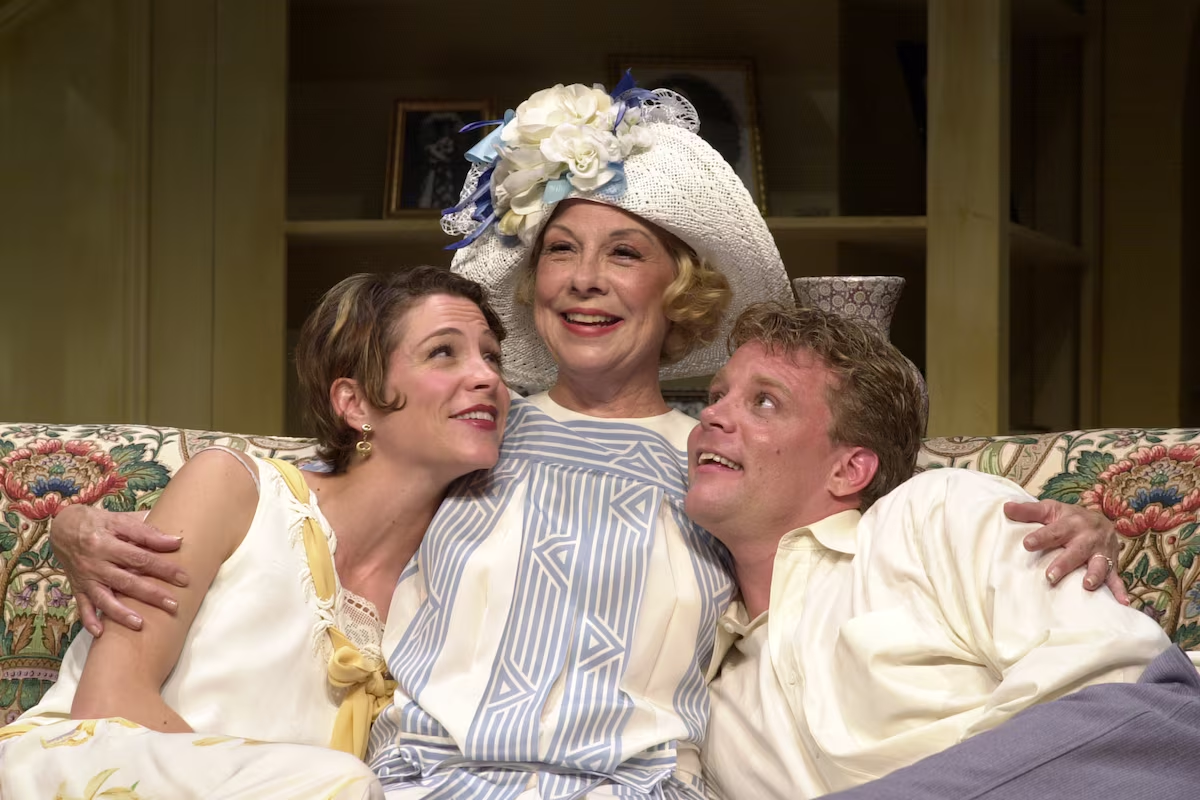

Open this photo in gallery:
Dawn Greenhalgh performs with her children, Samantha Follows and Laurence Follows, in a 2001 family production of Noël Coward’s Hay Fever.Gravenhurst Opera House/Supplied
Dawn Greenhalgh’s parents were British subjects living well in Shanghai in the 1930s. The father of the future actor was a civil engineer who helped maintain the cosmopolitan city’s waterworks. The family wasn’t wealthy but they belonged to clubs, and with membership (and British citizenship) came privileges.
When life handed them lemons, they made gin and tonics.
Things began to go sour when Japanese forces invaded China in 1937. The situation worsened after the invasion of Pearl Harbor four years later. Japanese authorities looted China and controlled Shanghai, going door to door to earmark expensive possessions to be confiscated in the name of Emperor Hirohito.
Open this photo in gallery:
Ms. Greenhalgh plays Natalia Petrovna in A Month in the Country in 1973.Ragsdale, Robert C./Stratford Festival
Young Ms. Greenhalgh was cheeky. When the Japanese made it to her house, the child defiantly played the patriotic anthem There’ll Always Be an England on the piano as they entered the home.
“Though worlds may change and go awry …”
Her world went drastically awry when the family was held in a Japanese internment camp in a former university dormitory outside Shanghai for three years. In 1944, the adult inmates mounted a play, The Challenge. The performance changed her life.
“Theatre became like a religion to me,” she told The Globe and Mail in 2002.
Ms. Greenhalgh, a powerhouse stage diva and brash matriarch of a Canadian theatrical dynasty, died in her long-time home in Toronto on Nov. 6, surrounded by her family. The lifelong smoker was 93.
From the archives: ‘Theatre became like a religion’
“She died of old age,” said Megan Follows, one of four actor-children born to Ms. Greenhalgh and the late thespian Ted Follows.
Ms. Greenhalgh was one of the few surviving performers from the Stratford Festival’s inaugural season, having joined the company in 1953 as a 19-year-old ingénue from the High School of Montreal. She played a Lady at the Court of France in All’s Well That Ends Well, a Tyrone Guthrie-directed production that featured Alec Guinness as the King of France.
Unsatisfied with small roles, she left after two seasons but would return for six others. In 1958, she married festival actor Mr. Follows in Stratford, Ont. He proposed to her over the phone while she was working in New York.
“We got a lot of publicity, Stratford marriage and all of that,” she said in Richard Ouzounian’s book Stratford Gold. “And I remember Jason Robards gave me for a wedding present his script of Long Day’s Journey into Night.”
Open this photo in gallery:
She works alongside Nicholas Pennell in The Imaginary Invalid in 1974.Robert C. Ragsdale/Stratford Festival
At Stratford, she played such characters as Charmian in Antony and Cleopatra in 1967, Natalia Petrovna in A Month in the Country in 1973, Béline in The Imaginary Invalid, the Princess of France in Love’s Labour’s Lost and Dionyza in Pericles, all in 1974; and Heloise in Heloise and Abelard in 1978.
“As an extraordinary artist she could be both charming and unsettling,” former Stratford Festival artistic director Antoni Cimolino said in a statement. “It was a pleasure to hear her perspective on plays and productions as it was informed by a lifetime of wide experience, a sparkling intellect and an independent, free-thinking mind.”
While the parents thrived on stage as acting partners in Stratford, Halifax (as founding members of Neptune Theatre) and elsewhere, their tumultuous marriage received less than stellar reviews. Their arguments earned them the nickname “The Fighting Follows.”
“On stage they got along like a house on fire,” their son Laurence Follows said. “But the minute they had to work in a matrimonial situation, that’s when it broke down.”
The marriage made in Stratford lasted until 1979 and produced the acting, writing and directing Follows children Samantha, Laurence, Edwina and Megan, the latter known for her titular role in the 1985 Canadian television miniseries Anne of Green Gables and its two sequels.
Ms. Greenhalgh was known to enjoy gin and vermouth with her olives. “I think drinking emboldened her when she was younger,” Laurence said. “She had to move into an adult world fast.”
Open this photo in gallery:
Ms. Greenhalgh stars as the Princess of France in Shakespeare’s Love’s Labour’s Lost.Robert C. Ragsdale/Stratford Festival
After the divorce, she was taken to an Alcoholics Anonymous meeting by a famous (and anonymous) fellow actor. Ms. Greenhalgh, who thrived portraying complex, powerful characters but always had the capacity to show vulnerability, never took another drink, according to Laurence.
“It saved her life,” Megan said. “We got a lot out of her sober.”
Early in her career she did live radio. Among her many small-screen credits were Canadian television series Slings & Arrows, Strange Paradise, the animated Babar (voicing Queen Celeste) and, with her daughter, Anne of Green Gables. She appeared in Sophia Coppola’s The Virgin Suicides and David Cronenberg’s 2014 satirical black comedy Maps to the Stars.
In the 2002 Globe profile, Ms. Greenhalgh was described as a husky-voiced entertainer who had a look in her eyes that suggested she “had seen more than her fair share of life.” What her eyes implied, her life drama confirmed. And although there isn’t a film based on her years in China, Steven Spielberg’s 1987 war drama Empire of the Sun wasn’t far off.
Hazel Dawn Greenhalgh was born in Shanghai on Sept. 25, 1933, the day an extermination campaign began against communists in China’s Jiangxi province. She and her brother were the offspring of British subjects who spent little time in England. Laurence Greenhalgh was born in India; homemaker Elizabeth Greenhalgh (née Birchby) was from Shanghai.
Open this photo in gallery:
Alongside her daughters Megan and Edwina Follows, Ms. Greenhalgh stars in a production of My Mother’s House, focused on the family’s lives.Fred Lum/The Globe and Mail
Their daughter seemingly inherited a wicked sense of humour from her father, who was tasked to cook meals for 1,500 inmates after Shanghai fell to the Japanese. He called the rotten protein he was given “Italian meat” because it shared the red, white and green colours of the Italian flag.
After the Second World War, the family moved to England but soon returned to Shanghai. The father worked for the Sassoons, the global merchants known as the Rothschilds of the East. Calamity struck again when Chinese communists took over Shanghai in 1949. The teenaged Ms. Greenhalgh was sent to Hong Kong somewhere around that time.
“I got out just before the city went up in flames, carrying 20 pounds of luggage, mostly Fats Waller records,” she told The Globe in 1970.
The plan was for her to move on to England. Not allowed to supply her with money, her parents instead outfitted her with a leopard-skin coat that she was to sell once she made it to the land of fish, chips and corner kicks.
Open this photo in gallery:
Ms. Greenhalgh “always performed like her life depended on it,” her daughter Megan says.Robert C. Ragsdale/Stratford Festival
She never sold the coat, never even made it to England. The teenager worked as a secretary for six months and hung out in Hong Kong with the mostly American aviators of the former Flying Tigers group who formed years earlier to oppose the Japanese invasion of China. Then the headstrong kid headed to Hollywood.
She made it there with the help of the famous Chinese-Canadian pilot Albert Mah. He was older by a decade; the two had a fiery but platonic relationship. After living in Los Angeles and San Francisco, she needed to leave the U.S. and formally re-enter because of immigration protocol. The idea was to do so from Montreal, but she instantly took a liking to the city and stayed instead.
High School of Montreal principal Grace Gardner arranged for the fascinating Ms. Greenhalgh to be sponsored by Imperial Order Daughters of the Empire so she could complete her schooling. There she founded and edited the school newspaper, The Medium. The school had a theatrical tradition – the great actors Christopher Plummer and Norma Shearer attended the place.
Ted Follows: Canadian actor’s career spanned more than 70 years
She played Gertrude opposite Richard Easton’s Hamlet at the school and was recommended to Tyrone Guthrie, the theatre legend (and second-cousin of film star Tyrone Power) brought in from England to be the Stratford Festival’s founding artistic director.
According to Ms. Greenhalgh, Mr. Guthrie hired her on the strength of her pipes alone.
“He said, ‘Right, you’ve got a great voice.’”
In the 1950s, she toured with the Canadian Players, formed by Stratford’s Tom Patterson and Douglas Campbell to produce plays across the country in the festival’s off-season. Her future husband, Mr. Follows, was in that troupe. Ms. Greenhalgh said he was the one actor she always felt totally safe with on stage. “Even if the scenery fell down, I knew it would be okay. He was always so well prepared that he could rescue any mishaps.”
Open this photo in gallery:
She plays a Lady at the Court of France in All’s Well That Ends Well, a Tyrone Guthrie-directed production.Peter Smith/Stratford Festival
As part of a pioneering generation of actors in Canadian theatre and live television, the immigrant Ms. Greenhalgh was committed to the country. “It was important for her to be a part of that voice,” Megan said. “She absolutely loved Canada.”
Ms. Greenhalgh brought her parents to Toronto in the 1950s. They came with nothing. The mother found work as a seamstress at Simpsons department store; the father worked in a waterworks facility.
Ms. Greenhalgh kept the leopard-skin coat they had given her. “In her mind, it kept her parents wrapped around her when she wore it, I think,” Megan said. In the 1960s, Ms. Greenhalgh had it tailored to a more contemporary fashion.
Among the family collaborations was the Theatre Calgary production of Tennessee Williams’s The Glass Menagerie in 1989. Ms. Greenhalgh played the problematic mother, Amanda Wingfield; her real-life daughter Samantha played the daughter, Laura; Daniel MacIvor played the son, Tom.
At the time, Mr. MacIvor was a young playwright and serious actor who felt he was in a semi-playful contest with the veteran Ms. Greenhalgh for the play’s spotlight attention.
“I’m sitting on stage at the table trying to be Tom,” he told The Globe. “Dawn would walk up with her back to the audience and make a comment like, ‘Dead house.’ There was a competition happening and she was messing with me. She had a glint in her eye, but it was a little intimidating.”
Open this photo in gallery:
Ms. Greenhalgh died in her long-time home in Toronto on Nov. 6, surrounded by her family.DONALD WEBER/The Globe and Mail
A 2001 mounting of Noël Coward’s Hay Fever at the Gravenhurst Opera House in Ontario’s cottage country was produced by her son, directed by her ex-husband and featured the whole clan (including a couple of in-laws) on stage.
Another family reunion at the Gravenhurst Opera House, 2002’s The Originals, was about the Straw Hat Players, Canada’s first professional theatre company. Both Ms. Greenhalgh and Mr. Follows performed in that troupe. In The Originals, Megan’s 10-year-old daughter played her grandmother as a young girl.
From the archives: All in the Follows family
“Canada doesn’t have many theatrical dynasties, but the Follows family is certainly to Canadian theatre what the Redgraves are to the British stage,” The Globe’s Ray Conlogue wrote.
The nana to six grandchildren and two step-grandchildren did not remarry and never officially retired. Though she had issues with short-term memory, Ms. Greenhalgh had a recurring role in the 2022 Apple TV+ disaster medical series Five Days at Memorial and acted in the 2025 indie comedy-drama Stealing the Sky, directed by Megan.
She leaves her four children and extended family, along with a disintegrating leopard-skin jacket and a legacy as an intense presence and an indomitable, unshockable survivor.
“My mother always performed like her life depended on it, with an ability to transform into a greater self,” Megan said. “It was not something she could ever do halfway.”
You can find more obituaries from The Globe and Mail here.
To submit a memory about someone we have recently profiled on the Obituaries page, e-mail us at obit@globeandmail.com.