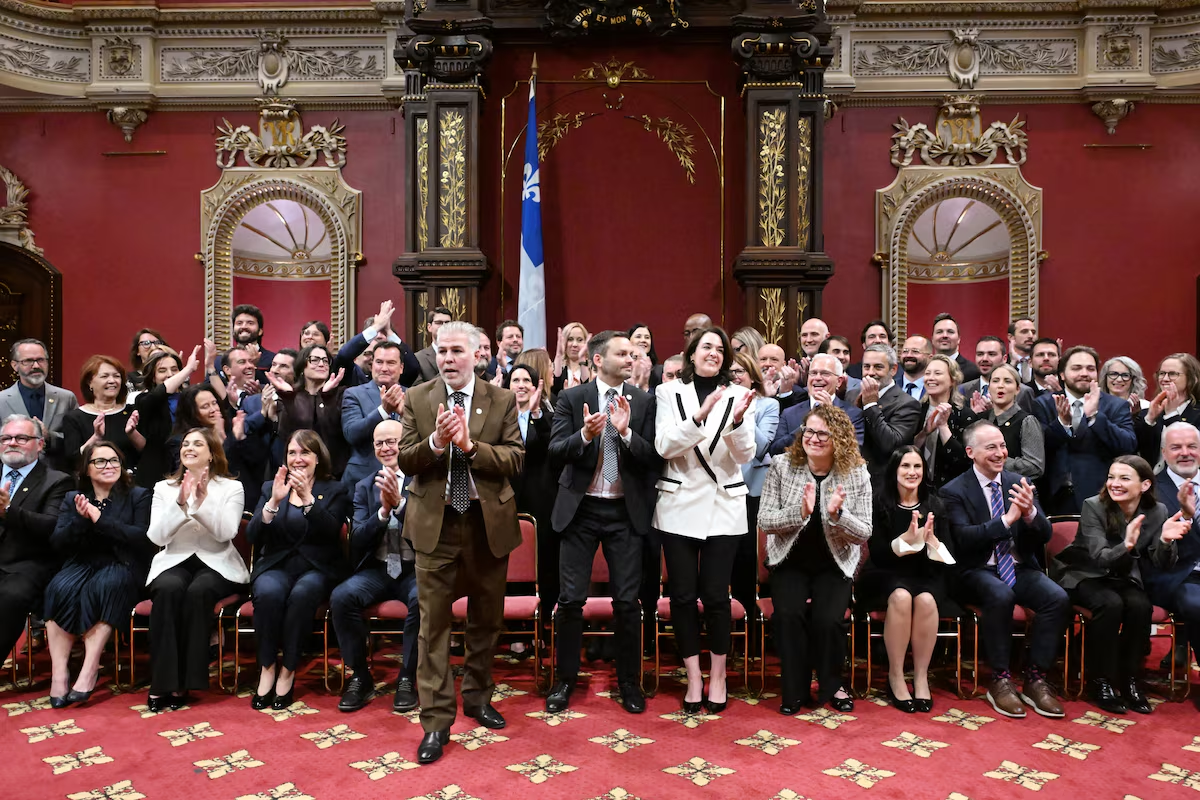

Open this photo in gallery:
Quebec Premier Paul St-Pierre Plamondon, centre, applauds with Parti Québécois members after a swearing-in ceremony last month where the legislators swore allegiance only to the people of Quebec.Jacques Boissinot/The Canadian Press
A Quebec court has ruled that members of the provincial legislature must take an oath of allegiance to King Charles III, raising the prospect of a standoff with a new Premier who says he will not swear fealty to Canada’s monarch.
The decision, released Monday, could delay the first sitting of the National Assembly since the Parti Québécois formed government in last month’s provincial election.
The session is scheduled to start Dec. 1, but none of the 127 members of the legislature have sworn allegiance to the Crown.
“I cannot take an oath to the King of England,” Premier Paul St-Pierre Plamondon told reporters during a press conference in Montreal on Monday, adding that many Quebec lawmakers think the ceremony is “a disgrace.”
“I will be considering all legal and political options to respect democracy,” he said.
In the 22-page decision, Quebec Superior Court Justice Ian Demers granted an emergency application to suspend a 2022 law that had abolished the requirement for MNAs to swear allegiance to the monarch.
After the Oct. 5 election, provincial legislators swore allegiance only to the people of Quebec. But the law’s suspension means they must take an oath to the King before they can sit in the National Assembly.
“Contrary to what it may seem, the oath does in fact play a vital role in our democracy,” Justice Demers wrote, adding that it “acknowledges the primacy of the Constitution, personified by the King.”
The judge ruled an injunction was necessary because if lawmakers did not take the oath of allegiance to the Crown, “all laws passed by the National Assembly would be unconstitutional and would have to be re-enacted.”
“The paralysis that would inevitably result is an irreparable harm to the public interest,” he wrote.
Justice Demers also warned elected officials against ignoring the decision and sitting without taking the oath. “The Constitution is not an à la carte menu from which a subject can choose to follow only what suits them,” he wrote.
Editorial; Memo to the PQ: The Constitution is not a menu
Mr. St-Pierre Plamondon said his government will appeal the ruling, and that the case will likely end up at the Supreme Court of Canada. He said he will ask the appeal court to allow legislators to sit without taking the oath while the appeal is in progress.
“I find it puzzling and problematic that there is an attempt to force elected officials to swear an oath of allegiance to the King of England through a judge who is exercising his judicial authority against 127 elected officials from all parties who agree that this must stop,” he said.
The 2022 law was passed unanimously after Mr. St-Pierre Plamondon and his caucus, then in opposition, refused to take the oath and were barred from entering the National Assembly.
In August, the Public Interest Litigation Institute, a legal association founded by Ottawa lawyer Lawrence David, launched a constitutional challenge of the law.
Mr. David argued Quebec has no authority to unilaterally amend the Constitution, and that bills adopted by lawmakers who have not sworn allegiance to the Crown will be legally invalid.
Andrew Coyne: Quebec’s oath of allegiance dodge could end in legal chaos
His case has yet to be heard on the merits. But after the October election, he filed for an emergency injunction to force MNAs to take the oath before the National Assembly reconvenes.
“The Superior Court has vindicated the Constitution and ensures that democracy in Quebec will unfold in compliance with all legal rules,” Mr. David said in an interview Monday. “No politician is above the law.”
But Patrick Taillon, a professor of constitutional law at Laval University, said he was surprised by the decision, which he believes will be vulnerable to appeal.
He pointed to a 1985 Supreme Court of Canada decision that invalidated nearly a century’s worth of laws in Manitoba because they were drafted only in English. The court declared the invalid laws would remain in force temporarily until the province could translate them into French.
Prof. Taillon said a similar solution would be found if a court invalidated Quebec laws passed by legislators who had not sworn allegiance to the King.
“It’s certain that in our case such an extension would be granted, so there is no irreparable harm,” he said.
Quebec removed the crown from its coat of arms, but that might not be a sign of sovereignty
MPs and senators are similarly required to take an oath of loyalty to the monarch before taking their seats in Parliament. Calls to abolish this requirement ramped up after Charles became King in 2022, upon the death of his mother, Queen Elizabeth II.
Mr. St-Pierre Plamondon has said he is committed to “abolishing the monarchy” in Quebec by eliminating the office of lieutenant-governor, the King’s official representative in the province. At his request, the province’s Lieutenant-Governor did not attend the government’s swearing-in last month.
But in his decision, Justice Demers cast doubt on Quebec’s ability to make unilateral changes to the Constitution.
“Nothing prevents Quebec, another province, or even the federal government from establishing a republican system. The Constitution does not prohibit it,” he wrote.
“But before implementing such changes, it requires a level of agreement that goes beyond consensus. It requires unanimity.”