
Good morning. We’re taking a step back from all the recent artificial-intelligence drama to take a closer look at the gargantuan task of adoption across workplaces – and the major choke points that are emerging. But first:
Up first
In the news
Telecom: Sources say the federal government is willing to consider takeovers that would leave the sector with three major companies, reversing decades of policies meant to promote four competitive players.
Investing: Two major Canadian pension funds stand to reap large gains on Anthropic investments as shares start trading with record US$2-trillion Nasdaq debut – even surpassing SpaceX.
Auto: Almost three years after Stellantis closed its Brampton plant for retooling, workers remain in limbo as the factory’s future is determined. Next week, transportation reporter Eric Atkins will answer reader questions on this story.
Open this photo in gallery:
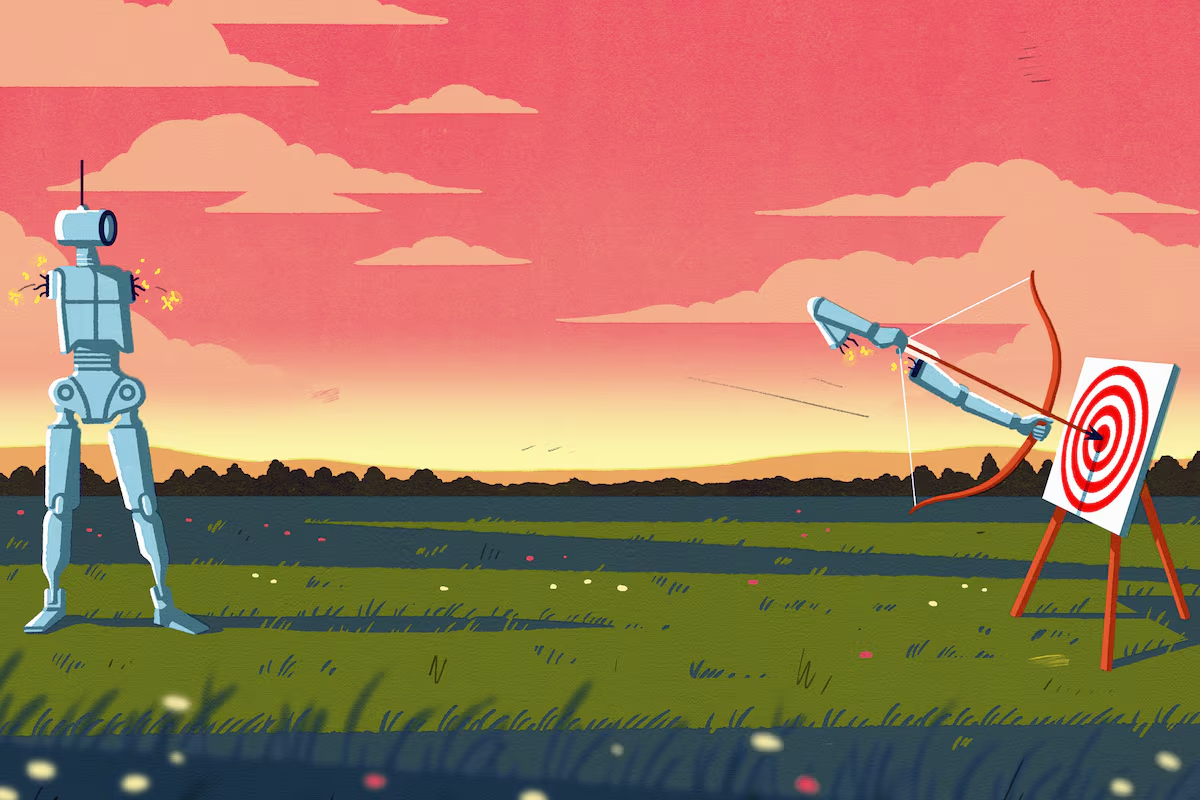
While the use of AI is accelerating, integrating the technology into workplaces is proving to be a challenge for employers.Illustration by Pete Ryan
In focus
Finding the AI choke points
Hi, I’m Vanmala and I’m The Globe’s Future of Work reporter. Lately, I’ve been really homing in on the intersection of AI and the workplace to try to grasp how employers are integrating AI into their workflows and how employees are adjusting to it.
That’s the subject of my recent feature piece: the challenges of AI adoption, and the stumbling blocks companies find themselves having to navigate.
For weeks, I had conversations with numerous employers, managers and workers about how the AI rollout has been going, and whether employers are starting to see productivity gains from adopting the technology. The answers to those questions varied greatly depending on whom I asked. Some small businesses were half-hearted on AI tools, citing accuracy as a problem. In order for them to make a significant investment in AI technology and revamp workflows, they had to first trust that the technology would result in productivity gains. That appeared to be a roadblock.
A manager at a small plastics manufacturer told me that the AI tool he used kept “spitting out wrong data,” and that, in theory, he would like to expand AI across his workplace but he was mentally not ready to because he did not trust the tool.
Bigger companies, like the big banks, have had a more seamless experience in adopting AI into their workflows. At Toronto-Dominion Bank, a custom-made chatbot called the TD Virtual Assistant is now used by 19,000 tellers at branches across the country to help them answer customer queries. TD’s chief AI scientist Maksims Volkovs said that tailor-made tools tend to have fewer accuracy problems because developers set parameters around what data the AI agent can rely on.
Open this photo in gallery:
Integrating AI into workplaces with different departments, personalities and hierarchies has not been smooth sailing.Illustration by Pete Ryan
At Bank of Montreal, employee AI usage of Microsoft Copilot has soared over the past year, from mere thousands of users two years ago to approximately 58,000 employees. “That’s roughly every single employee,” said Larissa Chaikowsky, the chief learning officer and head of talent at BMO Financial Group. When asked about whether accuracy is an issue, Chaikowsky said the company repeatedly reminds employees of a caveat when using genAI tools: Check to make sure it is right.
Apart from trust and accuracy, another major obstacle in scaling up AI adoption has been the lack of adequate training for workers.
A couple of white-collar bank employees who spoke with me anonymously said they lacked confidence in figuring out how to effectively adopt AI into their workflow and said that they would have liked to be trained more in the various tools available to them. By contrast, Chris Pinkerton, the managing director of Employment Hero, an HR payroll software company, told me that his employees went through six rounds of training on various AI tools and are often given time to experiment with using AI in the hope that they will develop prowess in the technology.
The stakes are high. The Carney government is betting on workplaces rapidly adopting AI to see tangible gains in the nation’s productivity, which has been lagging for decades. How Canadian companies navigate these choke points and help employees adapt to a world where they will be working alongside AI could be a key determinant of their future success. We’ll be documenting it.
Charted
Out of office
Grand Theft Auto VI has fans calling in sick and singing its praises. The game has already set records worldwide, with more than 17 million copies sold through preorders, and is widely expected to become the bestselling video game of all time.
Quoted
A strawberry, if it’s at its peak, cooked beautifully in the sun, and picked in a timely manner by individuals that love to grow these ingredients … that’s a two-Michelin-star dish with just a couple other things that go with it.
— Shane Harper
After a rare autoimmune disorder stole his sense of taste, star chef Shane Harper rethought his approach to food. That pivot led him to farm full-time at Pearl Morissette, widely considered Canada’s best restaurant.
Up next
More files we’re following
By the numbers: Today we’re keeping an eye on Canadian retail sales for September, which are expected to show a slight gain.
Networking: Canada says it intends to complete a trade agreement with Taiwan even as Ottawa rekindles relations with China after a deep freeze.
Collaboration: Dominion Dynamics is bringing together a consortium of a dozen companies across Canada to support the production of its uncrewed combat aircraft.
Morning update
Global stocks tumbled as Anthropic’s market debut failed to restore investor faith in the artificial intelligence sector.
Wall Street futures were mixed with the Dow pointing higher after major North American markets closed sharply lower yesterday. TSX futures were in negative territory.
Overseas, the pan-European STOXX 600 was down 1.13 per cent in morning trading. Britain’s FTSE 100 dropped 0.55 per cent, Germany’s DAX slid 1.58 per cent and France’s CAC 40 declined 1.13 per cent.
In Asia, Japan’s Nikkei closed 5.06 per cent lower, while Hong Kong’s Hang Seng fell 1.89 per cent.
The Canadian dollar traded at 69.83 U.S. cents.
Listen on the go
Check out our curated Morning News Playlist on The Globe’s app. The top business and news stories are curated in one place so you can listen on your commute. Download the app on iOS or Google Play and click the Listen tab with the headphones icon.