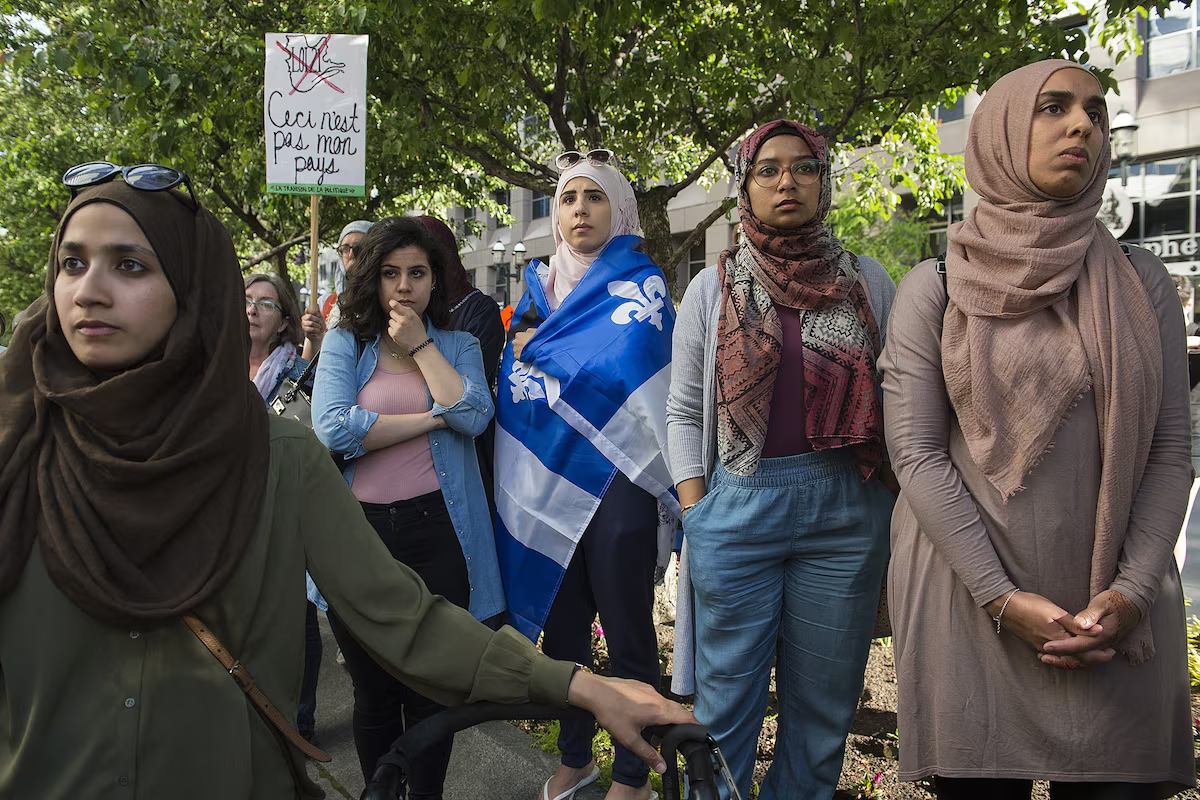

Open this photo in gallery:
People attend a demonstration to protest against the Quebec government’s Bill 21 in Montreal in 2019. The law prohibits many public-sector workers from wearing religious symbols on the job.Graham Hughes/The Canadian Press
The Supreme Court of Canada will deliver its landmark ruling in the Quebec secularism case on Nov. 27.
In a brief announcement on Friday, the country’s top court said the ruling will be issued next Friday at 9:45 a.m. Ottawa time.
The hotly political case is rooted in foundational questions about Canada’s Constitution and the limits of the Charter of Rights and Freedoms. Seven judges of the top court heard the appeal over four days in March, one of the longest hearings in the history of the Supreme Court.
The decision is the biggest in the court’s recent history and one of the most important Charter rulings ever. The Supreme Court’s judgment is in part a reckoning with the political compromises of the early 1980s that helped achieve the patriation of the Constitution from Britain in 1982 and the inclusion of the Charter in the Constitution.
The Supreme Court will rule on Quebec’s Bill 21 next week. Here’s what to know about the controversial law
At issue in the Quebec secularism case at the Supreme Court is the province’s Bill 21. Passed in 2019, the law prohibits many public-sector workers in the province, including teachers and police officers, from wearing religious symbols (such as a hijab or a cross) on the job. The provincial government shielded Bill 21 from court challenges with Section 33 of the Charter, the notwithstanding clause, which allows legislatures to override many of the rights in the Charter.
Quebec’s goal is secularism but some people believe Bill 21 violates freedom of religion and is a state attack on minorities. The notwithstanding clause requires renewal every five years and Quebec did so in 2024. Bill 21 was also twice upheld by the lower courts in Quebec, in 2021 and 2024, both times because of the notwithstanding clause.
The clause, which went mostly unused for decades, has become popular in recent years among some conservative-led provinces. Quebec’s Bill 21 in 2019 was a demarcation point. Alberta used the clause in four laws last year, one to end a teachers’ strike and the other three to restrict the choices of transgender youth.
Opinion: Quebec’s plan to ban schoolkids from wearing religious symbols is a silly but harmful distraction
The Bill 21 case at the Supreme Court intensified federal-provincial political fissures. The federal Liberal government, and numerous advocacy groups, in March argued that the judges should impose additional limits on the notwithstanding clause. Ottawa asserted that the clause’s extended use to override rights effectively eliminates rights and rewrites the Constitution.
Quebec insists its political autonomy is in peril and at the Supreme Court the province vied against six groups of appellants who argued Bill 21 should be struck down. The federal government, as well as some appellants and intervenors, want the court to endorse what are called judicial declarations, where a superior trial court could rule that a law protected by the notwithstanding clause violates Charter rights, even as that law is allowed to stand.
Quebec parried the fusillade of arguments aimed at taking down Bill 21 and rejected the idea of judicial declarations.
“It is not up to the court to answer a political question that does not concern the courts,” Quebec government lawyer Isabelle Brunet argued at the Supreme Court in March.
Supreme Court set for busy November with major hearings, decisions ahead
Ontario, Alberta and Saskatchewan, all conservative led, sided with Quebec. The NDP in B.C. and Manitoba were open to judicial declarations but did not support limits on the notwithstanding clause. (B.C. in October elected a Conservative government.)
In late 1981 an agreement to formalize the notwithstanding clause in the Charter was a key compromise to bridge a political divide at the time, as Pierre Trudeau sought to patriate the Constitution and enact the Charter of Rights. Many provincial leaders felt the Charter could usurp legislators, with courts striking down laws.
The federal government has never invoked the clause, through decades of Liberals and Conservatives in power.
The Nov. 27 date for the Bill 21 judgment had been widely viewed as likely by court watchers, after Chief Justice Richard Wagner in June at his annual news conference said the judges aimed to publish the ruling before the end of Justice Sheilah Martin’s tenure on the top court. She retired at the end of May but has six months, until the end of November, to participate in judgments.