Niki Trosky said she felt like she was crumbling inside when a red light on a security scanner at Calgary’s airport suddenly illuminated as the cremated remains of her late father passed through.
The life coach and author, who is originally from Winnipeg and now has a home in Mexico, was travelling with her father’s ashes from Manitoba’s capital to Los Angeles, with a brief layover in Calgary, late last month.
“I wanted to bring some of his ashes back here with me so I could have him close,” said Trosky, who described her father, Thomas Trosky, as a devoted dad who never let her down.
“[The] best person in the world,” she told host Marcy Markusa in an interview with CBC Manitoba’s Information Radio earlier this week.
Thomas, a former teacher and decorated sportsman who was affectionately known by the nickname “Trigger,” died on July 1.

Niki Trosky says she wanted to bring some of the remains of her late father, Thomas ‘Trigger’ Trosky, back to her home in Mexico ‘so I could have him close,’ but she ran into challenges getting them through security screening at the airport in Calgary. (Submitted by Niki Trosky)
While passing through security at Winnipeg’s airport with her son, Trosky said staff were compassionate and took her father’s cremated remains through a separate screening process. They also told her she would have to go through security again in Calgary before heading to Los Angeles.
With only about an hour between connecting flights, Trosky and her son rushed over to security once they arrived in Calgary. Staff there warned her the airport’s new security scanner hadn’t been letting some remains through.
“I put him in the bin, and sure enough, he goes through and we get the red light,” Trosky said, recounting the worry she felt over whether she’d have to leave her dad behind — or worse, throw him away.
“I can feel this crumbling sensation inside of my body,” she said.
Security staff told her to go to the WestJet counter to see if the ashes could be stowed in her checked bags instead. She ran to the desk as fast as she could.
“I had tears in my eyes, and I just said, ‘They’re not letting me bring my dad on the plane. I need your help,'” Trosky recalled.
The woman behind the counter worked quickly to try to pull the checked bags before they were loaded into the L.A.-bound plane. But it was too late.
Trosky’s father’s ashes never made it onto that connecting flight.
‘Another layer of grief’
Pam Moss, executive director of the Funeral Service Association of Canada, says people may feel a sense of uncertainty when transporting their loved one’s cremated remains, adding “another layer of grief to an already very, very difficult time.”
That’s why funeral industry workers have been trying to ensure that before they jet off to the airport, travellers know about new screening technology and Canadian Air Transport Security Authority rule updates concerning transporting ashes, said Moss.
“We always tell everybody, every funeral director, every family member — go to CATSA’s website, because that’s what you have to follow,” she said.
The air security authority said in a statement to CBC News that passengers are “generally permitted” to take cremated remains with them, but that depends on whether the ashes successfully pass through security screening.

The Canadian Air Transport Security Authority says some urns and containers holding cremated remains haven’t been able to pass security screenings since new CT X-ray scanners were installed at some Canadian airports. (Canadian Air Transport Security Authority)
Some urns and containers holding cremated remains haven’t been allowed through screenings since CATSA started installing new X-ray security machines that use CT scanning at airports across Canada in 2024, the authority said.
The authority says it is working closely with Transport Canada — which sets the rules — and that it is testing an enhanced screening procedure for urns and other containers at locations across Canada.
Advice for travellers
Cremated remains are a “dense material” that can be hard to screen, CATSA’s website says. The ashes must pass screening tests to move on to their next destination, and funeral home documents don’t override that requirement, the authority says.
Smaller quantities of 350 millilitres or less — about the size of a regular pop can — are more likely to pass through screening, depending on the container. Plastic, cardboard, cloth and wood are more likely to pass than stone, metal or ceramic, the website says.
Travellers can also ask their funeral director for temporary containers for air transportation, which are more likely to pass screening.
If the container doesn’t make it past security, travellers may be able to put it into their checked baggage instead, ship it by mail or cargo, or leave it with someone who isn’t travelling.
Moss said having ashes turned away at airport security can be “terribly upsetting,” and her group has been raising concerns about the emotional, cultural and religious impact of the recent changes with both CATSA and Transport Canada.

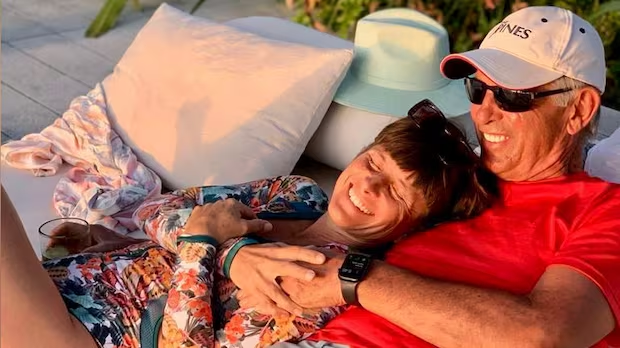
Niki Trosky and her late father. (Submitted by Niki Trosky)
Trosky made the difficult decision to leave her father’s ashes behind in Calgary with the WestJet employee behind the desk, Karen D’Costa-Stegemann, who vowed to reunite them.
“She looked at me, and she’s, like, ‘I’m gonna take care of him. I’ve got him. I’m going to get your dad to you.’ And something in me instantly shifted,” Trosky said.
“It’s really turned what could have been one of the worst moments of my life into one of the most beautiful.”
D’Costa-Stegemann took the remains home with her, placing them temporarily on her own mantle, next to her late husband.
The ashes are now back in Winnipeg with Trosky’s mom.
Trosky plans to bring a piece of him from Manitoba to Mexico soon.
“I’ll be going home for Christmas, and so hopefully I can bring some of my dad back when I come back from that trip,” she said.