
Listen to this article
Estimated 4 minutes
The audio version of this article is generated by AI-based technology. Mispronunciations can occur. We are working with our partners to continually review and improve the results.
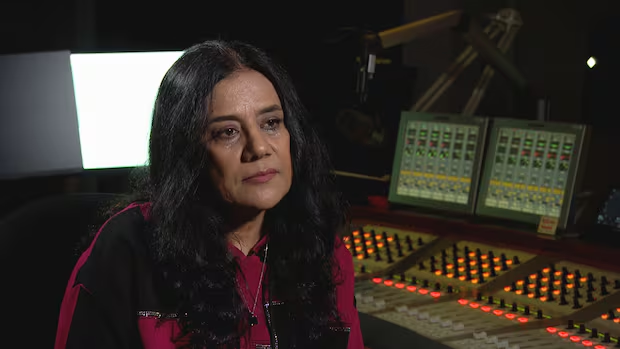
When Zakia Haidari thinks of Afghanistan, she thinks of her niece.
“My family is in Afghanistan, my niece is a teenager and when I think of her future if the Taliban regime continues, she won’t be able to go outside — I don’t want that,” she said.
Haidari worked in broadcast media for 13 years in Afghanistan, before fleeing to Pakistan in 2021 after the Taliban came to power, leaving family and friends.
After moving to Canada three years ago, she found a purpose in Radio Jawan, a Toronto-based internet radio program meant to champion and empower Afghan women.
Radio Jawan was founded by Mukhtar Omar, who runs the program independently out of his home. The project was born after Omar, whose own broadcasting career began in Afghanistan in 2001, made his move to Canada in 2012.

Mukhtar Omar, right, during his time as a broadcaster in Afghanistan. (Submitted by Mukhtar Omar)
Omar says Radio Jawan was born after a trip back two years ago left him saddened over the conditions of Afghan women.
Along with programming such as Saday-e-Khamosh (Voice of Silence) and Az Labalay-e-Tarikh (From the Pages of History), shows focused on untold Afghan women stories and Afghan history respectively, Omar began offering online classes, with a promise.
“Join the class wherever you are and once you’re well educated, you’ll know how to produce a program, be an emcee and present news,” Omar said.
Program now has volunteers all over the world
According to Omar, eight out of 10 participants of the class have gone on to join Radio Jawan, producing programs remotely. What began as a small group of volunteers has grown to 28, housing a total of 12 shows in four languages.
“They may be within their homes, but their voices will be heard from Kabul to Washington,” he said.
Among those voices is the program’s Afghanistan-based producer, whose identity CBC Toronto has agreed to withhold over concerns for safety. For her, it’s not state-of-the art equipment or a large production crew that keeps her telling news — rather her conviction and love for journalism, she says.
“I don’t have many tools but I use my phone and laptop,” she said in a Zoom interview from her home. “I record many times over to make sure I have a good report for Radio Jawan.”
Her items are typically a combination of original work by reporters, as well as a collection of news from international outlets such as BBC Persian among others. Next, it’s passed to Pakistan, where a team of Radio Jawan editors review it, and finally goes to Canada to be wrapped up and broadcast.
“The Taliban tried to clip our wings but we are not giving up,” the woman said.
Since coming to power in 2021, the Taliban has dampened progress for women’s rights in Afghanistan, according to Human Rights Watch.
WATCH | Afghan women share hardships they face under Taliban:
Oppression of Afghan women only growing 5 years after Taliban takeover
As Afghanistan marks five years since the Taliban retook power, women there tell CBC News about the increasingly harsh oppression they live under — including one woman who continues to study and teach in secret.
“I believe the media has a powerful role in creating social change,” Haidari said. “As a woman and journalist, it’s important to share our stories.”
A 2024 Hot Docs debuting documentary, An Unfinished Journey, for example, profiled the stories of four Afghan women who fled Afghanistan in 2021 after Taliban rule pressured them away from their careers in parliament and media.
“Sometimes when I hear and read [Afghan women’s] stories I cry,” Haidari said. “I hope one day the world will hear them and know their suffering.”
Haidari hopes Radio Jawan can aid in that mission.
“I see Radio Jawan as a bridge between Afghan women and the world,” she said. “If I can do anything for them, I will — I hope one day everything changes.”