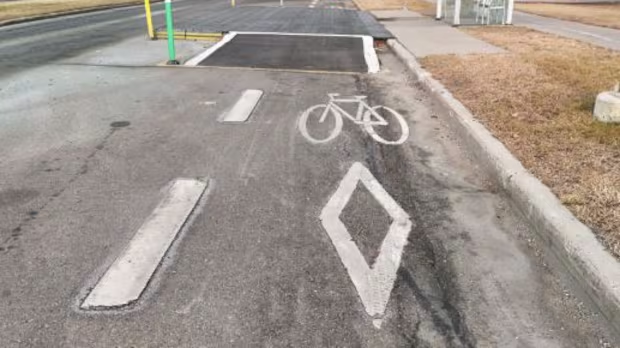
Alberta’s government is proposing to ban future bike lanes that remove or restrict motor-vehicle traffic and give itself the power to remove some existing bike lanes.
Those changes are part of Bill 43, which the government is calling the Safe and Sensible Roads Act. It’s an omnibus bill that, in addition to bike lanes, seeks to increase penalties for unsafe commercial trucking operators, give the provincial government more oversight on municipal LRT projects and establish a framework and minimum safety standards for personal e-scooters and other similar devices.
According to a news release the government issued Thursday, the province will work with municipalities to ensure bike lanes are safely planned and fit within the broader transportation network. The proposed changes, the release said, would help make sure communities consider how bike lanes affect traffic flow, commuters, emergency services and the movement of goods.
“It is intended to preserve roadway capacity at the end of the day,” Transportation Minister Devin Dreeshen said during a news conference Thursday.
Municipalities could request exemptions on a case-by-case basis, but must provide supporting information and rationale for the minister’s assessment, the release said.
The proposed legislation does not include criteria municipalities must meet to qualify for exemptions, nor does it explain how bike lanes would be selected for removal.
Dreeshen said the government will ask for traffic impact assessments linked to certain bike lanes and work with cities to identify problematic ones. If data shows bike lanes have had detrimental effects on communities, cities, with their “extensive” bike lane budgets, will be responsible for paying for their removal.
If passed, the government expects the legislation would take effect in April, with regulations also scheduled to come in the spring.
Dreeshen has been saying for months that bike lanes make sense in some locations, but should not take away parking spaces or traffic lanes used by motor vehicles.
Some residents agree with the minister and have expressed their concerns about specific bike lanes with him. He said at Thursday’s news conference that Albertans have reported problems with multiple streets in Edmonton, including Hermitage Road and Victoria Park Road, and with 26th Avenue S.W. in Calgary.
Bike lane supporters and urban planning and transportation experts have said bike lanes make roads safer for everyone and help reduce traffic.
Dreeshen told CBC News in August he was emboldened by the Ontario Court of Appeal, which overturned a lower court’s decision that the Ontario government’s plan to replace some bike lanes with car lanes was unconstitutional.
‘Uninformed decision,’ mayor says
Edmonton Mayor Andrew Knack called the bike lane changes a “dangerous, uninformed decision” that will make the city’s roads less safe, destabilize local decision-making and make life less affordable for Edmontonians.
The legislation wasn’t based on evidence, he said, adding that the Transportation Ministry already has information from the city about bike lanes’ effects on traffic.
“They just want to throw out red meat and have a culture war,” he said.

Edmonton Mayor Andrew Knack said Bill 43 isn’t based on evidence. (Craig Ryan/CBC)
Calgary Coun. Nathaniel Schmidt told CBC News he’s not sure what outcome the province is trying to achieve, because the City of Calgary already engages residents and conducts transportation studies for bike lanes.
“It’s something that I’m not seeing as one of the top issues, even in my own ward,” he said.
Cyclists, union bash bill
A small group of Edmonton cyclists gathered outside the Alberta legislature Thursday morning to share their thoughts on the recently announced bill.
“You don’t have to ride a bike to know that spending tens of millions of taxpayer dollars, tearing out concrete that is already in the ground, is not sensible and is complete fiscal recklessness,” said Tyrel Brochu, a board member with Paths for People.
He added that the non-profit wasn’t consulted on the legislation, despite asking to meet with ministry officials many times.
Brochu feels decisions about bike lanes should be made locally, and parents shouldn’t have to worry about their children getting hit by a truck while biking to school or a rec centre, he said.

Cyclists say they were not consulted on the legislation, despite asking for a meeting with the ministry many times. (Mia K. Bellemare/Radio-Canada)
Heather Young-Leslie, the Edmonton-based president of the Bikeology Guild of Canada, said people who want cyclists to ride only on side streets don’t understand what it means to use a bicycle as their main form of transportation.
“I want a bike lane to allow me to go to the places I need to go to,” she said.
In a news release, CUPE Alberta President Raj Uppal said ripping out bike lanes will lead to more construction and road closures in cities.
Regulating e-scooters
Alberta’s Safe and Sensible Roads Act, if passed by the Legislature, would also allow municipalities to authorize privately-owned and rented e-scooters — and other personal micromobility devices — and create rules for them that meet or exceed provincial minimum safety standards.
During Thursday’s news conference, Dreeshen noted more people are using these devices in cities, so the government wants to ensure they are used safely.
Currently, citizens in Calgary and Edmonton can ride e-scooters from companies like Lime, but Albertans can’t legally ride their own devices without exemptions from the province.
The government also intends to change the name of the Public Transit and Green Infrastructure Project Act to the Urban Rail Transit Act.
This new act would apply to current and future urban rail transit lines and make municipalities tell the provincial cabinet minister about planned changes to them.
The government says these changes would expand provincial oversight and ensure cities’ LRT projects align with provincial priorities.