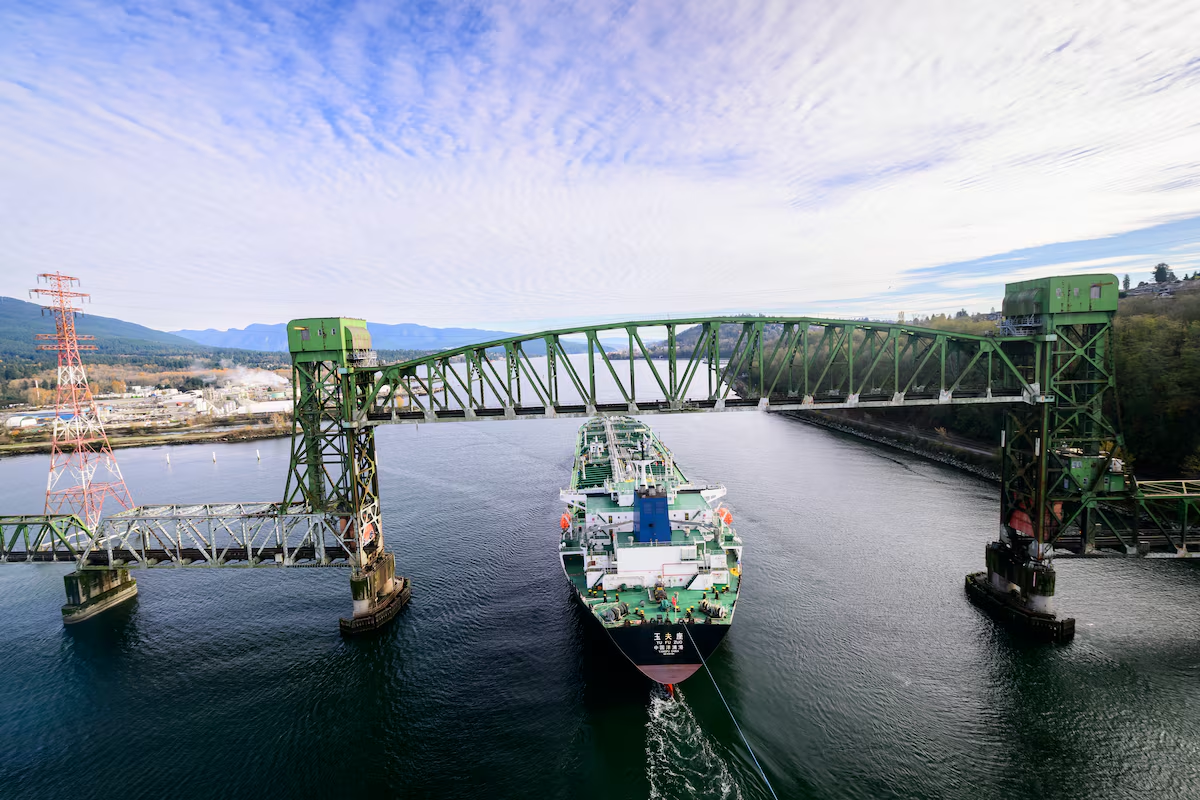

Open this photo in gallery:
Trans Mountain says it has loaded 722 tankers at the Westridge Marine Terminal in Burnaby, B.C., since its expanded system started operating in May 2024.Jennifer Gauthier/The Globe and Mail
Shipments of crude oil from the British Columbia coast rose sharply in October, after Trans Mountain finished a project to boost capacity on its pipeline system two months ahead of schedule.
The pipeline, which can now carry 980,000 barrels a day of oil to the coast from Alberta, was also full in the summer, but dropped to 90 per cent of capacity in September, according to data from the federal Crown corporation. High demand for the line is being driven by production growth in Alberta and a global energy crisis exacerbated by the war in Iran.
Various international customers are “reimagining what their supply strategy should be” as the conflict drags on, said Jennifer Pierce, Trans Mountain’s chief administrative officer.
Carney pitches proposed Pacific Link crude pipeline to business leaders at Asian summit
That’s particularly true in Asia, where Prime Minister Mark Carney this week pitched a business summit on the proposed Pacific Link oil pipeline as a project that could feed growing demand in the region for Canadian crude. That conduit would run adjacent to the Trans Mountain system for much of its length.
Trans Mountain reported that it has loaded 722 tankers at the Westridge Marine Terminal in Burnaby, B.C., since its expanded system started operating in May 2024. More than 65 per cent of those travelled to Asia. Demand for Canadian heavy crude is particularly high among Chinese refineries, which have more than doubled their purchases.
Thirty oil tankers set sail from Westridge in October – the most counted yet and six more than in September, according to a Royal Bank of Canada analysis released Thursday.
Export volumes climbed to 15.9 million barrels, the analysis said. Asia-Pacific was the primary destination for tankers last month, with China receiving the lion’s share. Additionally, two tankers were bound for California (versus none in September), three for Washington state and one for Alaska.
Trans Mountain’s capacity-boosting project, completed in October, introduced drag-reducing agents into the pipeline system, reducing friction between the oil and the line itself. This increased capacity by roughly 90,000 barrels a day.
“We are seeing record production out of the basin, and we’re also seeing record demand coming in on the Pacific Coast,” Ms. Pierce said, adding that the company found “ways that we were able to complete that 2½ months ahead of schedule and put it into service.”
Is it really a good idea for the government to subsidize a pipeline?
Growing demand has Trans Mountain looking to further increase the system’s capacity.
It has applied for approval for a second, larger optimization project to boost capacity by a further mainline 210,000 barrels a day. The project would add 30 kilometres of new 36-inch diameter pipe adjacent to the existing main line and 11 new pump stations along the route. It would also increase power to the system to make pump stations more effective.
If it’s approved, Trans Mountain will go ahead with an “open season,” in which oil companies commit volumes to the expanded line to make the commercial case for the project.
“We’re anticipating that we would have a regulatory decision on the technical aspects by April, and we need to have the commercial underpinnings for that to move forward with a final investment decision,” Ms. Pierce said.
The RBC analysis said the lack of space on Trans Mountain, persistent demand from Asian buyers for Canadian barrels and further supply growth expected from Alberta’s new Oil Sands Growth Program, announced last week, all reinforce the case for the Pacific Link pipeline.
Ottawa last month designated the proposal as a project of national interest. It was the first such official designation under the Building Canada Act, which provides an accelerated pathway through regulatory approvals with the support of the federal government.