
Listen to this article
Estimated 4 minutes
The audio version of this article is generated by AI-based technology. Mispronunciations can occur. We are working with our partners to continually review and improve the results.
The debate over shipping hazardous materials by rail has been reignited after a CN Rail train came off the tracks in northwest B.C., leaking diesel into the salmon-bearing Skeena River for the second time in eight months.
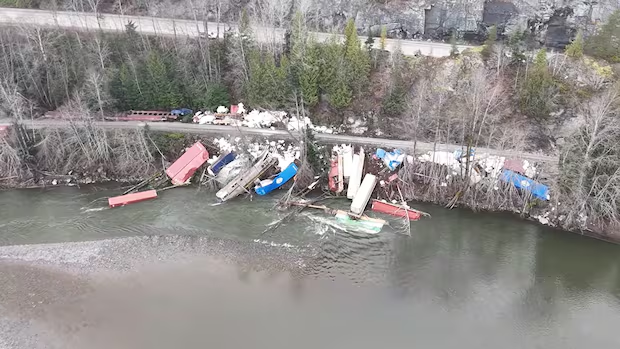
The company says a suspected rockslide pushed a locomotive and several cars down an embankment and into the water Tuesday, with diesel from the locomotive then leaking more than a kilometre downstream.
It’s the second such incident this year, following a similar derailment during extreme weather this past March.
In an update Thursday morning, CN Rail said it had repaired the track and traffic is running again, and the B.C. government says a containment boom and absorbent pads are in place and a surface water sampling plan has been drafted.
The province also says it’s asked CN Rail to provide an estimate for how much diesel was spilled, but so far, the volume has not been shared.
Drone footage from the site shows a visible sheen traveling downstream.
WATCH | Drone footage taken Nov. 19 shows the aftermath of the spill, 2 days later:
Former NDP MP Taylor Bachrach, who lives in the region and previously served as the party’s transport critic, called the derailments a “wake-up call.”
“The railroad, for hundreds of kilometres in our region, goes right next to the Skeena River,” he said, identifying it as highly important for salmon.
“When we’re talking about the shipment of dangerous goods along that rail line, the implications, the consequences of a major disaster are really unthinkable.”
The debate over rail shipments is especially fraught in northwest B.C., where the Port of Prince Rupert has emerged as key to shipping energy products to overseas Asian markets in light of the U.S.-Canada trade war.
WATCH | Understanding the North Coast tanker ban:
What politicians get wrong about the B.C. oil tanker ban
Even so, efforts to build a pipeline to transport heavy crude oil to the North Coast have been resisted due to concerns about environmental impacts.
Likewise, proposals like that from Calgary-based Strathcona Resources to ship up to 250,000 barrels of Canadian oil to Prince Rupert a day have also met with opposition.
They are made more challenging by the Liberal government’s support of the Oil Tanker Moratorium Act, which blocks large oil tankers from travelling along B.C.’s northern coast.
Concerns over response time
No major spill incidents were recorded between Terrace and Prince Rupert in the decade prior to this year, according to provincial data.
Even so, the more recent spills have First Nations in the area worried about the increased train traffic through the sensitive region.

CN Rail says cleanup efforts are underway after a train derailed into the Skeena River on Nov. 17, 2026. (Submitted by Carl J. Reibin)
Kitsumkalum First Nation Chief Councillor Troy Sam said he wants to make sure the province and industry groups work with First Nations to improve response times.
“My position is to make sure this doesn’t happen again,” he said. “What did we learn from this incident and how could we respond better?”
Gitxsan Hereditary Chief Skogam’Lahkx Toby Howard said his government is calling for all cargo train traffic between Burns Lake and Prince Rupert to be put on hold until the full track can be inspected for safety.
“The whole system … it’s pretty old,” he said. “There are a lot of things we need to address.”
WATCH | First Nations call for action after 2nd diesel spill:
Diesel leaking into Skeena River after train derails near Terrace, B.C.
Peter Ross, an environmental toxicologist with the Raincoast Conservation Foundation, said that while diesel tends to dissipate and evaporate on its own, it still poses a risk to fish and wildlife who come into contact with it.
And, he said, the two spills within a few months raise larger concerns.
“I think this really speaks to the dangers of transport when it comes to petrochemicals,” he said.
While he was confident officials would manage the spill, Ross wondered whether they would see the bigger picture.
“It’s something we do very poorly as a society, is add all of these cumulative effects together to try to define the risk to fish and wildlife,” he said.