
Open this photo in gallery:
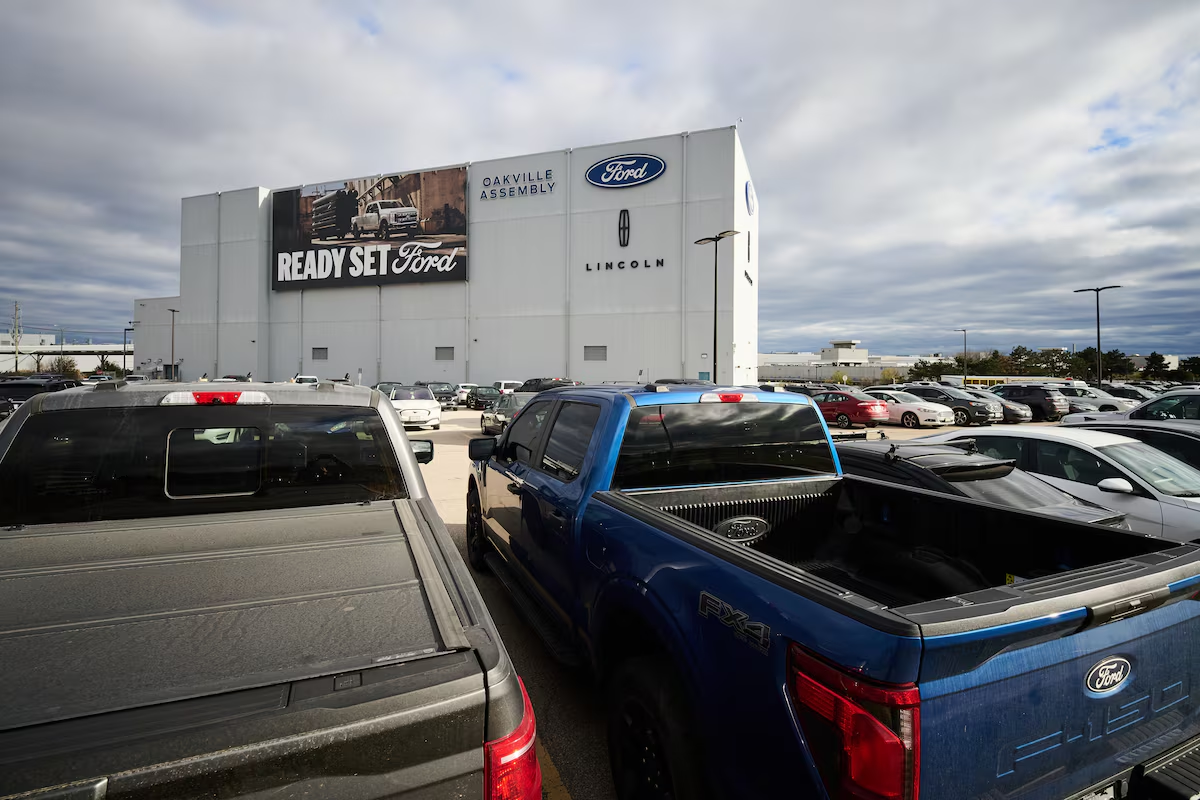
Ford vehicles are parked outside the Ford Oakville Assembly Complex in Oakville, Ont., on Monday. The automaker reopened its plant, which will produce F-Series trucks, this week.Sammy Kogan/The Globe and Mail
Canada’s auto manufacturing sector is divided on the best path forward as Ottawa once again pursues an agreement with Washington in a bid to stabilize the industry.
The Detroit Three automakers are pushing for a tariff deal sooner rather than later that can staunch the bleeding and hopefully be improved over time. Honda Motor Co. HNDAF and Toyota Motor Co. TM-N, by contrast, want Ottawa to avoid locking in to an uncompetitive tariff level, and support the idea of a tradeable import credit system that would reward companies that build more cars in Canada than they sell.
Industry insiders and lobbyists say the division lies in different commercial realities among the five carmakers operating in Canada: the models they make, how much U.S. content is in the vehicles, and how they supply the Canadian market.
This makes things tricky for Canada-U.S. Trade Minister Dominic LeBlanc and chief trade negotiator Janice Charette as they try to establish red lines for the sector in talks with Washington that broke down over the summer but have regained momentum in recent weeks.
Open this photo in gallery:
Trade Minister Dominic LeBlanc rises during Question Period in the House of Commons on Parliament Hill earlier this month.Justin Tang/The Canadian Press
The stakes for the Canadian auto industry were evident this week. Ford Motor Co.’s reopening of its assembly plant in Oakville, Ont., and Honda’s announcement that it’s restarting engine production in Canada point to resilience in the sector. Meanwhile, Stellantis NV’s STLA-N sale of its idled plant in Brampton, Ont., to armoured-vehicle maker Roshel Inc. was a warning shot about what faces the industry if Ottawa can’t land a deal to restore competitive access to the U.S. market.
The Trump administration’s 25-per-cent tariff on Canadian-made autos – minus a carve-out for U.S. parts in the vehicles – has put severe pressure on an industry that typically exports nearly 90 per cent of production to the United States. The value of Canadian passenger car and light truck exports to the U.S. tumbled nearly 12 per cent from 2024 to 2025, and exports are tracking even lower in 2026.
In August, Washington offered to lower the headline tariff rate to 15 per cent, as part of a broader trade deal that would have reduced the sectoral duties, known as Section 232 tariffs, on several key Canadian industries in return for concessions from Ottawa. The U.S. parts carve-out would have been maintained, but the tariff relief would not have been extended to medium- and heavy-duty trucks.
Ottawa, Ontario working on package to persuade Stellantis to cancel sale of Brampton plant
Many in the Canadian auto industry balked at the proposal and applauded Prime Minister Mark Carney’s decision to walk away from negotiations. However, that choice has left an unsustainable status quo for the sector.
Ottawa and Washington have continued informal talks about autos and other tariffed industries. Commerce Secretary Howard Lutnick now leads the American side of the discussions, rather than U.S. Trade Representative Jamieson Greer, according to three sources with knowledge of the talks. The Globe and Mail is not naming the sources as they were not authorized to speak publicly.
Much of the current haggling is over technical details, including the definition of U.S. content. Because U.S. auto tariffs don’t apply to American content in Canadian vehicles, a broader definition that included factors such as R&D and marketing costs would lower the effective tariff rate on Canadian cars.
Open this photo in gallery:
U.S. President Donald Trump greets U.S. Commerce Secretary Howard Lutnick at a campaign rally in Greenville, N.C. on Oct. 20.Matt Ramey/The Associated Press
“You want to get a [headline tariff] number as low as you can, and then work the process,” Steve Carlisle, former president of GM North America, said in an interview. He said trade officials from both countries are used to bargaining over content definitions, given the rules-of-origin requirements in the United States-Mexico-Canada Agreement. “There’s some big numbers outside of the material costs.”
Regarding tariff relief for medium- and heavy-duty trucks – which Mr. Carney highlighted as a major sticking point – one potential path forward would be to move a few tariff codes from one bucket to another. That would allow the larger Ford and General Motors trucks produced in Oakville and Oshawa, Ont., to qualify for a lower tariff rate offered to light vehicles, while leaving the higher tariff in place for vehicles such as semi-trucks.
Ultimately, the big question is how hard Ottawa should push for better terms than were offered in August. On this, Mr. LeBlanc and Ms. Charette are hearing different things from different parts of the industry.
Canadian auto sector sees new hope from U.S. Democrats’ midterm victory
“We need relief, and we need relief quickly,” said Brian Kingston, president and chief executive of the Canadian Vehicle Manufacturers’ Association, which represents Ford, GM and Stellantis. “The idea that we’re going to wait this out for a new U.S. administration that somehow believes in a world of free trade, I think, is extremely naive. We’ve seen no indications that that’s going to happen. So if there is a window to strike a deal now, we should take that deal to ensure that we have an industry to save.”
There are several reasons why Ford and GM, in particular, could stomach a higher tariff rate than their Japanese counterparts. Their main Canadian products are trucks, which tend to have higher per-vehicle profit margins than the compact cars or small SUVs produced by Honda and Toyota in Canada. They also tend to use more U.S. parts, so they face a lower effective tariff rate.
A commonly used rule of thumb is that 50 per cent of the value of a Canadian-made car is composed of U.S. parts, which lowers the average effective tariff rate to 12.5 per cent. However, one of the industry sources, who has knowledge of GM’s tariff math, said the company’s Canadian-made cars tend to have more than 50 per cent U.S. content. The source would not specify the exact effective tariff rate, but acknowledged it was several percentage points lower than 12.5 per cent.
Sale of Brampton auto plant from Stellantis to Roshel leaves laid-off workers in the lurch
Likewise, while Ford and GM are more affected by Washington’s refusal to lower tariffs on medium- and heavy-duty trucks, the issue may be less important for the sector than Mr. Carney has suggested.
The industry insider said roughly 80 per cent of the Chevrolet Silverado trucks GM currently makes in Oshawa are already considered light-duty vehicles for tariff purposes – and would have seen tariff relief under the August proposal.
The mix at Ford’s plant in Oakville, which will produce F-Series trucks, isn’t yet clear. Production is just getting started and the breakdown will depend on the orders the plant receives.
Open this photo in gallery:
A Honda employee works along the vehicle assembly line in Alliston, Ont., in 2024.Nathan Denette/The Canadian Press
Toyota and Honda are also keen for Ottawa and Washington to strike a deal, but the offer on the table in August would not have been sustainable, said Brendan Sweeney, president and CEO of the Pacific Manufacturing Association of Canada, which represents the two automakers.
“Help in the short term is helpful, but we don’t want to lock into something, whether it’s 15 per cent minus U.S. content or whether it’s something else … that could jeopardize our competitiveness vis-à-vis the United States,” he said.
The Japanese manufacturers tend to have less U.S. content in their Canadian supply chains, and the models they make in Canada, including the Honda Civic and the Toyota Rav4, also tend to have lower margins – though this varies between models.
Deeper EU ties to open more partnerships for Canada’s auto sector, Carney says
In the near term, an effective tariff rate in the 7.5-per-cent range (essentially what was on offer in August, factoring in the parts carve-out), would make Canadian production reasonably competitive with the U.S., according to another industry insider with knowledge of Toyota’s operations.
That’s because Washington is driving up the cost of producing cars in the U.S. by tariffing steel, aluminum and auto parts from outside North America, while Canada has built-in cost advantages tied to the exchange rate, health care and power costs, among other factors.
But the big concern for Toyota’s Canadian operations, the source said, is that Washington will eventually realize it’s shooting itself in the foot and remove the tariffs that increase domestic production costs, while leaving in place any tariffs Ottawa agreed to. The Globe is not naming the source as they were not authorized to speak on the record.
Lamborghini sticks with thundering gasoline engines as the world buys EVs
Another major fault line separates the D3 and the Japanese automakers. Earlier this year, Ottawa suggested changing its tariff remission system by introducing a tradeable import credit scheme.
Under the proposal, companies making cars in Canada would be granted credits that they could sell to other auto manufacturers who would use them to reduce their Canadian tariff bills. The idea is to reward production in Canada and help those manufacturers defray the cost of U.S. tariffs.
The Japanese automakers, who produce far more vehicles in Canada than they sell, have backed the idea. The D3, which sell more cars in Canada than they produce, are squarely against it.
Ottawa held consultations on the proposal earlier in the year, but has so far held off on implementing it.
Editor’s note: A previous version of this story was incorrectly accompanied by a photo showing U.S. President Donald Trump with U.S. Secretary of the Interior Doug Burgum. It has been replaced by a photo showing Trump with U.S. Commerce Secretary Howard Lutnick.