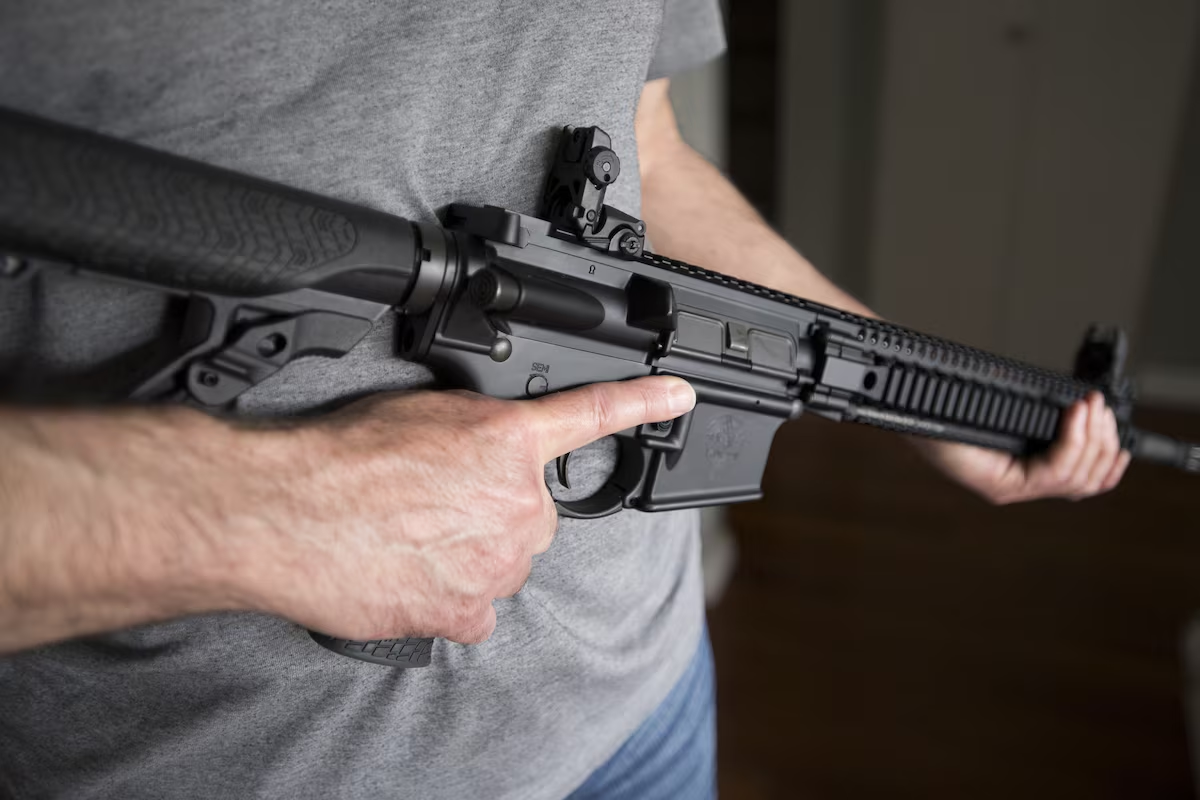

Open this photo in gallery:
As of mid-2026, the federal government had paid businesses $96-milion for about 74,000 guns – an average of $1,300 per weapon.JONATHAN HAYWARD/The Canadian Press
The federal government will defend its 2020 ban on assault-style firearms at the Supreme Court of Canada on Monday, taking on an array of challengers that argue Ottawa exceeded its legal authority.
The case, to be heard Monday and Tuesday, is the biggest hearing at the top court this fall. It centres around legal questions about the reasonable extent of Ottawa’s power to ban weapons such the AR-15, Beretta Cx4 Storm and other firearms to protect public safety despite the use of the guns in some cases for sport shooting or hunting.
The federal Liberals enacted the ban under former prime minister Justin Trudeau. “Assault-style firearms designed for military use have no place in Canada,” he said at the time. Ottawa invoked its regulatory powers, rather than legislation, to ban more than 1,500 types of firearms in 2020, and increased the list of banned guns to more than 2,500 in late 2024 and early 2025.
The lower courts have twice ruled in Ottawa’s favour. The Supreme Court in March agreed to hear the appeals.
A continuing amnesty period for the possession of the prohibited weapons is in effect until 90 days after a judgment from the Supreme Court. Businesses and individuals can dispose of their guns or permanently deactivate them, and Ottawa is also buying them back. As of mid-2026, the federal government had paid businesses $96-million for about 74,000 guns – an average of $1,300 per weapon.
The firearms case involves four different challengers and, unusually, includes several self-represented litigants who will argue in front of the nine judges of the Supreme Court without a lawyer. Five other gun groups as well as the provinces of Alberta, Saskatchewan and Ontario also oppose the ban.
Opinion: Canadians deserve to know what guns were used in the Tumbler Ridge mass shooting
The appellant Christine Generoux, from Ottawa and in her late 30s, has been dubbed “an unlikely heroine of Canadian gun culture” by a sport shooting group. She is set to argue her case herself on Monday morning, and in her legal filing said there was no justification to deem the guns unreasonable for use in recreational purposes. She also spoke of what she called the sentimental, life-sustaining and cultural nature of guns.
“Sport shooting is destroyed and hunting disrupted,” Ms. Generoux stated. She further argued the issue goes deeper than reasonableness – a key legal question of whether Ottawa stayed within the limits of its powers. “It strikes at the heart of Parliamentary democracy and Canadian identity.”
The Canadian Coalition for Firearms Rights, an appellant that does have legal counsel, argued the heart of the firearms case goes beyond the individual rights of gun owners. The group said Ottawa’s regulations were too vague to be within its powers and described this as legality succumbing to “ambiguous administrative will, leaving people to navigate a standardless whim.”
The group stated that mass shootings are rare in Canada, “claims of firearm use in homicides are exaggerated” and most high-profile shootings involve illegal guns.
The ban “concerns the profound disruption of the lives of ordinary, law-abiding Canadians,” it argued in its appeal. “They are not extremists; they are farmers, veterans, competitive athletes, Indigenous harvesters, and neighbours in communities across Canada.”
The federal government’s response began by listing a series of deadly mass shootings in Canada and around the world where the killers wielded assault-style firms, starting with Portapique, N.S., in 2020, Montreal’s L’École Polytechnique in 1989 and the Islamic Culture Centre in Quebec City in 2017.
Ottawa’s response then addressed the core of the legal case: whether the federal cabinet was allowed to use regulations based on a section in the Criminal Code to achieve its public-safety policy objectives rather than through the legislative powers of Parliament. The minority Liberal government tried and failed to codify the banned assault-style firearms in law in 2023.
The federal government is arguing that Parliament has long empowered cabinet with broad discretionary authority to prohibit firearms in the interest of public safety, and that the exercise of that political power “was reasonable and justified by the serious public safety concerns these firearms pose.”
Opinion: A pilot for Canada’s gun buyback was a failure. The Liberals are committing anyway
Ottawa has few allies at the top court. The Canadian Coalition for Gun Control, an intervener in the case, provides the only explicit backing, echoing the federal government’s position that the Criminal Code allows for the authority to pass regulations to ban the firearms. The group cited the overriding purpose of public safety and argued that the broad nature of the ban adheres with the rule of law.
The three provincial governments that intervened in the case are all conservative-led and are once more opposing the federal Liberals at the Supreme Court, as they had earlier this year in the landmark case on Quebec secularism and the Charter of Rights and Freedoms.
Alberta and Saskatchewan said Ottawa overstepped its powers in the firearms ban, while Ontario more plainly stated: “The regulations are unconstitutional.”
Alberta hired veteran lawyer Guy Pratte at Borden Ladner Gervais in Ottawa to helm its arguments. His father, Yves, was a Supreme Court judge in the late 1970s, and earlier this year Mr. Pratte argued on behalf of the federal government in the Quebec secularism case.
Alberta’s legal filing said Ottawa “at the stroke of a pen” criminalized firearms ownership for more than 100,000 Canadians licensed to own such guns for hunting and sport shooting “without any evidence that these firearms users pose a threat to public safety.”
The province also said hunting and participation in shooting sports are “matters of exclusive provincial jurisdiction” and that the Criminal Code only allows cabinet to ban guns by regulation if they are not reasonable to use for those purposes, rather than in pursuit of a policy of public safety.