
Open this photo in gallery:
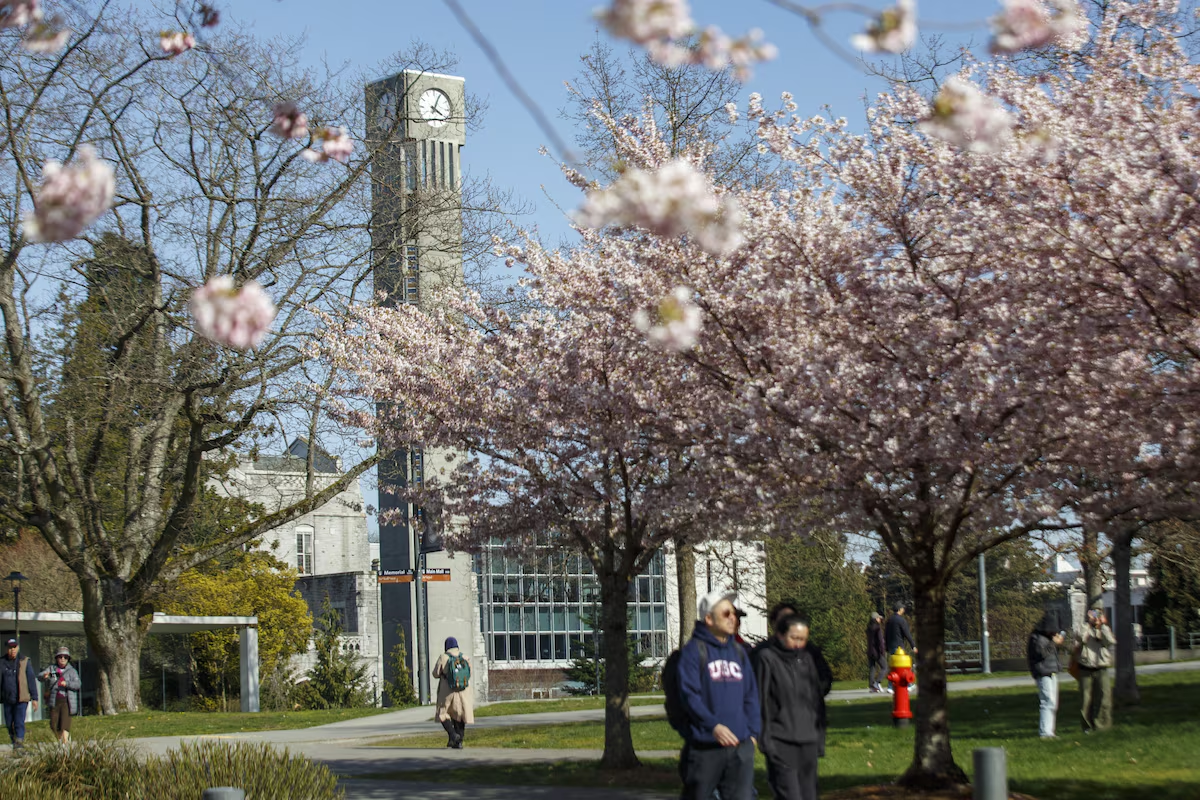
People walk past the Ladner Clock Tower on the UBC Vancouver campus. Time changes across Canada have come about willy-nilly, with little co-ordination among the provinces, Marcus Gee writes.Isabella Falsetti/The Globe and Mail
The current shemozzle over Canadian time zones says a lot about the state of the federation, none of it good.
British Columbia has switched to permanent daylight time. So have Alberta, the Northwest Territories and now Manitoba. Sensible Saskatchewan decided back in 1966 to put the province on Central Standard Time all year.
Parts of northwestern Ontario are adopting year-round daylight time to keep in step with neighbouring Manitoba, but the rest of Ontario is still turning its clocks forward for only half the year. Quebec is leaning toward scrapping the twice-a-year clock change, but has yet to act.
Got that? The changes have come about willy-nilly, with little co-ordination among the provinces, much less with Ottawa. Many Canadians are understandably confused.
Wait, British Columbia is only two hours behind Ontario and Quebec? And you enter a new time zone when you travel to Seattle from Vancouver?
Yes, Western Canada is now on a different time than neighbouring parts of the United States, which remains our biggest trading partner despite Donald Trump and all his tariff nonsense. The East Kootenay region of southeast British Columbia, which voted in August to go with the new “Alberta Time” year-round, now finds itself on the same time as part of the Florida panhandle. Alaska is two hours behind British Columbia, although the two share a lengthy border.
Is this any way to run a railroad? Or a country?
In depth: Year-round daylight time has a dark side. Here’s how Canada can prepare for it
China, nearly as broad as Canada, has just one time zone. So does India.
Parts of the United States have been talking about getting rid of “spring forward, fall back” for years – and most of Arizona actually did in 1968 – but the idea that the states would all just sort of make up their own minds and pull the trigger when they felt like it is inconceivable, even though the American federal system, like ours, gives wide powers to its constituent parts. The three times the United States went temporarily to year-round daylight time – during the world wars and the oil crisis of the 1970s – it was Congress that made the call for the whole country.
We in Canada are so used to living in a disjointed, fractious cage match of a country that we scarcely notice it any more. The time-change mess is only one tiny example among many.
We put up with interprovincial trade barriers that penalize consumers and trim billions from our economic output. We tolerate the absurdity of a referendum on the possible future separation of the richest, most favoured province while in the midst of a perilous confrontation with our powerful neighbour. We see the separatist leader of Quebec spurn the Constitution and exclude the Lieutenant-Governor from his swearing-in ceremony with barely a murmur of protest from elsewhere.
The usual explanation for our disunity is that Canada is a big country cobbled together from disparate peoples and parts. But that could be said of almost any nation. The United States started as a quarrelsome collection of 13 British colonies. France has so many distinct regions that Charles de Gaulle lamented: “How can you govern a country that has 246 varieties of cheese?” India has hundreds of languages, thousands of ethnic groups and countless sects and castes.
Canada is a uniform, easily governed country by comparison. You can fly from Victoria to Halifax and find little difference in the way people speak, eat or live. Yes, we have lots of ethnic diversity and a big language minority, the French-Canadians, but Nigeria has three major language groups and many smaller ones.
Marsha Lederman: If I could turn back time: B.C. is making a mistake by not changing the clocks
Our variety is not unique. What stands out is the way we fetishize it. Freud called this the narcissism of small differences. Wikipedia helpfully describes it as “the idea that when people in a relationship or community have a lot in common, they can actually be more likely to fight with each other and mock each other, because they become overly sensitive to small differences they notice in one another and treat those differences as bigger than they are.”
We Canadians have become masters at it. We often act more like a pack of feuding principalities than a country with 159 years of success. It won’t do. Today we face the biggest threat to our independence in memory, coming from right next door. The moment demands unity, not narcissism.
Now would be a good time to get over ourselves and accept that we have far more in common than keeps us apart and far more to gain by working together than by squabbling over who gets how much.
We could start by agreeing on what time of day it is.