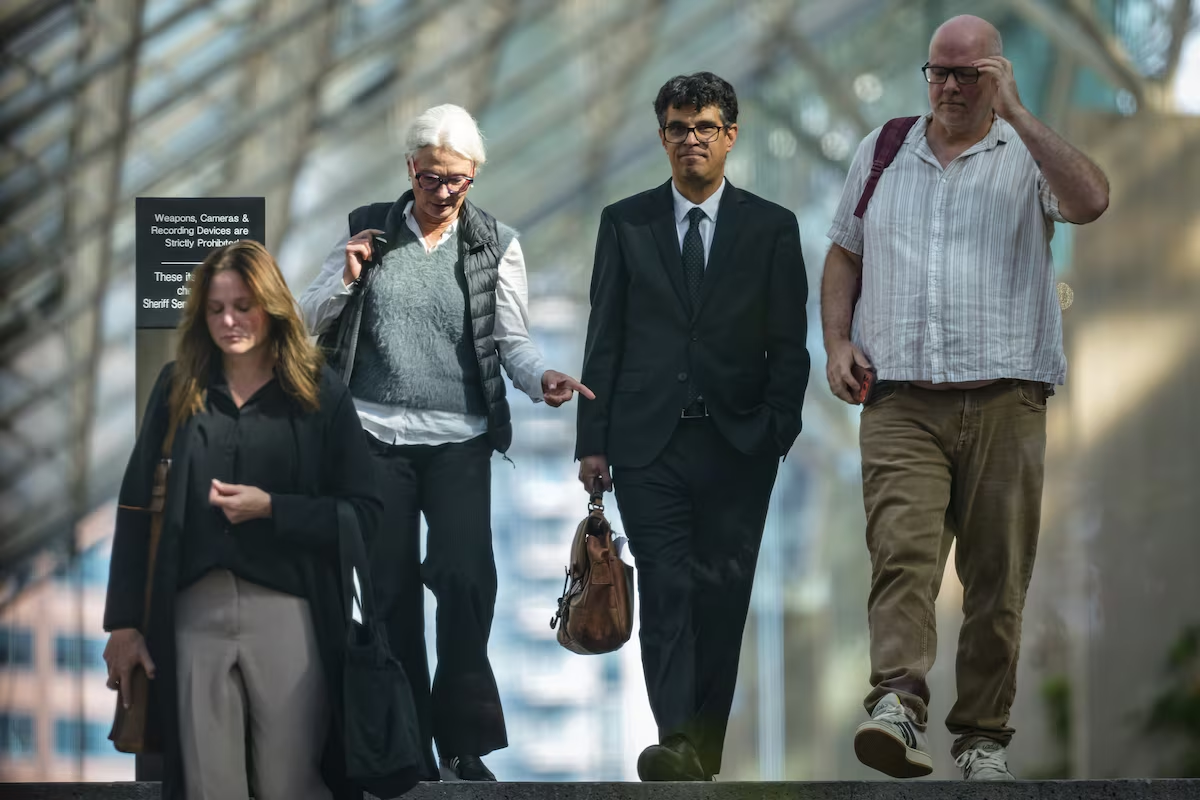

Open this photo in gallery:
Author and former University of British Columbia professor Steven Galloway, second from right, and his wife Katie Wagner, front left, leave B.C. Supreme Court with two unidentified people, in Vancouver, on Oct. 6.DARRYL DYCK/The Canadian Press
Bestselling author Steven Galloway had all the tools needed to rehabilitate his public image and career after the University of British Columbia fired him a decade ago, a public relations expert testified Thursday.
Norman Stowe, managing partner of the public relations firm Pace Group Communications, told B.C. Supreme Court that despite being accused of sexual assault by a former creative writing student, Mr. Galloway could have leveraged several strengths if he had a coherent crisis communications plan in place.
Mr. Stowe was testifying as a defence witness at the trial for the defamation case Mr. Galloway first launched in 2018, which alleges that his lucrative literary career cratered after he faced public accusations of sexual harassment and sexual assault in 2015. He is suing the former student with whom he had an affair from 2011 to 2013, whose complaint sparked the firestorm, and three others who repeated her allegations online in the years that followed.
Mr. Galloway was suspended and then, seven months later, fired in June 2016 as head of UBC’s creative-writing program without severance because of breach of trust.
UBC professor regrets helping colleague approve Galloway accuser’s unfinished thesis to complete degree
Mr. Stowe testified Mr. Galloway’s advantages included having enduring public support from prominent members of Canada’s literary community; media coverage that was, by and large, positive; a UBC-commissioned report from a retired judge exonerating him of the sexual assault allegations; and two settlements from his alma mater.
“He had a lot going for him that never seemed to come together in a way that he could move on from this,” Mr. Stowe testified.
Mr. Stowe wrote a report this summer for the defence team of the woman who levelled the allegations. She can only be referred to as A.B. because of a trial publication ban.
Mr. Stowe’s expert report is expected to be used by the defence in closing arguments to argue that Mr. Galloway’s reputation was affected by his own response to this scandal.
Mr. Galloway initially sued two dozen defendants in his lawsuit alleging that his career was effectively ended by the allegations. UBC’s independent investigator found he had committed sexual harassment by entering into an affair with A.B. but he was never charged with a crime and has always denied the allegations of sexual assault.
Calling police on Galloway was an ‘act of care’ after suicide remark, says UBC professor
A.B. is not testifying and, at the start of the trial last month, her lead lawyer Arden Beddoes told the court that he was withdrawing her defences of truth and fair comment. Mr. Beddoes said A.B. was amending her defence to say she reported sexual assaults and is no longer saying she had been sexually assaulted, but she is still not admitting that she spread lies about Mr. Galloway. Mr. Beddoes has said that A.B. had tried to kill herself twice this year because of the stress of the case.
During cross-examination from Mr. Galloway’s lead lawyer Daniel Burnett, Mr. Stowe agreed that he had incorrectly found in his report that the author took “no steps” to rehabilitate his career after the scandal.
Mr. Stowe maintained that high-profile people have had “reputational challenges” as bad or worse than Mr. Galloway’s, and had moved on and been successful, citing Bill Clinton, Martha Stewart and Tiger Woods.
Mr. Burnett interjected to ask if these people had been accused of misconduct “as bad as rape?” to which Mr. Stowe agreed that sexual assault allegations are “powerful.”
Galloway accuser not wholly responsible for fallout from allegations, lawyer argues
But, Mr. Stowe testified that regardless of the allegations, the plan for rehabilitating one’s public image “from scratch” is very similar and, in his opinion, Mr. Galloway’s actions stalled.
“He had all of these opportunities and tools and assets and support,” Mr. Stowe said.
Last month, the court heard Mr. Galloway testify he did not seek out professional public relations help after he was suspended from UBC, but did talk to friends about his strategy to push back against allegations of sexual assault he has always denied.
Mr. Burnett explained how his client had followed the three public-facing steps of Mr. Stowe’s six ironclad rules for managing a crisis, as detailed in the expert report: “build a narrative and stick to it” (by always maintaining his innocence), “enlist facts and voices of others” (by having literary stars such as Margaret Atwood sign an open letter in 2016 supporting him), and “don’t be a recluse” (by doing an interview with The Globe and Mail’s Gary Mason and, later, writing an op-ed for the National Post).
Galloway success disappeared ‘almost overnight’ after assault claims, publisher says
Later Thursday, defendant Mandi Gray, who is on medical leave from her position as an assistant professor of criminology at Trent University due to the proceedings, also began her testimony. She and two other women are accused of defaming Mr. Galloway online by repeating A.B.’s claims he sexually assaulted her.
Vanshika Dhawan, Dr. Gray’s lawyer, told the court that her client was also withdrawing the defences of qualified privilege and responsible communication for five social media posts she made in 2016 and 2018. She is not defending three of these alleged instances of defamation but will argue fair comment for the remaining two, Ms. Dhawan said.
“If I had the opportunity to go back in time, I would have said this using different language,” she said of her three defamatory posts on the platform X, formerly Twitter, which she added was not “really a platform known for nuanced thought.”
Ms. Dhawan said her client recognizes the “profound personal consequences” Mr. Galloway has faced, but disputes that any damages awarded should be substantial if defamation is proven.