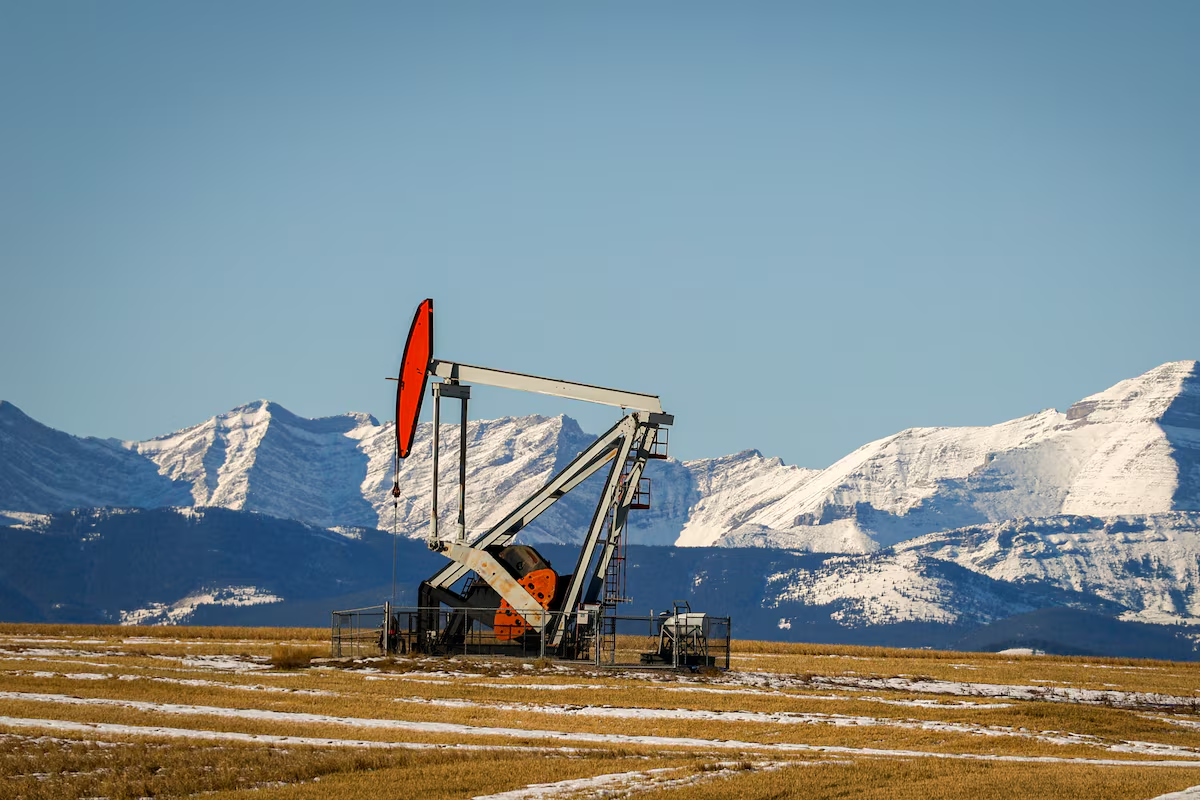

Open this photo in gallery:
A pumpjack draws oil from a well head with the Canadian Rockies in the background near Longview, Alta.Jeff McIntosh/The Canadian Press
Indigenous leaders have launched a new volley of court challenges against Prime Minister Mark Carney’s push to rapidly approve the Pacific Link oil pipeline, arguing Ottawa failed to adequately consult an array of First Nations.
Two new applications for judicial review, representing nine First Nations, call on the Federal Court to quash Ottawa’s declaration of the proposed oil pipeline as a project of national interest.
At a Monday news conference in the Vancouver suburb of Richmond, Indigenous leaders asserted that Ottawa’s plan is unconstitutional and effectively pre-approved the pipeline after cursory talks with some First Nations over three months through the summer.
“It bypasses the meaning of what consultation is,” said Terry Teegee, regional chief of the British Columbia Assembly of First Nations. “Other First Nations should all be concerned across this country.”
Open this photo in gallery:
Terry Teegee, regional Chief of the British Columbia Assembly of First Nations, in 2023.Darren Calabrese/The Canadian Press
The federal government, at the start of October, announced the national-interest designation for the Pacific Link oil pipeline, from the Edmonton area to a port in the Vancouver region. This plan provides Ottawa’s backing at the start of the process and will enable it to grant many necessary and varied permits much more quickly than in the past. It also marked the first such move under the Building Canada Act, a centrepiece of Mr. Carney’s work to shift Canada’s economy away from the capricious whims of the United States.
The latest court challenges up the stakes against the national-interest designation. In October, Cold Lake First Nations in Alberta filed the first case in Federal Court, focused on inadequate consultation and the related Pathways carbon capture project in the oil sands that Mr. Carney has tied to the Pacific Link pipeline.
The federal Liberals want the Pacific Link review process done by September and the pipeline built and moving oil by 2032, at an estimated cost of about $40-billion. This is an unprecedented timetable for such major infrastructure work in recent decades and more so echoes pipeline building in the 1950s.
Oil industry faces major spending hikes to fill planned pipeline expansions
While Mr. Carney aims to transform the Canadian economy in a handful of years, the risk looming over these ambitions has always been legal challenges against the fast-track pipeline review process.
In the 2010s, before the Trans Mountain pipeline expansion was eventually built, setbacks in court because of inadequate Indigenous consultations delayed the plan for years. The legal losses followed former Conservative prime minister Stephen Harper’s legislative changes to speed pipeline approvals.
As of last year, Canada produced 5.4 million barrels of oil a day – double the output of the mid-2000s when the oil sands boom began. The country is the world’s fourth-largest oil producer, with 3.9 million barrels a day going to the United States.
In the federal government’s official order on Oct. 1 declaring the Pacific Link pipeline in the national interest, it stated it had “taken into account the concerns” identified in consultations with Indigenous people. It also described “meaningful dialogue” and concluded “Canada has fulfilled the duty to consult, consistent with the honour of the Crown,” invoking key pillars of constitutional obligations affirmed in several Supreme Court of Canada rulings.
As Ottawa prioritized Pacific Link, Energy Minister Tim Hodgson acknowledged legal challenges were coming. “Whether they’ll be successful or not is a very different question,” he said on Oct. 1.
Pacific Link would carry a million barrels a day, on the same terrain and with about the same capacity as Trans Mountain.
Here’s how Carney’s promises stack up ahead of his government’s second budget
On Monday, a spokeswoman for Intergovernmental Affairs Minister Dominic LeBlanc said Ottawa had “conducted rigorous consultations” with more than 110 Indigenous communities near or along the potential pipeline route.
“Canada will continue to uphold its duty to meaningfully consult with Indigenous peoples,” spokeswoman Eve Loignon-Giroux said in a statement.
In the new Federal Court challenges, the Cheam First Nation alleged that “Cabinet erred in law by proceeding without adequate consultation.” The Cheam – located on the Fraser River east of Vancouver near the Trans Mountain pipeline and proposed Pacific Link – filed as an applicant on behalf of itself and seven other First Nations.
“We stand up to hold the Federal Crown accountable,” Cheam Chief Michael Victor said. “Our Nation believes in Nation-building but it must treat First Nations as equal constitutional partners.”
The Tsartlip First Nation, near Victoria, also announced on Monday that it had filed a Federal Court challenge, stating that Ottawa’s Major Projects Office only provided “very general information” about the proposed pipeline and calling the consultation process “defective.”
Experts have forecast details of the legal challenges the federal government would face.
In early October before the first legal challenge, University of Calgary law professor David Wright described the Building Canada Act as “experimental deregulation,” a law that had come into force in June “after a virtually unprecedented expedited legislative process.”
The key question is whether Ottawa fulfilled its duty to consult and accommodate each First Nation involved. Prof. Wright cited a 2020 Federal Court of Appeal decision, which Ottawa won, after the Trans Mountain project had been challenged a second time over inadequate Indigenous consultation. The ruling, in its look at meaningful consultation, spoke of “two-way dialogue” that leads to “demonstrably serious consideration of accommodation.”
“How the government will try to achieve this in such an extremely compressed timeframe remains to be seen,” Prof. Wright said in his analysis of the goal to complete the Pacific Link review by September. “The term ‘mission impossible’ comes to mind.”
Last week, Dawn Farrell, chief executive officer of Ottawa’s Major Projects Office, told MPs on Parliament Hill that her team compiled the concerns of affected First Nations this summer and is still consulting with them. She said she understands some First Nations are critical of the accelerated approval process.
“We haven’t been able to show them what our intentions are and we haven’t been able to follow through and make sure that the work that we do is as we say it’s going to be,” Ms. Farrell told a meeting of the standing committee on environment and sustainable development.
With reports from Jeffrey Jones