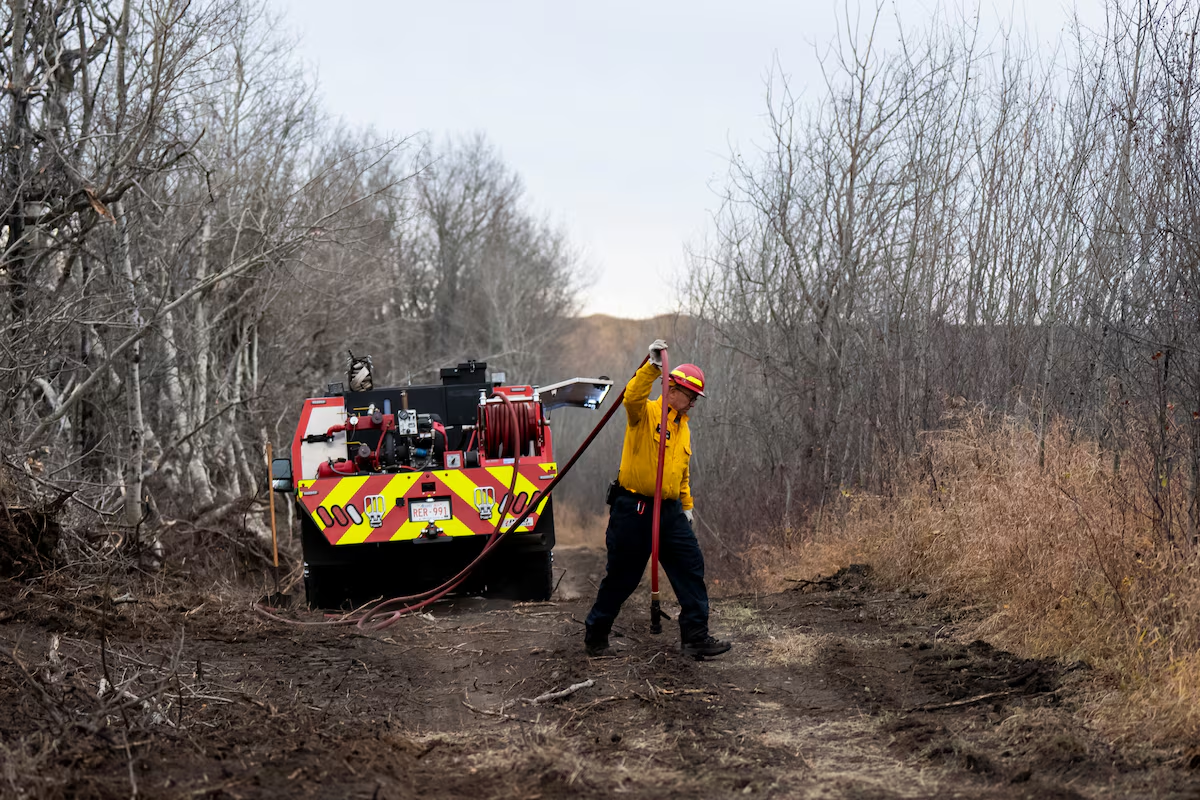

Open this photo in gallery:
Firefighters work along a firewall next to CFB Wainwright in Alberta, on Oct. 19. The majority of the 39 military members that were injured in the devastating fire at the base suffered severe burns.Christopher Katsarov/The Canadian Press
It can take hours for a nurse specialized in burn care to change the dressing on severe wounds, carefully removing layers of bandages before cleaning the damaged area, applying necessary anti-infection treatments and covering with a new wrapping.
Ashley Callahan, who has been involved in burn care for nearly two decades and now manages a team of specialized nurses at Ontario’s Ross Tilley Burn Centre, describes the process as “a bit of an art as well as a science.” She said the job of a burn nurse is not just physically demanding but also mentally challenging as they often treat patients during the worst days of their lives.
“A burn nurse is not just an expert in wounds; they’re an expert in everything that is involved in that very long journey of recovery,” said Ms. Callahan. “For most of us, it really is a calling. You do not move into this work without loving it and feeling like you have purpose.”
The fast-moving fire that killed four and injured dozens at a military base in Wainwright, Alta., on Oct. 17 has drawn attention to the specialized field of burn care, which blends emergency and critical medicine, reconstructive surgery, rehabilitation as well as supports for nutrition and mental health. Of the 39 soldiers who were injured, more than half still remain in hospital.
Thirty-three military members injured in CFB Wainwright fire remain in hospital, McGuinty says
The extent of the injuries varies among the military members, but the majority suffered severe burns. Those with skin so scorched that it cannot heal on its own have required skin grafts, which is a surgical procedure where donated skin or a patch of healthy skin from another part of the patient’s body is removed and transplanted to the area needing repair.
Because of the expertise required for burn care, 28 health care professionals, mostly nurses, arrived in Alberta last month from Ontario to help treat the fire victims. This includes specialists from Toronto’s Ross Tilley Burn Centre at the Sunnybrook Health Sciences Centre, Toronto’s Hospital for Sick Children and Hamilton Health Sciences.
Requests to Ontario’s Ministry of Health and Alberta Health Services to interview these burn specialists have been denied.
Alan Rogers, a burn surgeon at Ross Tilley since 2014, said he is in touch with 10 of his nursing colleagues and another surgeon who quickly raised their hands to travel to Alberta to help treat the Wainwright patients. He said they are managing a large number of dressings daily and have been warmly received by hospital staff.
In just minutes, tiny Wainwright hospital became scene of horrors and heroism
Ross Tilley is Canada’s largest burn centre with a 14-bed intensive care unit, two operating rooms and an outpatient service. Yearly, between 350 and 450 patients are treated and upward of 700 surgeries are performed – a substantial increase since 2014, said Dr. Rogers.
Patients are admitted to the unit when they have suffered severe, acute burn injuries or complex soft tissue wounds that require critical care. Dr. Rogers said admission is not just based on the degree of burn, its depth and extent, but whether the injury involves sensitive areas of the body, such as the face, hands or genitalia.
The Alberta victims, he said, fit these criteria.
“We often admit some of the worst, most extensive and most challenging wound cases at the burn centre,” he said, related to such causes as fire, frostbite and flesh-eating diseases.
Infection is the leading cause of death for burn victims because the body no longer has its natural armour.
Victims of Wainwright fire remembered as young people dedicated to service
Inside the operating room for a skin graft, surgeons meticulously remove damaged skin to reveal a healthy wound bed where a thin layer taken from another part of the body is then placed. This skin can be stretched to cover bigger surfaces.
If successful, it will bind to the body and acquire its own blood supply.
Should cryopreserved cadaver skin need to be used, it will be thawed and placed on the damaged area. The body will eventually reject this skin, but it can help to prevent infection while a patient heals and acts as a bridge until a permanent graft can be placed.
Dr. Rogers said specialized nurses are the backbone of burn care, spending nearly every moment at the bedside of the wounded.
Wainwright fire a wake-up call for country unprepared for mass casualties, experts say
Severe burn victims are not able to regulate their own temperature, so nurses must work in rooms that “feel like a sauna” while wearing head to toe personal protective equipment to shield their patients from outside hazards, explained Ms. Callahan.
These nurses are responsible for pain and fluid management, changing dressings, infection control, co-ordinating therapy and, more generally, helping comfort and educate patients and their families on the long road ahead. Multiple surgeries are often required, in addition to daily physical and occupational therapy.
Some patients are in such critical condition that they are hooked up to a ventilator or on dialysis while burn care is performed, sometimes completely sedated.
For every 1 per cent of total body surface area burned, Ms. Callahan said a patient should expect to spend one to two days in hospital. Some of the injured soldiers in Alberta will likely require months of care.
“So, you can imagine the relationship we develop with our patients and families,” she said. “Burn nurses and burn centres save lives and ensure people can return to their highest quality of life.”