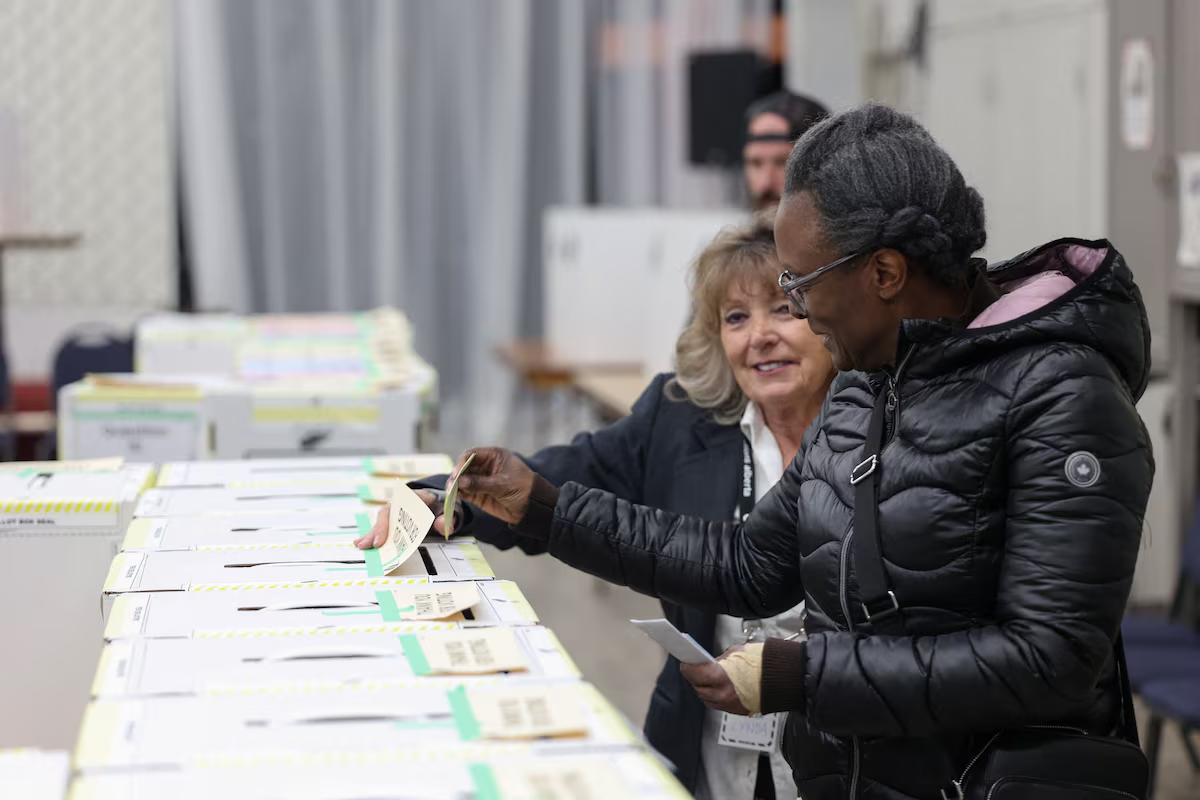

Open this photo in gallery:
A woman votes during the Alberta Referendum in Calgary on Monday. Beyond the main question on separation, voters marked ballots on nine other referendum questions.Ahmed Zakot/Reuters
The preliminary count in Alberta’s referendum shows that a small majority of voters support reducing immigration. On questions of whether Premier Danielle Smith’s government should pursue constitutional reform on issues such as appointing judges or abolishing the federal Senate, voters are split.
Beyond the main question on separation, voters in Alberta marked ballots on nine other referendum questions.
Ms. Smith and her government campaigned in favour of voting no to separation but yes to the other nine questions. In a social media post Monday morning, the Premier made one last push for “Yes to the Nine” and said it would mean Alberta “gets a real say” over immigration and “constitutional reforms that protect this province’s authority no matter who sits in Ottawa.”
See the vote counts for Alberta’s nine other referendum questions
As of midafternoon Tuesday, the yes votes were leading in all but one of those additional questions, with 88 per cent of polls reporting. Ms. Smith has said she will use the results to push for negotiations with Ottawa and other provinces while also proposing her own policies, likely after next year’s scheduled provincial election.
On some questions, however, the results remained too close to call.
Preliminary results showed 54 per cent of voters answered yes to a proposal that Alberta take greater control of immigration, in part to limit the number of newcomers.
Three related questions about limiting services such as health care to some newcomers, or charging fees, garnered 55-, 57- and 58-per-cent support.
On constitutional questions, support for reform ranges from 49 per cent to 54 per cent.
Those figures held steady as votes were tallied Tuesday.
Follow our live coverage of the referendum
As the final ballots are counted, it is unclear what impact the questions will have on government policy or any response from other provinces and Ottawa.
Five years ago, 62 per cent of Albertans voted in favour of a referendum question about removing equalization from the Constitution. But turnout was low, and nothing tangible happened.
Constitutional reform in Canada is difficult, requiring the support of at least seven provinces representing more than half the country’s population, alongside Ottawa’s backing.
In Ottawa on Tuesday, Prime Minister Mark Carney said the federal government will work with the provinces on immigration, arguing that jibes with the spirit of one of Alberta’s referendum questions.
The slim majority on some questions and split result on the rest means there won’t be any obvious, immediate impact, said Shaun Fluker, a law professor at the University of Calgary.
“There really aren’t any legal consequences flowing directly from the outcome of these nine questions,” he said in an interview Tuesday.
Five takeaways from Alberta’s separation referendum
Prof. Fluker called the results of the immigration questions disappointing and described them as divisive, adding that Ms. Smith’s government did “such a poor job informing Albertans about the context of the questions.”
He pointed to Question 6, which asked Albertans to back the provincial government in seeking the support of other provinces to amend the Constitution so the provinces, rather than the federal government, name judges to the top two courts in each province, the superior and appeal courts. Fifty-one per cent of voters said yes.
In the Constitution, the federal government has the power to name judges to these courts, but an appointment system in place for the past four decades solicits a range of input on potential candidates, who apply to judicial advisory committees. Each province gets some input on appointments to their own courts, including from the provincial justice minister and chief justice.
Richard Mailey, director of the Centre for Constitutional Studies at the University of Alberta’s law school, said the referendum results in general don’t make a strong case for an Alberta mandate to negotiate, but judicial appointments may be an exception.
“This is one area where I see some room to manoeuvre, despite the small size of the majority that supported it in the referendum,” Prof. Mailey said.
He cited potential support from Ontario and Quebec and the fact that constitutional reform isn’t necessary for Ottawa to offer provinces more input on appointments by increasing their power on the judicial advisory committees.
Carney hails Alberta’s rejection of separation, but other referendum questions muddy the waters
Two weeks ago, the federal government named two new judges in Alberta: Justice Thomas Rothwell, a judge on the Court of King’s Bench, was elevated to the Court of Appeal; and Malcolm Lavoie, deputy minister of justice in Ms. Smith’s government, was appointed to the Court of King’s Bench to replace Justice Rothwell.
The day after the appointments, the Alberta government put out a news release praising the appointments, an unusual move.
“Alberta’s government welcomes the federal government’s willingness to meaningfully collaborate on these judicial appointments,” Alberta Justice Minister Mickey Amery said in a statement, adding that the province’s top courts “should reflect Albertans and the province they serve.”
“Our government looks forward to continuing our collaboration with the federal government while hearing from Albertans about the future of judicial appointments in our province,” Mr. Amery said on Oct. 9.
Mr. Lavoie was a law professor at the University of Alberta before he joined Ms. Smith’s government at the start of 2024. During his time in government, he worked on the province’s various uses of the notwithstanding clause in the Charter of Rights and Freedoms and last March argued at the Supreme Court of Canada in favour of no new restrictions on the clause in the landmark Bill 21 case from Quebec.
Justice Rothwell had been an assistant deputy minister in Alberta’s Justice Department before he became a judge in 2020. Early in his career, he served as a clerk to John Major, a former Supreme Court justice from Calgary.