
Open this photo in gallery:
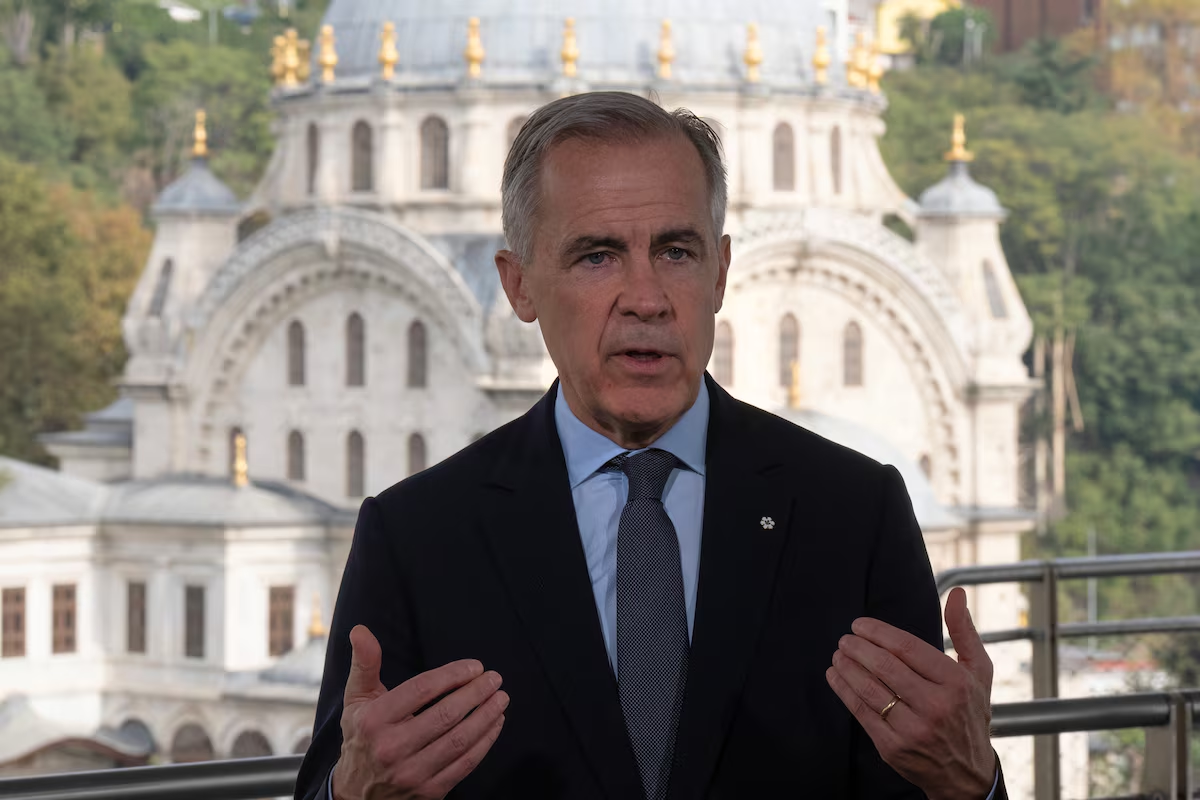
Prime Minister Mark Carney speaks with reporters during a news conference in Istanbul, Turkey, on Friday.Adrian Wyld/The Canadian Press
Prime Minister Mark Carney says there is no merit to allegations from Donald Trump’s administration that Canada is interfering in U.S. elections.
“I’m disappointed that their envoy sees that it’s his role to make these suggestions,” he said of U.S. ambassador Pete Hoekstra during a news conference in Istanbul on Friday.
The United States embassy in Canada this week circulated what it called a “fact sheet” that accused Ottawa of trying to sway U.S. politics. American voters are preparing to cast ballots in tight midterm elections that will turn on a small number of closely fought races.
U.S. embassy accuses Canadian politicians of election meddling
“The Canadian government brushes off concerns about potential interference in U.S. elections, even as its ministers and premiers openly describe plans to influence American politics in official documents and public appearances,” the U.S. embassy statement alleges.
Mr. Carney referred to these charges as “unsubstantiated claims.”
He said the Canadian government has a “very deep diplomatic presence” in the U.S. and its “hundreds or thousands” of interactions are normal efforts by foreign governments to build relations in the United States.
“We have lots of interaction with American companies, citizens, individuals, and stakeholders more broadly and we’re very careful to not be seen to interfere. We have no intention to interfere with their democratic processes.”
The Prime Minister said he wasn’t going to point fingers, but that there are lots of concerns about American interference in Canadian political processes.
“I’m not going to get into tit-for-tat,” Mr. Carney said. “The resources of the media here can make their own judgment about the extent to which very, very senior U.S. officials have directly made suggestions to intervene, so to speak, in Canadian sovereignty, Canadian democratic processes, encourage certain outcomes, encourage certain peoples through that process.”
Mr. Hoekstra’s talk of Canadian political interference follows similar accusations last month by Trump adviser Peter Navarro, who told Canadian lobbyists to “get the hell out” of the U.S. and warned Canada against interfering in U.S. midterm elections.
In a recent interview on a Canadian podcast, Mr. Hoekstra referenced the actions of several Canadian politicians, including Industry Minister Mélanie Joly, and said the U.S. is “closely watching Canadian activities” right now.
“It appears that some of this – from our perspective, in the way we view our elections – could be inferred to be election interference,” the U.S. ambassador told The Really Big Show podcast in a recent episode.
“You have Minister Joly talking about, ‘Of course we are going to target retaliatory tariffs in politically sensitive states,’” he said.
Joly pushes back on accusations of meddling in U.S. elections
As another example, Mr. Hoekstra mentioned an Ontario government TV ad that ran in the United States last year that criticized U.S. tariffs on Canadian goods.
“We appreciate foreign-policy leaders coming into the United States and those types of things, but you know, keep your nose out of American politics,” Mr. Hoekstra said.
“We’re monitoring it, we’re evaluating it, and if some of it becomes election interference, you know, then America will respond to it.”
Mr. Carney said the Department of Global Affairs, well in advance of these allegations, has been reminding its staff and diplomats to avoid meetings that can be exploited to feed these “unsubstantiated allegations” targeting Canada. He said Global Affairs has told its diplomats to “be careful whom you are even seen with – physically in the same place as” to avoid feeding these accusations.
Canadian diplomats told not to meet with U.S. midterm candidates
He said the U.S. allegations should not be accepted as fact or fair comment. “I don’t think it should be normalized.”
Canada and the United States are in the midst of a costly trade war.
Asked whether there is a chance of a deal with Mr. Trump on trade before the Nov. 3 midterm elections, Mr. Carney said, “It’s up to up to the United States. They’re a little hard to predict.”
The Prime Minister said he’s always willing to sit down and resume negotiations if the United States is willing to bargain in good faith. He added that Canada is willing to wait for a good deal, even as long as a U.S. future administration.
“We don’t care about the timing of that,” he said, adding even if it has to be months from now “or longer than that, or another administration before a proper deal comes into place.”
The trade conflict between Canada and the U.S. began last year when Mr. Trump began imposing tariffs and telling Canada it could avoid these levies by agreeing to become the “51st state.” After negotiations on a new trade deal stalled in August, Mr. Trump escalated the conflict.
The U.S. began collecting 50-per-cent duties on roughly $28-billion of Canadian goods on Aug. 22, and Canada matched the tariffs dollar for dollar one day after Labour Day. These U.S. tariffs are on top of existing levies on Canadian steel, aluminum, autos and lumber.
Canada, Turkey announce strategic partnership to deepen energy, defence and trade ties
Mr. Carney said he wasn’t concerned that the repeated allegations of Canadian interference in the U.S. midterms is paving the way for retaliation such as tariffs after the elections.
“I don’t see that coming to pass. I will observe that there have been a very broad range of justification for U.S. tariffs, and there’s almost an industry to create justification for them.”
He said his trip to Turkey this week to build ties is an effort to diversify trade and strengthen Canada. “I can’t predict what the United States is going to do, but certainly we know what we’re doing.”
Industry Minister Mélanie Joly says Canada would never interfere in U.S. elections. Her comments came after U.S. Ambassador Pete Hoekstra said Canadians should keep their noses out of American politics during the congressional midterms.
The Canadian Press