
Open this photo in gallery:
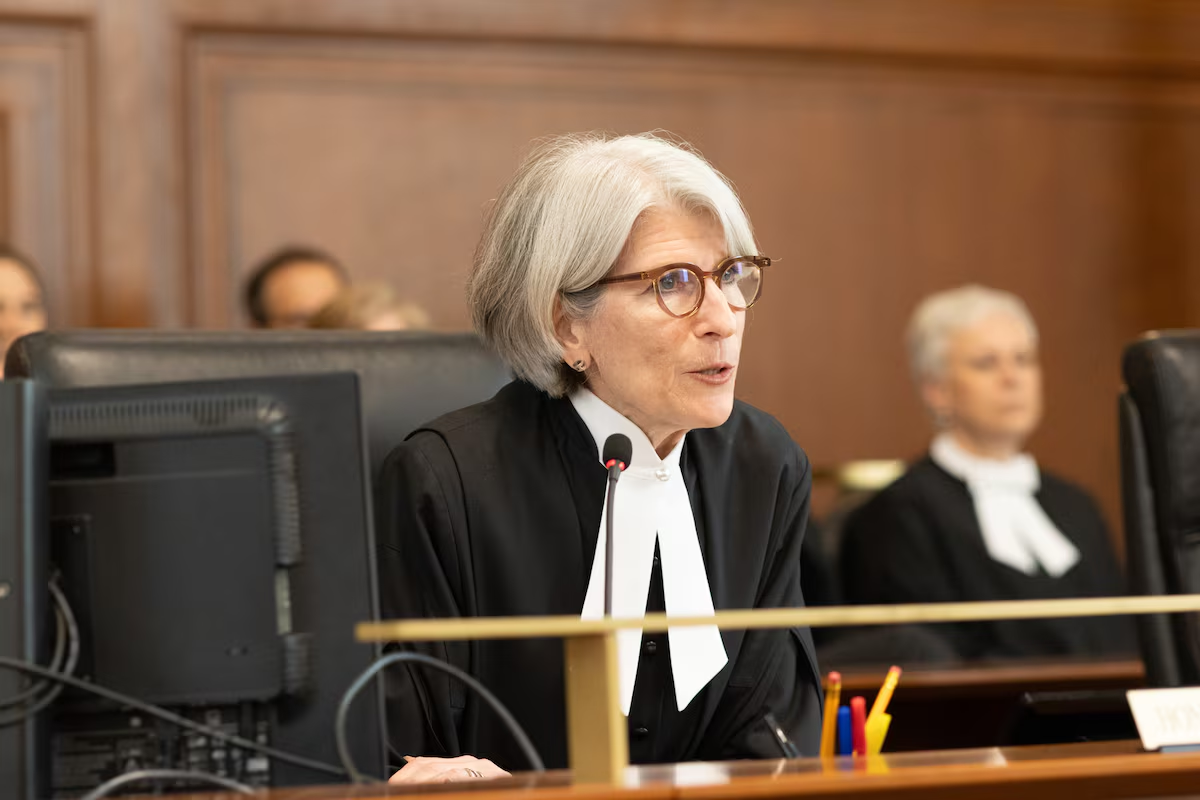
Chief Justice Manon Savard will remain on the bench as a part-time supernumerary judge on the appeal court.PAUL FOURNIER/Supplied
When Manon Savard started her studies at McGill University, she planned to become an accountant.
It was the early 1980s and she instead turned her mind to industrial relations. But following a lecture given by Roy Heenan, the highly regarded labour lawyer and co-founder of the firm Heenan Blaikie LLP, she took his advice and went to law school.
The law drew her in. She worked in labour law for more than 20 years at Ogilvy Renault LLP in Montreal before becoming a judge in 2009.
In mid-2020, during a brief lull early in the pandemic, then prime minister Justin Trudeau named her Chief Justice of Quebec and head of the province’s Court of Appeal.
On Tuesday, Chief Justice Savard serves her last day in the role. In her six years as the province’s top judge, she has been at the helm of major cases such as the ongoing challenges to Bill 21.
She will remain on the bench as a part-time supernumerary judge on the appeal court, but as she steps down as chief justice she is redoubling her longstanding efforts to call for more provincial funding of the courts in Quebec.
Open this photo in gallery:
Chief Justice Savard wants the court to more regularly publish plain-language summaries of decisions and with more English translations.Graham Hughes/The Canadian Press
Money is needed for everything from ending a reliance on paper in the justice system to better communications of the courts’ work to Quebeckers. Two years ago, she called it an “investment in democracy.”
In an interview with The Globe and Mail, she said courts must shed their traditional reserved silence and the presumption that everyone will appreciate and respect their work.
“There is a lack of confidence towards institutions,” Chief Justice Savard said. “And in the past six years, I worked very hard on that.”
Judges such as Chief Justice Savard, alongside peers who include Supreme Court of Canada Chief Justice Richard Wagner and Chief Justice of Ontario Michael Tulloch, insist they must better explain what they do.
In Quebec, however, the big issue isn’t court delays, Chief Justice Savard said. Unlike other provinces, she said her appeal court does not often have to consider cases that have run afoul of strict deadlines imposed by the Supreme Court of Canada to complete criminal trials within specific deadlines.
Instead, Chief Justice Savard said Quebec courts need more funding to make them more efficient.
Open this photo in gallery:
Chief Justice Savard concludes her term on Tuesday.Supplied
A push to go electronic is not complete. Paperwork sops up too much staff time. And while her court improved its website, she said it should be better.
She also wants the court to more regularly publish plain-language summaries of decisions and with more English translations.
The goal is for the top court in Quebec to reach more Quebeckers.
It’s exactly what she did in one of her biggest judgments, Bill 21.
The 2019 law prevents public sector workers, including teachers and police, from wearing religious symbols such as a cross or hijab on the job. The Quebec government says it promotes a secular state, but many believe the law flagrantly violates freedom of religion and is aimed at minorities.
The Quebec Superior Court in 2021 upheld the law, because the provincial government shielded it with the Charter’s notwithstanding clause. It allows governments to override large swaths of the Charter.
When the case came to her court, Chief Justice Savard knew it was a key moment. She needed to speak to all Quebeckers.
In late 2022, a panel of three appeal court judges heard the case, Chief Justice Savard and Justices Yves-Marie Morissette and Marie-France Bich.
The Chief Justice explained their role to a packed courtroom in her opening remarks: It was not to judge whether the law was a good idea. It was about whether the legislation abided by the Constitution and the Charter.
The appeal court unanimously decided it did in a 300-page ruling released in February, 2024, and upheld Bill 21 because of the notwithstanding clause.
The judges also said, when the clause is used to shield a law, there is no role for courts to issue judicial declarations. Such statements would be the judges’ view on whether a law violates the Charter, even as the law is allowed to stand because of the notwithstanding clause.
Open this photo in gallery:
Judge Francois Doyon, from left, Chief Justice Manon Savard and judge Guy Gagnon explain the justice system during a guided tour of the Quebec Court of Appeal as it celebrates its 175th anniversary in Montreal, in March, 2025.Graham Hughes/The Canadian Press
Chief Justice Savard, the lead author on the ruling, wrote that while there were many views on Bill 21, “whether from a political, sociological or moral perspective,” the judge would focus on the legal aspects of the debate and not “the wisdom of enacting” the law.
The case is now at the Supreme Court. The top court heard an appeal of the Quebec ruling in March.
Chief Justice Savard, in her recent interview with The Globe, said the ruling was about everyone clearly understanding how the process functions.
“I wanted to make sure that people will understand that we are not politicians,” Chief Justice Savard said. “We are here to apply the law. I felt it was important to make the distinction.”
Further, there was the extra work the court put in: the long English translation that was carefully measured and assessed against the original and official judgment in French, as well as extensive summaries of the case in accessible language that pointed to specific paragraphs in the ruling.
It took a lot of staff time. That means money.
To do it more regularly, she said: “We need some funding for that.”
As Chief Justice Savard steps down, there will be an acting chief justice. It is not clear when the federal government will appoint a new chief justice.
The federal Liberals, several years ago, allowed judicial vacancies to rise to record levels, a problem that has been mostly rectified, but Ottawa has been slow to fill top jobs.
Reflecting on her time as Quebec’s top judge, Chief Justice Savard said years as a labour lawyer, brokering disagreements and listening closely to all sides, was all valuable.
And, at 65, she doesn’t want to leave the bench behind quite yet. She had mulled retirement, but last summer knew she wasn’t ready. On a recent family vacation, her daughter asked what she was reading. A court ruling from another province, the judge said.
“You’re on vacation!” her daughter said.
“I know,” the Chief Justice responded, “but it’s so interesting.”