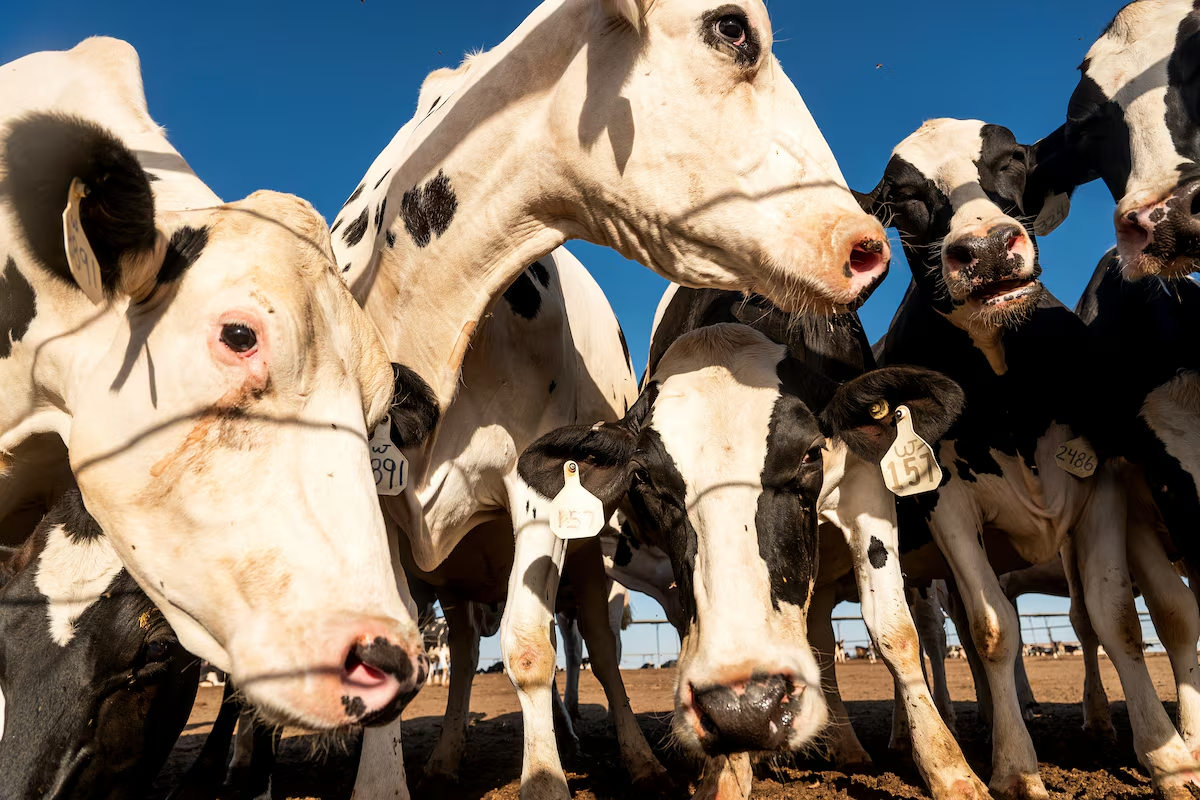

Open this photo in gallery:
Noah Berger/The Associated Press
Canada’s supply management system for dairy is a flashpoint in the contentious free trade agreement between Canada, the U.S. and Mexico, with Washington consistently demanding more access to what it considers an unfairly protected Canadian market.
The White House’s demands are clear. The Trump administration wants Ottawa to change the way import licences are allocated so that Canadian retailers – such as Loblaws, Walmart and Costco – will be able to import American dairy products.
In creating the United States-Mexico-Canada Agreement, which went into effect in 2020, Canada consented to an increase in dairy imports from the U.S. However, the Americans argue that they have not been able to capitalize because Ottawa only allows dairy processors and distributors access to import licences. Demand from these entities is not as high as demand from retailers would be, according to the U.S. Dairy Export Council, resulting in less than half of the total quota being used.
2025: U.S. dairy industry presses Canada for changes to quota
Ottawa has so far refused to comment on whether it will be changing dairy import restrictions. However, in October sources told The Globe and Mail that the office of Dominic LeBlanc, the federal minister responsible for Canada-U.S. trade, had discussed the costs of changing import licencing rules with dairy processors.
But securing more access to Canada’s dairy market remains a high priority for Washington. U.S. Trade Representative Jamieson Greer shortlisted Canada’s supply management system for dairy in his December letter to Congress regarding the USMCA, and Shawna Morris, executive vice-president of trade policy and global affairs at the National Milk Producers Federation and the U.S. Dairy Export Council, told The Globe that her organizations’ demands are a “high priority for the White House as well as Congress.”
“Canada’s actions to so blatantly flout the intent of the deal have caused a tremendous amount of sustained, bipartisan concern and dedication to ensuring that this major ag element of the agreement is properly ironed out in the Review,” Ms. Morris said by e-mail in reference to the USMCA.
To understand why Washington might make dairy trade a USMCA linchpin, here are five charts that tell the story of a U.S. milk industry facing increased production, stagnant domestic demand and a competitive global market where other big players face the same pressures.
A domestic dairy glut
U.S. milk production is on the rise.
National production grew 2.8 per cent in liquid terms in 2025, the largest annual jump in 20 years. Part of this increase is attributable to increased cow productivity. The average cow in the U.S. can now pump out 5,000 more pounds of milk annually than it could two decades ago, according to the United States Department of Agriculture.
The number of cows has also increased. At 9.6 million cows, the U.S. dairy herd is the largest it has been in 30 years, with an increase of 190,000 head over the year to April, 2026, according to the USDA.
Processing capacity is also expanding, with US$12-billion of investment in more than 50 projects across 19 states coming online by 2028.
Simultaneously, domestic consumption of dairy products has stagnated. Total per capita dairy demand peaked in 2021 and by 2025 had returned to near 2018 levels, according to the USDA’s Economic Research Service.
“The growth in U.S. demand is topping out,” said George Frisvold, an agricultural economist at the University of Arizona who has researched the U.S. dairy industry. “And when demand starts topping out, you look for export markets.”
Exports are the name of the game
Given the rise in production and flattening of domestic demand, the industry needs to sell excess dairy into export markets, said Mr. Frisvold. And it has been quite successful. Over the past 10 years, U.S. dairy exports have grown 15 per cent to US$9.4-billion, according to the USDA’s Foreign Agricultural Service.
The U.S. has been able to capitalize on a rising global population and middle class, which has increased demand for high fat and high protein products, Mr. Frisvold said.
Mexico is the U.S. dairy industry’s fastest growing export market, accounting for 61 per cent of growth over the past decade. Mexico accounted for 28 per cent of total U.S. dairy exports in 2025.
Key growth markets identified by the U.S. Dairy Export Council’s 2025 trade priorities report include Taiwan, Vietnam, the United Kingdom, Indonesia, Malaysia, Thailand and the Philippines.
The global dairy trade is cutthroat, competitive and dominated by a few key players
But gaining market share overseas will be difficult.
The global dairy trade is a tight arena dominated by what the industry dubs “The Big 5″ – the U.S., New Zealand, the EU, Argentina and Australia.
And most of these nations – a number of which are closer to developing Asian countries than the U.S. – are increasing their dairy production, in particular Argentina (an extra 4 per cent annually) and New Zealand (and extra 1.8 per cent annually).
At the end of 2025, global milk production had grown 5.2 per cent year-on-year, one of the steepest milk supply increases in documented agricultural history, according to Rabobank, a Dutch bank specializing in agricultural markets.
A forecast from Rabobank published earlier this month suggests that the rate of increase will decline, but farmers will still have to contend with the weak prices that come as a result of abundant global supplies.
The U.S. dairy farmer’s bottom line cannot afford to take a hit
The U.S. dairy farmer is already facing tough on-farm economics, said Leonard Polzin, agricultural and dairy economist at the University of Wisconsin-Madison. This is driven by a “hidden squeeze,” he said, noting that insurance, borrowing costs, energy, repairs, veterinary and labour costs have all increased since 2016.
The average dairy farm in the U.S. only covered its total business costs twice between 2014 and 2024, according to data from the USDA.
A December report from the University of Illinois projected milk prices across the next year would average around US$20.15 per 100 pounds.
Should the total costs of production equal 2024’s average of US$23.65, farmers would lose US$3.21 for every 100 pounds of milk sold, said the report.
The business of a number of dairy farms across the U.S. is benefitting from the high price of beef and the low price of grain, said Prof. Polzin.
Feed accounts for a substantial part of production costs and grain prices are low right now. When prices for beef are high, cows that don’t meet the genetic standard for milking are bred with angus cows to produce calves sold for beef.
Beef prices are near all time records, and a two day-old calf can currently be sold for US$1,000, said Mr. Polzin. Gross revenue from beef on dairy farms is four times higher today than it was in 2019, he said.
But this isn’t sustainable, he said. Grain and beef are commodities. Commodities are cyclical. Prices will change.
“Feed costs will go up. Beef revenues will go down. And then what?”
The crunch on dairy farms is part of a long-term trend, said Mr. Frisvold. The sector has consolidated substantially as a result of something he calls the “agricultural treadmill” – a race toward efficiencies that begets lower prices, which drive more efficiencies, economies of scale and consolidated political power.
“As you have a smaller number of producers, you start to have more power because it’s a lot easier to organize … you can lobby a lot more effectively if there’s fewer of you.”
Conclusion: Yes, the Canadian market matters
The current pressures facing the U.S. dairy sector suggests that any gain in an export market would be a boon to the U.S. dairy farmer who is contending with abundant global supplies, a competitive trade environment and a looming free fall in prices.
While Canada is a small market, it is also one where the U.S. has a competitive geographical advantage, said Mr. Polzin. It is also a market where the U.S. has seen gains, with exports growing 11 per cent across the last decade due to the changes in USMCA.
“Wherever we can move product – and where our transportation costs are competitive – is always a benefit,” said Mr. Polzin.