
Open this photo in gallery:
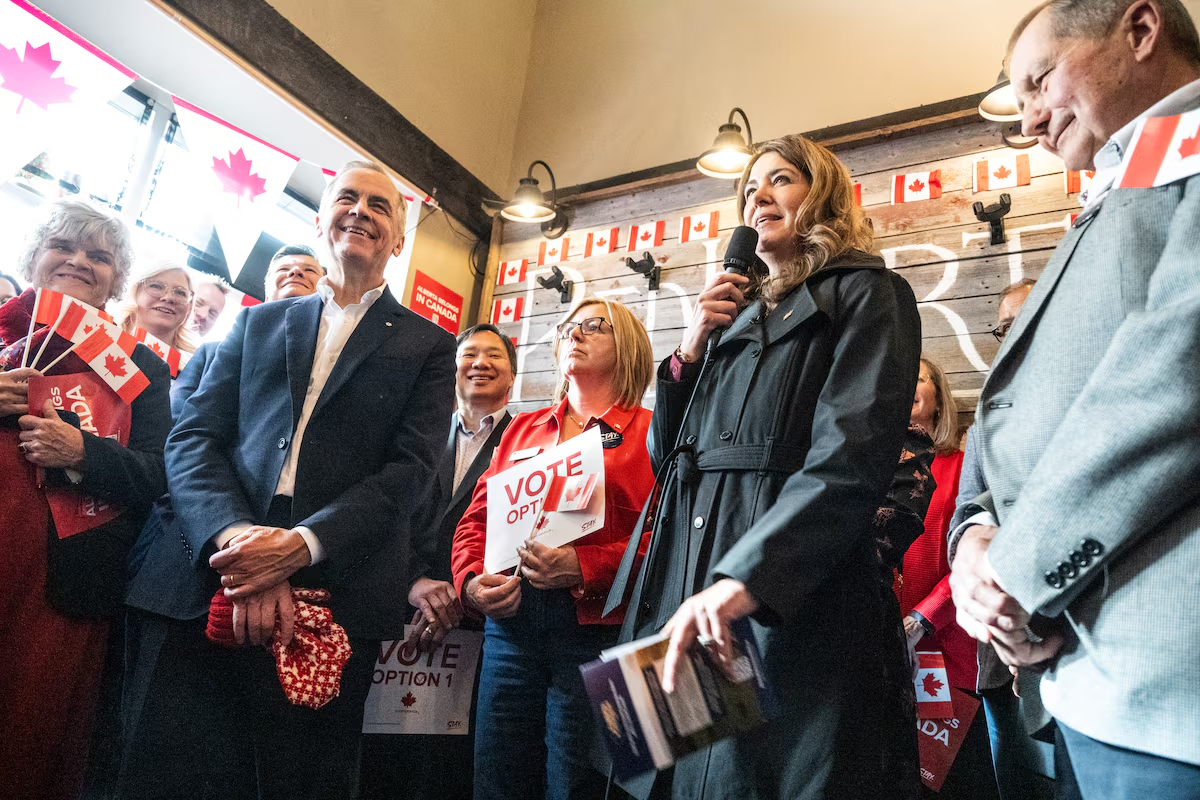
Prime Minister Mark Carney attends a national unity rally in Red Deer alongside Alberta Premier Danielle Smith, and former premier Ed Stelmach, on Friday.John Ulan/The Canadian Press
The campaign to keep Alberta in Confederation hit a fever pitch on Friday as politicians from across the country crisscrossed the province, aiming to drive up turnout and boost the pro-Canada vote ahead of Monday’s referendum on secession.
Premier Danielle Smith stood beside Prime Minister Mark Carney at a federalist rally in Red Deer. The two have shared a stage on numerous occasions over the past year in their bid to build a bitumen pipeline to the West Coast, a plan both leaders have endorsed as a sign that Canada can work for Alberta.
“As you know, we don’t always agree on everything. We often disagree quite publicly on several things,” Ms. Smith told a crowd of pro-Canada supporters decked in red and white.
“But today we can all agree that on Question 10, that we are voting for Option 1 to remain in Canada.”
A day earlier, a crack appeared in the thawing relationship between Mr. Carney and Ms. Smith, when he urged Albertans to vote “no to the nine,” referring to the Premier’s nine proposals on immigration and constitutional changes also on Monday’s referendum ballot.
Explainer: What about Alberta’s nine other referendum questions?
But the Premier, who had responded on social media, stood her ground on her plan to wrest more control over immigration from Ottawa.
“I have bad news for you, Prime Minister: All of the premiers are interested in talking about immigration and how we might be able to reform it,” she told Mr. Carney in Red Deer, handing him Alberta government literature advertising her proposals.
Former Alberta premier Ed Stelmach, who co-authored an op-ed this week also calling for voters to reject Ms. Smith’s immigration questions, stood next to her.
Ms. Smith says she is seeking to fortify her mandate by getting the electorate’s approval on those questions, which she argues would provide leverage to gain more autonomy within Confederation.
Those questions propose restricting some newcomers’ access to social services and charging some non-permanent residents for their access to health and education.
Opinion: Canada is strong, but it will be forever altered by Alberta’s separation referendum
The gathering in Red Deer was one of several events on Friday where politicians made the case for a united Canada.
At a rally in Edmonton in the evening, Mr. Carney delivered a speech very similar to the one he gave the night before in Calgary, reminding Albertans to “vote like Canada depends on it.”
Prime Minister Mark Carney told thousands rallying in Calgary on Thursday that Albertans should vote to keep the province in Canada.
The Canadian Press
The Prime Minister spoke of how the province and the city is his home, where he grew up and that the future of the country is “too precious to play games with.”
“This referendum is about something larger than any of us,” he said at an event organized by Forever Canadian, one of the province’s most prominent federalist groups. “It is about the province and country we love, and it’s about what we can build together.”
Mr. Carney reiterated a point he made the night before, saying that recently Albertans were made to feel their “energy contributions were running against the tides of history.”
“What should have brought us together began to divide us. Contributing to a half-century of politics that have too often pulled us apart.”
Mr. Carney went on to tout the plan to build the Pacific Link pipeline, which he described as “true nation building.”
“Now is the time to build, not break. Now it’s our turn to stand up for Canada.”
Ms. Smith followed up her lunchtime appearance alongside Mr. Carney with a keynote address and on-stage conversation at the Canada Strong and Free Network conference, a conservative gathering, in downtown Calgary.
Researchers find uptick in U.S. influence campaigns targeting Alberta referendum as vote looms
Ms. Smith struck a positive tone on her relationship with Mr. Carney’s government, saying that Alberta and Ottawa are “moving together,” and spent much of the on-stage conversation discussing conservative party politics.
Conservative Leader Pierre Poilievre, at the same conference earlier in the day, made his case to Albertans to reject choosing a second, binding separation referendum.
Mr. Poilievre argued that many of the frustrations Albertans feel are no different from those shared by Canadians across the country.
He pointed to concerns about immigration, affordability and energy policy as the issues driving separatism.
“Much of this referendum debate has rightly focused on the flaws of the country. But while we focus on those things, we must not forget – and we must not ignore – what Canada has done for Alberta,” he told the crowd of roughly 200 people.
“But here’s the thing: there are Canadians right across the country that wonder the very same things,” Mr. Poilievre said.
Some leaders in Alberta’s separatist movement argue that Monday’s referendum is a chance to voice dissatisfaction with Ottawa or use the threat of separation to extract concessions from the federal government.
On Friday, Mr. Poilievre offered a patriotic appeal to voters, saying it was not the best vehicle for protesting policies from Ottawa.
“To those people who are thinking about taking out their frustration on the current government by voting for separation, I say this: Canada is more than a government. It is a people, a flag, a land, a history, a promise.”
While Mr. Poilievre didn’t mention Ms. Smith’s nine other referendum questions, he encouraged voters to “lock arms with Quebeckers who want to have full autonomy over their provincial jurisdiction, just like we Albertans do.”
Conservative MP Dane Lloyd, the man spearheading the party’s pro-Canada campaign, told The Globe and Mail that the Conservatives’ door-knocking campaign has met few big-city Albertans who are voting for a second referendum. Support for a separation vote is higher in rural areas, he said, but they’re still “overwhelmingly pro-Canada.”
Mr. Lloyd said he’s expecting high turnout. He thinks that bodes well for the federalist camp.
“I would like to see a very decisive, high number. I think we need a very high number,” he said on the sidelines of the conference.
Former Alberta premier Jason Kenney, speaking to reporters at the conference, credited Mr. Carney with his campaign strategy leading into the referendum.
He pointed to the Prime Minister’s push for an oil pipeline to the West Coast, which was preceded by rolling back numerous energy and environmental policies implemented under former prime minister Justin Trudeau. Mr. Kenney added that it was “powerful” to hear Mr. Carney refer to himself as an Albertan. (Mr. Carney was raised in Edmonton.)
“I think he’s played it just about right. He’s not been here constantly, and he’s not telling us, telling Albertans how to think or what to do,” he said.
“He’s one of us; he’s saying, ‘Let’s get this done together.’ ”
Albertans continued to vote at advance polls on Friday. Saturday is the final day of early voting before referendum day on Monday.
Roughly a million Albertans had voted in the referendum as of 10:30 p.m. on Thursday night – about a third of all electors in the province – Elections Alberta wrote in an e-mail.