A massive data centre to provide computing power for the artificial intelligence giant Anthropic is under pre-construction just outside Port Hawkesbury in Cape Breton.
EverWind Fuels will build and own the facility, while Anthropic will lease the first phase for a term of at least 20 years. Anthropic said in a news release the data centre “will power Claude models and serve growing demand from Canadian and global customers.”
EverWind, headed by Australian-American private equity veteran Trent Vichie, had previously confirmed it has data centre ambitions, but said little else.
On Friday, EverWind released more information about its plans.
The company said it will build the facility in two stages, with the first phase to come online by the end of 2027 and the second in 2028.
The first phase will have a capacity of 95 megawatts and the second, 325 megawatts, for a total of 420 megawatts. Nova Scotia’s current electrical generating capacity is close to 3,000 megawatts.
EverWind and Anthropic said they will pay for any required upgrades to Nova Scotia’s electricity system.
EverWind raising $8 billion for project
EverWind said it is raising $8 billion in private capital to fund the project and an additional $2 billion for four of the onshore wind farms it is planning to build.
“This is investment that is in the ground here, supporting Nova Scotians, not only its energy economy but its knowledge economy as well,” Vichie said at an announcement in Point Tupper, the industrial park where the facility is to be built.
Land clearing is underway and officials said they hope to have foundations poured before winter.

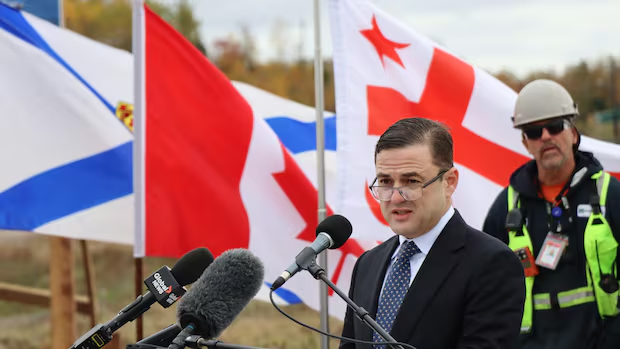
Trent Vichie, CEO of Everwind, spoke at the event. (Tom Ayers/CBC)
EverWind’s four wind farms would eventually support the data centre’s electricity needs, but existing generation on the provincial grid would be the primary supply to begin.
The Independent Energy System Operator, which manages the provincial grid, told CBC News it studies all new projects to ensure the grid can handle them, before allowing them to connect. It did not answer specifically whether there is capacity to connect this data centre, although EverWind officials said they’ve been assured there is capacity, at least for phase 1.
Anthropic was not at EverWind’s Friday announcement and Vichie was initially mum about which AI company he was partnering with. Anthropic issued a news release later in the day.
But EverWind did have a large contingent of supporters at its event. Politicians from every level of government were on hand to praise the project.
Premier Tim Houston thanked Vichie for bringing such a large sum of money to Nova Scotia, and said it demonstrates “what is possible in our province.”
“Please don’t stop, keep moving, we’ll be here to support you in that,” he said, directing his remarks to the EverWind CEO.

EverWind’s data centre will be in Point Tupper, just outside Port Hawkesbury. (Tom Ayers/CBC)
Kings-Hants MP Kody Blois, who is parliamentary secretary to the prime minister, said the data centre aligns with the Liberal government’s priorities.
“Today is an example of how we’re building a stronger Canada,” he said.
Richmond County Warden Lois Landry noted there has been some skepticism in the community in recent weeks as people have been speculating about the project’s specifics, but she said she feels optimistic after learning more information.
“We’re hearing about potential construction and long-term employment, opportunities for local businesses and infrastructure investment that could support future growth,” she said.
EverWind has been trying to develop renewable energy projects in Nova Scotia for several years. It says those plans remain unchanged.
The data centre is to be built at the same site as one of EverWind’s other proposed projects — a green hydrogen and ammonia facility.
Data centre controversies
Data centres have become a flashpoint across Canada, especially those that power AI, because they can have huge footprints and require vast amounts of energy and water for cooling. Concerns about AI’s potential impacts on jobs and dire warnings about risks to human existence also have some people pushing back.
There are some proposed data centres that would dwarf this one in size, including the Wonder Valley data centre in Alberta — the first phase of which is meant to be more than a gigawatt — but this project is still on the larger end of facilities that have been recently announced in Canada.
EverWind and Anthropic have signed on to Ottawa’s responsible data centre development principles — a set of non-binding guidelines the federal government released last month.
Houston recently laid out similar guidelines. Both levels of government say they expect any data centre to have local benefits, minimal environmental impact and minimal water use, and for there to be no resulting power rate spikes.
“We applaud the federal and provincial governments for setting high standards for responsible development,” Vichie said in a news release. “And we will continue to work with communities to ensure that our work meets their expectations.”
WATCH | Prime minister’s parliamentary secretary speaks at announcement:
$10 billion private investments in Nova Scotia to include AI data centre
The prime minister’s parliamentary secretary, Kody Blois, says $10-billion investments in an AI computing data centre and wind projects to help power it show that Nova Scotia has set the ‘conditions’ to draw private sector development.
EverWind said it will use a closed-loop water-glycol system. The company’s preliminary estimate for water usage is an average of 100,000 litres per day for the first phase and 500,000 litres of water per day including both phases.
Water would be drawn from nearby Landrie Lake. The provincial regulator has approved the Landrie Lake Water Utility to withdraw 34 million litres from the lake each day, which would make EverWind’s daily requirements about one per cent of the total safe withdrawal volume.
The company promised the data centre would come with a community benefit program worth tens of millions of dollars. A specific dollar figure was not provided. Local communities and Anthropic would consult on how to spend the money.
A consortium of Mi’kmaw communities, fronted by Membertou First Nation, is negotiating a nine per cent equity stake in the project.
But not everyone is ready to endorse the project.
Nova Scotia’s Ecology Action Centre (EAC) said it poses more questions than it answers.
Thomas Arnason McNeil, policy advocate on grid decarbonization at the EAC, raised concerns about the project’s scale.
“There will need to be analysis and work that is done in terms of quantifying … the impact on ratepayers and understanding what the environmental impacts of the project will be,” he said.
McNeil added that while the group is reserving judgment for now, thorough impact assessments are essential before moving forward.
MORE TOP STORIES